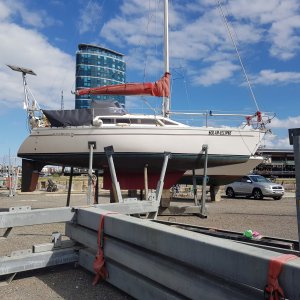
Lift Keel, partly raised or fully down?

andyjcox1

Well-Known Member
Joined
8 Feb 2010
Messages
78
Visit site
Hi all, I have a Jeanneau Fantasia 27 lift keel and always assumed that when sailing and motoring it is better to have the keel fully down. I was chatting to someone today who suggested it may be better to sail with it partly raised and wondered what the collective opinion is.

Thanks in advance for your words of wisdom.
 
My understanding is that you want it fully down for grip when close-hauled, but at least partially raised when the wind's aft of the beam as you don't need the grip so much, and it gives less water resistance = more speed. When motoring in reasonable conditions, I'd inclined to raise it, at least a bit, again to reduce water resistance = lower fuel consumption.
 
My understanding is that you want it fully down for grip when close-hauled, but at least partially raised when the wind's aft of the beam as you don't need the grip so much, and it gives less water resistance = more speed. When motoring in reasonable conditions, I'd inclined to raise it, at least a bit, again to reduce water resistance = lower fuel consumption.
In a dinghy when racing, then yes, but not in a cruising yacht. The last thing you want is an unstable boat which gets broached and pinned by a gust or knocked over by another boat's swell.
 
My understanding is that you want it fully down for grip when close-hauled, but at least partially raised when the wind's aft of the beam as you don't need the grip so much, and it gives less water resistance = more speed. When motoring in reasonable conditions, I'd inclined to raise it, at least a bit, again to reduce water resistance = lower fuel consumption.
Yes, our 27ft had a 3ft draft fin and bulb with a centre plate in it. Windward work, plate down, off the wind, half (or more) up.
So the majority of the ballast was fixed, but resistance reduced when less lateral force needed.
 
Our Beneteau manual and previous club Jeanneau 410 manuals both stipulate keel to be fully down except only when anchored or moored. I find the boat harder to manoeuvre with the keel up with all the leeway/windage.
 
In a dinghy when racing, then yes, but not in a cruising yacht. The last thing you want is an unstable boat which gets broached and pinned by a gust or knocked over by another boat's swell.
If your boat has ballast built into the hull then its OK to have the keel fully up when underway, for example when sailing downwind,
 
Our Beneteau manual and previous club Jeanneau 410 manuals both stipulate keel to be fully down except only when anchored or moored. I find the boat harder to manoeuvre with the keel up with all the leeway/windage.
If you want a laugh, try and steer ours with the board up. We lift ours at night when moored, as it clonks in the casing, and to beach the boat. Steering the last bit can occasionally be amusing. It can be easier to get off and push🤣
 
OK, Fin Keel Numpty speaking.

I helped deliver a Southerly lift keel yacht.

To windward , Keel down no problem. Broad reach half keel, no problem, No wind motoring Keel up, reduce wetted surface area, Ballast in the hull. No Probs!

THEN, entering Marina, Owner decided I should take her in and berth, the allocated berth wasn't available, FULL ASTERN, Chaos - until I remembered no Keel, Press button and sanity returned!
 
sailboatdata.com/sailboat/fantasia-27-jeanneau/

As can be seen the boat has a drop keel inside the ballast keel for extra lateral resistance when going to wind. Quite normal to raise it when off the wind or motoring , but as others have described useful to have it fully down when manoeuvring under engine. However not so critical as in flat bottomed boats like the southerly as the fixed ballast keel is quite substantial.
 
Very like the Kelt 620 I have parked by the barn. 'Salmon' fixed keel with a plate inside. Total 400kg; Arrived with the plate rusted to hell and completely not removable from the cast 'Salmon'. Had to cut one side out of the casting to seperate it all. Nightmare. Still discusing what he wants to do with it.
Original idea wa to park it by his Oyster shack, as no overnighting allowed in them. So, kip in the boat on the pontoon .
The new season might sort this out....
 
Not quite the same as the OP, but we had a small swing keel Beneteau which we raced a lot as it turned out to be very quick. The keel didn’t retract - just swung up against the bottom of the hull, reducing draft from 1.75m to 0.66m.

On one particular morning of a regatta, I couldn’t understand why we didn’t seem to be pointing upwind, and leeway seemed excessive. We came 4th in the race which was worse than usual but not terrible so it wasn’t a massive alarm bell. Having had a sandwich and a think I went down before the next race to check the swing keel. Yes it had been raised the entire race. 😂
 
Thanks all, that makes sense. The general consensus seems to be mostly keep it down for sailing to windward and manouevring. Can be left up or partially down when motoring in calm conditions or sailing off the wind. In all likelyhood I'll just leave it down unless needing to tease out an extra 0.5 of a knot.

One more point of discussion....I was told to leave it down when berthed in the marina to avoid stress on the lifting mechanism and provide stability, but I have also seen some advise to keep it lifted up when in my berth as there is the less fouling. Any experience for either argument.
 
Thanks all, that makes sense. The general consensus seems to be mostly keep it down for sailing to windward and manouevring. Can be left up or partially down when motoring in calm conditions or sailing off the wind. In all likelyhood I'll just leave it down unless needing to tease out an extra 0.5 of a knot.

One more point of discussion....I was told to leave it down when berthed in the marina to avoid stress on the lifting mechanism and provide stability, but I have also seen some advise to keep it lifted up when in my berth as there is the less fouling. Any experience for either argument.
Make sure it’s antifouled. And leave it down, or every time the wind gets up you’ll be fretting. The advantage of being able to become shoal draught is that you can take the boat into shallow water and scrub her, standing waist deep. We do that often, during the season, I keep a wetsuit on board til the water warms up. In the summer, it’s a pleasure. Brush in one hand, beer in the other.
 
In a dinghy when racing, then yes, but not in a cruising yacht. The last thing you want is an unstable boat which gets broached and pinned by a gust or knocked over by another boat's swell.
If the lift keel has any weight in it you want it down at all points of sailing or motoring to improve stability. Thus it should only ever be raised when drying out or approaching very shallow waters or possibly going downwind in v calm conditions. (As BobC suggested earlier). I suppose one might raise in on non drying moorings or in marina but why bother?

Realistically it is so small in profile compared to a great big yacht hull, that it wont make much difference to water resistance.
 
If it’s very draggy, it just needs a bit of attention. It should be smooth, and the edges should be suitably profiled.
Should have been built non-dragging, but having improved my rudder on Laminar Flows advise and seen great improvement in handling I accept it could have been built on the brick sh.t anti-hydrodynamic principle
 
Should have been built non-dragging, but having improved my rudder on Laminar Flows advise and seen great improvement in handling I accept it could have been built on the brick sh.t anti-hydrodynamic principle
These things are even more critical for us. But even the Mirror dinghy class have good foils if they want the boat to sail well. It’s a job to convince some people, clearly you've seen the light. I can tell if our centreboard needs cleaning because the rudder vibrates in the tirbulence.
 
Thanks all, that makes sense. The general consensus seems to be mostly keep it down for sailing to windward and manouevring. Can be left up or partially down when motoring in calm conditions or sailing off the wind. In all likelyhood I'll just leave it down unless needing to tease out an extra 0.5 of a knot.

One more point of discussion....I was told to leave it down when berthed in the marina to avoid stress on the lifting mechanism and provide stability, but I have also seen some advise to keep it lifted up when in my berth as there is the less fouling. Any experience for either argument.
My berth is semi tidal. My boat with in-hull ballast dries on the mud during spring tides. Therefore the keel is always up when the boat is on her berth. Stability never a problem. A benefit is that there is very little keel maintenance / painting needed.

Avoiding stressing the keel lifting rope is a good idea. My 700lb keel is lifted and lowered by a dyneema line. The keel has a second eye in it. Attached to that is a steel wire that acts as a depth tell tale. In the steel tell tale wire there are two eyes. A steel bar goes through the eye and then the bar rests on deck across the keel box. This way, the keel can spend its time either fully down, or half way up or fully up, according to which eye in the wire is used with the steel bar. Once the dyneema has raised or lowered the keel, the wire strop relieves it of all load.
 
Top