Lack Of New Bilge Keelers Keeps Used Prices High...Maybe?

Zagato

Well-Known Member
Joined
2 Sep 2010
Messages
2,813
Location
Chichester Harbour
Visit site
1970/80's thirty odd foot Barbicans, Golden Hinds etc with bilge keels around the 25-30K+ mark. That seems a lot of money. I wonder if it's because of the lack of new bilge keelers coming on the market, fin and bulb seems to be the fashion of the day at the moment. Apart from a handful of key manufactures such as Southerly/Cornish Crabber with lifting keels if you want a boat to actually stand up to moor in a drying harbour or estuary you have little or no choice. Is it just Britain that has so many drying areas and the big companies just cater for marinas in a wider market?

Some interesting examples For Sale here

http://www.eventides.org.uk/sell_your_boat_of_other_boating.htm

Good opportunity to maybe make a modern 30' bilge keeler unless there is already one out there!?
 
Last edited:
you would think that, wouldn't you. but it can't be true looking at the small number of new bilgies on offer. I think the frogs do one or two ( RM yachts) and Sirius do one too. But I guess most big builders do so for the charter / marina fleets.

As for the older boats you quoted, there's some wishful thinking in those prices for what are very MABs. We have some similar boats at our club and most of them are proving unsaleable. Its not that long since we sold a Konsort bilge keeler, unloved but sound, for 10k
 
Twin keels were an almost exclusively British phenomenon that arose because of the conditions at the time. In the 1950's, to 70's there were virtually no marinas and few deep water moorings, so boats that could dry out were very sensible. They were heavily promoted in the press, particularly by Maurice Griffiths and the construction methods of the day (hard chined ply and early GRP) lent themselves to that shape. Lifting keels were less popular because of cost, complexity, leaks, jamming and losing space down below on small boats.

Get to the 1980s and these advantages faded as marinas were developed, typical new boat sizes rose and sailing performance became more important. So you are left with a sort of bubble of now 30-50 year old boats of that style. The sorts of boats you are seeing on the EOA site fulfil a specific need, and although they seem expensive they can be good value - if you like that style. A really good GH or Barbican 33 is a real bargain at the typical £30-40k, considering the last new GH 31 built nearly 10 years ago cost the owner over £100k and building now to the same standard would be at least 50% higher.

As to why few builders offer twin keels now, the answer is simple. No demand. Hunter/Legend tried it recently and failed. The few that are produced are very specialised such as the RM. There is a steady demand for shallow draft boats in certain areas - western France and Poland for example, but most buyers seem to think drop keels are a better compromise.

BTW I removed the bilge keels from my Eventide and deepened the keel about 20 years ago - when I got a marina berth!
 
Several French builders: Allures, Feeling & Ovni, make lifting keel boats; clearly the solution in that country.
 
Bilge keels are ideal for impecunious sailors such as myself to want to avoid marina fees and do not have access to deep swinging moorings

Last time I looked, British Hunter would knock you up a new 245 for £55k ex factory (inc vat) so say £65k once commissioning and other equipment is factored in.

If I were to spend £65k plus on a new (very small) boat I would want her safely tucked up in a marina, and not bashing about on a drying mooring - so I wouldn't have such an absolute need for bilge keels.
 
Twin keels were an almost exclusively British phenomenon that arose because of the conditions at the time. In the 1950's, to 70's there were virtually no marinas and few deep water moorings, so boats that could dry out were very sensible. They were heavily promoted in the press, particularly by Maurice Griffiths and the construction methods of the day (hard chined ply and early GRP) lent themselves to that shape. Lifting keels were less popular because of cost, complexity, leaks, jamming and losing space down below on small boats.

Get to the 1980s and these advantages faded as marinas were developed, typical new boat sizes rose and sailing performance became more important. So you are left with a sort of bubble of now 30-50 year old boats of that style. The sorts of boats you are seeing on the EOA site fulfil a specific need, and although they seem expensive they can be good value - if you like that style. A really good GH or Barbican 33 is a real bargain at the typical £30-40k, considering the last new GH 31 built nearly 10 years ago cost the owner over £100k and building now to the same standard would be at least 50% higher.

As to why few builders offer twin keels now, the answer is simple. No demand. Hunter/Legend tried it recently and failed. The few that are produced are very specialised such as the RM. There is a steady demand for shallow draft boats in certain areas - western France and Poland for example, but most buyers seem to think drop keels are a better compromise.

BTW I removed the bilge keels from my Eventide and deepened the keel about 20 years ago - when I got a marina berth!

Interesting, I've just discovered Barbicans, Super Sovereigns, Eventides etc... a nice era for boats. I'll have a Google for some of the above named marques mentioned just out of interest. Have to say I wouldn't sleep to happily knowing my boat maybe banging up and down as the tide comes in but plenty let their boats do it so...

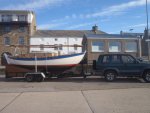
DSC200002_zps1ac9ce76.jpg


Not so disimilar to the hull on my Drascombe although it has bilge keels not plates with the longish keel. Many Cornish Yawls have bilge plates fitted with a long keel/lifting keel! Handy in estuaries for drying out. I like the one in the picture, a good all round coastal boat I should think plus it has character.
 
Last edited:
Yes a very nice un b******d about Eventide 24 with the original underwater profile. Would have been a bit of a pig with that big mainsail and a stemhead jib, but cutter rig tames the weather helm. Mine is the "grown up" version 26' with full length coachroof, longer, deeper keel and no bilge plates. You will find many variations on the theme, some from the original design options but many owner mods as they got built. A 24' is just about manageable as a home build, but the extra work for a 26 is considerable and a 31 probably double the time. Nicest 31 built took the owner over 10 years and then he unfortunately died before he could use it.

If you want to wallow in a bit of nostalgia get yourself some of Maurice Griffiths' books. Mostly out of print now but come up regularly in secondhand shops. I have them all, mostly signed by the author whom I met several times while he was alive - lived to well over 90!
 
Nobody is churning out small twin keel boats like the classic old British family cruisers that were built in the thousands in the 1950's through to the mid 80s.

Indeed - because people who can afford a new boat today can also afford a deep-water berth. A looming problem for the budget end of the market, though.

Pete
 
1970/80's thirty odd foot Barbicans, Golden Hinds etc with bilge keels around the 25-30K+ mark. That seems a lot of money. I wonder if it's because of the lack of new bilge keelers coming on the market, fin and bulb seems to be the fashion of the day at the moment. Apart from a handful of key manufactures such as Southerly/Cornish Crabber with lifting keels if you want a boat to actually stand up to moor in a drying harbour or estuary you have little or no choice. Is it just Britain that has so many drying areas and the big companies just cater for marinas in a wider market?

Some interesting examples For Sale here

http://www.eventides.org.uk/sell_your_boat_of_other_boating.htm

Good opportunity to maybe make a modern 30' bilge keeler unless there is already one out there!?

It's a conspiracy to drive us all into marinas & then only Conservatives will be able to buy a boat ;)
 
Indeed - because people who can afford a new boat today can also afford a deep-water berth. A looming problem for the budget end of the market, though.

Pete
At the inevitable risk of sweeping generalisation, the folks who are buying new boats now are not dissimilar from those buying new Centaurs, Macwesters etc in the 60s and 70s. Those that can't afford it now were then buying ships lifeboats, old rotting prewar pocket cruisers, fishing boats or trying to knock together a simple single chine plywood cruiser.

To my mind the budget end is catered for much better now. As many on here demonstrate you can get a good seaworthy cruiser for relatively very little money - boats that were unattainable for most 40 years ago.
 
At the inevitable risk of sweeping generalisation, the folks who are buying new boats now are not dissimilar from those buying new Centaurs, Macwesters etc in the 60s and 70s. Those that can't afford it now were then buying ships lifeboats, old rotting prewar pocket cruisers, fishing boats or trying to knock together a simple single chine plywood cruiser.

To my mind the budget end is catered for much better now. As many on here demonstrate you can get a good seaworthy cruiser for relatively very little money - boats that were unattainable for most 40 years ago.

I think you slightly miss my point. I wasn't trying to make a historical comparison with the time when Centaurs were new, and saying that things were better then. I don't think they were.

I'm talking about now - when a new boat costs, what, £80k upwards?[1] People who can afford that can afford a marina berth. Hence no (or very few) bilge keels being built. Nobody builds (or ever has or will build) boats that will suit the budget owner in 20 or 30 years' time, because he's not the one buying from the factory. The original question was about why this kind of boat is not built now; I believe this is the answer.

While things are fine now for the low-budget owner, benefiting from those 70s and 80s builds, what happens when the cheap 30-year-old fixer-upper is a Bavaria 34? Can't keep one of those on a drying mooring, I think alongside a wall would be iffy too. But the marina berth that it's designed for will still be just as expensive as it is today, full of whatever the shiny first-owner boat typical of 2033 may be (probably something Chinese!)

Pete

[1] Apologies if that figure is way out - I've never remotely considered the possibility of buying a brand new boat, so my grasp of their prices is hazy.
 
We are actually agreeing. Then as now, people buy new boats to suit their needs and few new boat buyers need their boat to dry out. Todays new boats are tomorrows budget boats for those who can't afford new boats. Not sure the lack of new twin keelers is an issue for the future. Virtually none have been built for 25 years so the pool of used boats is predominately fin keel and does not seem to limit their sale. Arguably there is a big enough pool of good old twin keel boats to satisfy what is inevitably a declining market in relative terms.

BTW you might just get a basic new Bavaria 33 for £80k, but you will need to spend another 10 to bring it up to reasonable cruising standard. Scary when I put it alongside my "old" 37.
 
Top