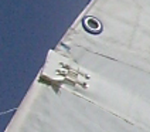
Knots, lashing (?) the mainsail battens in place

wombat88

Well-Known Member
Joined
1 Oct 2014
Messages
1,284
Visit site
Our mainsail has full length battens. The batten pockets are straight and you can't push the batten down into the pocket like on some sails.

The main has an eyelet on either side of the batten on the batten pocket and the batten has a hole in it (which doesn't quite align with the eyelets). I like to try and keep the battens tight so they seat nicely in the plastic fittings on the luff (protectors?)

Whenever I try and tie them up it looks a mess and and tends to come undone if left flogging for any length of time.

So what do you do?
 
It might be worth have a word with the sailmaker to see if a more secure method can be fitted. My current main has a velcro strap which has to be forced into the pocket with a special tool (with difficulty; I did ours on Wednesday and my hand is still sore). The battens need to be securely fixed so that the tension can be adjusted at the luff. There are more secure knots than reef knots but none so easy to tie. I think that in the past I would have used a reef knot with extra hitches on the tails for security.
 
My current main has a velcro strap which has to be forced into the pocket with a special tool (with difficulty; I did ours on Wednesday and my hand is still sore).

This is the system we have and keep a ruler on board for the sole purpose for feeding the velcro into the pocket.

For the OP - using what you have, can you not make 5 or 6 passes though the batton with a 2mm dyneema line and then tie off with a surgeons knott or similar.
 
You could drill extra holes in the batten if that helps? It might make tensioning easier.
I find some sort of zig zag effort finished off with a round turn and two half hitches easier to tension.
My dinghy which isn't a Laser has nice batten adjusters which adjust with an alen key. Maybe those are available in the right size. There are others which don't need a tool.
 
It might be worth have a word with the sailmaker to see if a more secure method can be fitted. My current main has a velcro strap which has to be forced into the pocket with a special tool (with difficulty; I did ours on Wednesday and my hand is still sore). The battens need to be securely fixed so that the tension can be adjusted at the luff. There are more secure knots than reef knots but none so easy to tie. I think that in the past I would have used a reef knot with extra hitches on the tails for security.

Mine is like that, and the "special tool" that I use is a screwdriver.
 
Mine is like that, and the "special tool" that I use is a screwdriver.

All right for bodgers I suppose.:) My sophisticated piece of hardware consists of a batten-like board with the additional refinement of a loop of cord for use as a wrist strap. No wonder the sail was so expensive.
 
Thanks all, not sure we are ready for the velcro solution yet. Thinner line and more holes in the batten should do the trick.

The other thing that I need to comprehend is batten tension. I remember having to do quite extensive 'rolling tack' training on a Merlin Rocket to get the top batten to tack. Now I don't think I'll have the same bother on a Jaguar 21 but the battens are long and whangy.

So should they be just in sufficient tension to bend a little bit or should the set flat?
 
Thanks all, not sure we are ready for the velcro solution yet. Thinner line and more holes in the batten should do the trick.

The other thing that I need to comprehend is batten tension. I remember having to do quite extensive 'rolling tack' training on a Merlin Rocket to get the top batten to tack. Now I don't think I'll have the same bother on a Jaguar 21 but the battens are long and whangy.

So should they be just in sufficient tension to bend a little bit or should the set flat?

Generally the batten should have some end pressure so that it curves. The top battens being shorter will have more effect on the sail shape and may make it difficult to get the sail to reshape when you tack if the tension is too much.
I think the eyelet and string method is OK. The primary idea is to tie the string across the end of the batten to get that end pressure. However it is good to use the hole in the batten to ensure the batten can not be lost. So do a pass through the hole.
The batten may be tapered in thickness to get more bend in the front 1/3 of the chord so make sure batten is in the right way. However the primary role of the batten is to support the roach of the main sail. That is the area of the sail extending beyond the straight line head to clew. It would flop over without the battens. The battens also stop flutter of the trailing edge. The latter roles not requiring end tension. ol'will
 
Thanks, I've found this on Youtube:

https://www.youtube.com/watch?v=c9GCEB2DWUo

Seems a neat solution.

Similar to mine in that the battens are probably too narrow (top to bottom) for the lashing to stay on them.

This mainsail is new to me (far from new) and has little roach. I suspect that the full length battens were intended to make sail handling easier together with luff slugs rather than a bolt rope (as was the original).
 
The Video you have linked is the way to do that style of battens. It is a system still the default setup on small racing catamarans as it is simiple and pretty fail safe.

Regarding batten tension. You should tension the battens so you just take any creases out of the batten pocket. You do not want to over tension the battens other wise you will find the sail will stretch and deform around the batten pockets. Don't worry about getting it perfect first time, tension the battens up, go sailing and adjust batten tensions induvidually.

You shouldn't have too many batten poping issues as a Jaguar's mainsail should be a decent bit flatter than a Merlin's mainsail.
 
Do have any adjustment on the luff end, might give better alignment of holes if you can adjust there (luff) first

I've met various systems- the batten poker strip and velcro cover with a tear-out lanyard not very adjustable but secure. The variety with the allen key adjusters at the leech end. And our current set up with batten cars and adjustment at the luff end by a screwdriver. The leech end is a blind pocket. (Selden system).
I have also experienced (windsurfing sails) with a broad tape round the leech end of the batten and a tape-clamp/buckle - that allows you to alter the tension and holds the batten in the pocket. That could be adapted to yacht sails without much difficulty. Windsurfing sails get a lot of hard use and I never had any real problems with those battens.
 
Top