
Isolated negative?

oilybilge

Well-Known Member
Joined
3 Nov 2017
Messages
213
Location
Suffolk
Visit site
Okay, so explain to me like I'm five...

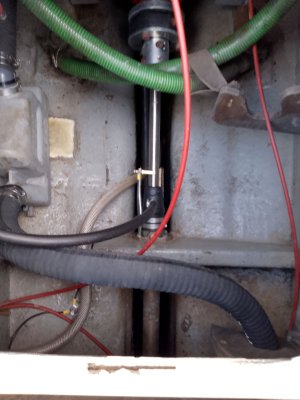
When my boatbuilder installed a new engine he didn't put the traditional wire over the flexible plastic coupling. So on the one hand there's the engine block connected to the boat's DC negative, and on the other hand there's the stern gear/ fuel tank/hull anode system.

The expert advice is to connect the two, and I'd be happy to do so, but I'd like to understand why.

It's an old wooden boat with an iron keel. We never use shore power. None of the other through-hulls are bonded. Assuming the two systems are truly insulated, what's the advantage of joining them?
 
The bridge over the coupling is to provide an electrical connection between the anode and the propeller/shaft so that the anode becomes sacrificial to the zinc in the propeller alloy. So you should have a wire from the anode to engine/gearbox and the anode should be close to the propeller. You should check that there is a circuit between the anode and the propeller by measuring the resistance. You may well find if the coupling is of the latest R&D type that there is an extra strap to replace the wire.

No need to connect an anode to a fuel tank. The anode circuit is nothing to do with the engine or house electrics. The anode should only be connected to the underwater metal it is protecting.
 
Thanks. I should have said, the anode is connected directly to the prop shaft by means of a copper ring which dangles off it.

As for the fuel tank, I'd always assumed this was grounded to prevent any build-up of static electricity, and connecting it to the anode was the easiest way to do this. The deck filler is similarly connected.
 
Neither need grounding. Not seen a copper ring used to connect the anode to the shaft. Do you have a photo? On my boat I use an MG Duff Electroeliminater which has 2 bspring loaded brushes running on the shaft. The flexible coupling fitted is difficult to bridge because of its design.

I expect your boat was built at a time when there was limited understanding of electrics and galvanic action. There was a tendency to see anodes as a cureall. Likewise grounding fuel tanks and fikkers with no evidence that static electricity is a problem.
 

Attachments

  • IMG_20231016_165203.jpg
    IMG_20231016_165203.jpg
    277.9 KB · Views: 9
The copper ring is the poor man's version of your electro eliminator. It's literally just a strip of copper formed into a ring and hung off the propshaft with the anode wire crimped onto it. A speciality of the local boat builder.
 
Does not sound like a particularly good way of maintaining electrical contact. Test is to measure resistance between the prop and the anode.
 
The copper ring is the poor man's version of your electro eliminator. It's literally just a strip of copper formed into a ring and hung off the propshaft with the anode wire crimped onto it. A speciality of the local boat builder.
My Twister came to me with this setup which I changed to a strap across the coupling.
 
Top