Is it just Me? Switch panel wiring

frderek

Active Member
Joined
21 Aug 2013
Messages
65
Location
Jersey, CI
Visit site
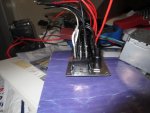
In attempt to tidy up a couple of "rat's nest" wiring situations on my boat I bought a switch panel on ebay.

However, the way it is wired seems all wrong to me.

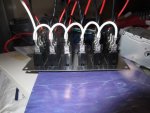
See the photos and see if you agree. All the number 3 terminals are wired together in white. All the number 1's have a black wire each, all the 2's are wired to a fuse.

Looking at the circuit diagram printed on the switches it seems to me that the 1's and 3's have been wired the wrong way round. Surely the 3's should be the 'incoming' positive, the 2's (via the fuses) the outgoing positives and the 1's should all be grounded to supply a ground for the 'neon' (I suspect LED) lights?

I've contacted the supplier through ebay but so far have had no response.IMG_0822.jpgIMG_0823.jpgIMG_0824.jpg
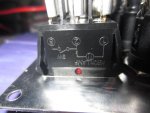
 
it looks wrong to me. i suggest swapping the white looped wire with the black tails. put the black tails in the middle and put the black wires from the fuse onto the number 3 terminal. they are all the wrong colors.
 
As I see it the white wire is the common incoming positive supply

The red wires are the switched and fused positive supplies to the various pieces of equipment powered from the panel.

the black wires from terminals "1"will have to be connected to the negative if the indicator lights are to function
 
it looks wrong to me. i suggest swapping the white looped wire with the black tails. put the black tails in the middle and put the black wires from the fuse onto the number 3 terminal. they are all the wrong colors.


But if I do that the 'neon' lights will be permanently on, won't they. Just swap 1 and 3 and leave 2 alone??
 
As I see it the white wire is the common incoming positive supply

The red wires are the switched and fused positive supplies to the various pieces of equipment powered from the panel.

the black wires from terminals "1"will have to be connected to the negative if the indicator lights are to function

Agreed.

Myself I would have linked the input to all the fuses and then fed the individual fuses to the pin 3's. All pin 1's need to go to negative to make the switch led work. Pin 2 is the output to the item being powered.

Yoda
 
Last edited:
Agreed.

Myself I would have linked the input to all the fuses and then fed the individual fuses to the pin 2's. All pin 1's need to go to negative to make the switch led work. Pin 3 is the output to the item being powered.

Yoda

But if pin 2 (via fuse) is the input and 3 the output then the the light will always be on regardless of the switch position, won't it. And what of the diode in the circuit diagram? If I remember my A-level physics correctly 'conventional current' flows from positive to negative so 2 must be +ve and 1 -ve and therefore, surely, 3 is the +ve input. AFAICS that's the only way the light will come on when the switch is closed. Unless I'm missing something?
 
One implementation would be:
3+ve all linked.
2 live end of fuse
1 equipment end of fuse.

In this case the neon would indicate a blown fuse (provided the load was significant)

Note that if it is indeed a neon then its never going to light at 12V
 
One implementation would be:
3+ve all linked.
2 live end of fuse
1 equipment end of fuse.

In this case the neon would indicate a blown fuse (provided the load was significant)

Note that if it is indeed a neon then its never going to light at 12V

I never thought of that! Mind you, the load is such that the voltage drop would be insufficient. It's not easy to tell but I think the diode is pointing from 2 to 1. Note that I did say 'I suspect LED' but it DOES say neon on the switch :) Oh, and it does light at 12V.
 
As I see it the white wire is the common incoming positive supply

The red wires are the switched and fused positive supplies to the various pieces of equipment powered from the panel.

the black wires from terminals "1"will have to be connected to the negative if the indicator lights are to function

That's what it looks like to me too. Dunno why they didn't just loop all the LED negatives together, but apart from that and the slightly odd colour choice of white for the incomer it seems sensible enough to me.

Pete
 
But if pin 2 (via fuse) is the input and 3 the output then the the light will always be on regardless of the switch position, won't it. And what of the diode in the circuit diagram? If I remember my A-level physics correctly 'conventional current' flows from positive to negative so 2 must be +ve and 1 -ve and therefore, surely, 3 is the +ve input. AFAICS that's the only way the light will come on when the switch is closed. Unless I'm missing something?

Diode ?.... the LED ? presumably they will be wired with their cathodes to the negative (terminal 1) I cannot see any indication in the diagram of the polarity,


I recko its a panel originally intended for AC mains use, hence the indication of a neon with a ballast resistor, now pressed into service for 12 volt DC by substituting an LED and appropriate series resistance
 
With no polarity indicated, I assumed that the pos supply would be switched so that's why I opted for 1 pos 3 neg and load between 2+ and 3-.

Srry that does not make sense , (its the incoming white wire on 3 that is switched)

although the load could be connected between 2 (switched and fused negative) and 1 (positive ) but it would be very unconventional.


surely its as simple as this

DSCF1422.jpg
 
Last edited:
But if pin 2 (via fuse) is the input and 3 the output then the the light will always be on regardless of the switch position, won't it. And what of the diode in the circuit diagram? If I remember my A-level physics correctly 'conventional current' flows from positive to negative so 2 must be +ve and 1 -ve and therefore, surely, 3 is the +ve input. AFAICS that's the only way the light will come on when the switch is closed. Unless I'm missing something?

Please see edited post! Slight 2 and 3 confusion! I just like the fuse before the switch, personal thing and others may disagree.
 
Please see edited post! Slight 2 and 3 confusion! I just like the fuse before the switch, personal thing and others may disagree.

I agree with that - if for no other reason than the fact that the light will then show if the fuse has gone.
 
Diode ?.... the LED ? presumably they will be wired with their cathodes to the negative (terminal 1) I cannot see any indication in the diagram of the polarity,


I recko its a panel originally intended for AC mains use, hence the indication of a neon with a ballast resistor, now pressed into service for 12 volt DC by substituting an LED and appropriate series resistance

Odd switch all round, normally it's 1 .... in 2 ..... out 3 ... neg for illumination, one must assume diagram on switch is correct.

Brian
 
Top