
International Gelshield

Clint

Active Member
Joined
26 Mar 2014
Messages
52
Location
Guildford
Visit site
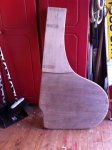
I am busy restoring a little Winklebrig trailer sailer, and have just finished taking the rudder down to bare wood. All the old very badly applied varnish and other unrecognisable paint is off, and it is ready for refinishing. I have been reading PBO's series on Hantu Biru, and see that they have prepared the rudder blade by using International Gelshieild epoxy primer. According to International this is for: Compatibility/Substrates - GRP Gelcoats & cured laminate. A quick drying, high performance, two-component epoxy for application to sound gelcoats to help protect against osmosis. So why did they use it on wood, unless I am reading the article incorrectly. What I really need is advise on how to successfully prepare the rudder. It is made up of Marine Ply.rudder5.jpg
Clint
 
If you are wanting the timber to show then first apply epoxy resin after warming the structure, this will help penaration and give a smooth finish only when enough coats have been applied, apply coats wet on tacky to avoid sanding between coats.

Allow to cure then add lots of very high UV resistant varnish, 5 coats at least.

The epoxy will protect the timber and harden the surface, the high UV varnish will protect the epoxy.

Good luck and fair winds. :)
 
I've used Gelshield on wood that is NOT underwater and it's "ok", but not very flexible. It has cracked in a few places where the wood has swollen.
 
If you are wanting the timber to show then first apply epoxy resin after warming the structure, this will help penaration and give a smooth finish only when enough coats have been applied, apply coats wet on tacky to avoid sanding between coats.

Allow to cure then add lots of very high UV resistant varnish, 5 coats at least.

The epoxy will protect the timber and harden the surface, the high UV varnish will protect the epoxy.

Good luck and fair winds. :)

+1 but I would suggest that you also add wooven fibre cloth on the ply with the epoxy, this will ensure that there is no cracking and it will protect the marine ply; once the wooven cloth is covered with epoxy it becomes very smooth and almost invisible.
 
+1 but I would suggest that you also add woven fibre cloth on the ply with the epoxy, this will ensure that there is no cracking and it will protect the marine ply; once the woven cloth is covered with epoxy it becomes very smooth and almost invisible.

Good point.

A singe layer of Roving cloth will retain transparency.

Good luck and fair winds
 
I was thinking of painting the rudder stock, and the blade. So should I still epoxy and fibre cloth the blade. The rudder is not really the most attractive of things, so I don't think putting coats and coats of varnish on is going to make it look any better, for me it's purely functional. As she is a trailer sailer, and not going to be spending months on end in the water, would it be worth applying any anti-fouling at all?
 
I was thinking of painting the rudder stock, and the blade. So should I still epoxy and fibre cloth the blade. The rudder is not really the most attractive of things, so I don't think putting coats and coats of varnish on is going to make it look any better, for me it's purely functional. As she is a trailer sailer, and not going to be spending months on end in the water, would it be worth applying any anti-fouling at all?
.

Yes, you still have to apply the epoxy coat, I would also apply the coat of cloth. You will also have to apply a primer over the epoxy prior to painting. Nothing muck sticks to epoxy without primer.

Good luck and fair winds. :)
 
Top