Installing two sets of solar panel?

Tim Good

Well-Known Member
Joined
26 Feb 2010
Messages
2,888
Location
Bristol
Visit site
I have 360w of solar already. 3 x 120w in series via a Victron MPPT. I want to and a further 60w roaming panel on my coachroof via another non MPPT controller. This is a quality controller by Sunware in Germany rated up to 240w.

From what I have read it is ok to rig two separate solar banks like this. As such I have rigged the additional panel and all seems fine.

However, it is a sunny day and the Victron controller has gone into float mode with zero amps output. However the sunware controller with the new 60w panel is still happily kicking out 3.8amps at 14.4v.

Thoughts on this?
 
Two devices trying to regulate the same voltage?
You may run into silly problems where the Victron goes into float mode because the other charger is taking the batteries to say 14V, despite them not being fully charged.
 
With a big enough bank this shouldn't happen.

3.8amps into say a 675ah bank isn't going to raise the voltage much. The controllers should be sensing the battery voltage not each other.
 
Last edited:
I have 360w of solar already. 3 x 120w in series via a Victron MPPT. I want to and a further 60w roaming panel on my coachroof via another non MPPT controller. This is a quality controller by Sunware in Germany rated up to 240w.

From what I have read it is ok to rig two separate solar banks like this. As such I have rigged the additional panel and all seems fine.

However, it is a sunny day and the Victron controller has gone into float mode with zero amps output. However the sunware controller with the new 60w panel is still happily kicking out 3.8amps at 14.4v.

Thoughts on this?

I guess the Victron switches to float mode at a very slightly lower voltage than the Sunware. Together they have charged the battery until the volts reached the point at which the Viicron has gone into float mode. The Sunware is soldiering on trying to get the voltage up to the point at which it too will go into float mode ( assuming it is a multistage device that has a float mode) Because you now have only 60 watts feeding a large battery bank this will take some time.
There is no current output from the Victron because it floats at 13.8 volts. 13.8 volts into a circuit being held at 14.4 volts just wont push any amps in. Its like a little kid trying to tip the seesaw with a fat kid on the other end!
 
I have 3 banks of solar panels with 3 separate regulators and each will have slightly different set points so will switch stated at different times.

Mine had been like that for 8 years now without any problem.
 
With a big enough bank this shouldn't happen.

3.8amps into say a 675ah bank isn't going to raise the voltage much. The controllers should be sensing the battery voltage not each other.

How do they do that ?

If the 60w controller is outputting 14.4v, this is what the Victron controller will see, it has no way of differentiating between battery state and controller output.
 
I have 3 banks of solar panels with 3 separate regulators and each will have slightly different set points so will switch stated at different times.

Mine had been like that for 8 years now without any problem.

Thanks. Do you connect your regulators all to the same point on your house bank?
 
I have 360w of solar already. 3 x 120w in series via a Victron MPPT. I want to and a further 60w roaming panel on my coachroof via another non MPPT controller. This is a quality controller by Sunware in Germany rated up to 240w.

From what I have read it is ok to rig two separate solar banks like this. As such I have rigged the additional panel and all seems fine.

However, it is a sunny day and the Victron controller has gone into float mode with zero amps output. However the sunware controller with the new 60w panel is still happily kicking out 3.8amps at 14.4v.

Thoughts on this?

The Victron controller sees the 14.4v from the Sunware controller and "thinks" the batteries are charged, so goes into float mode, where it won't put any current into the battery for the reasons Vic said. However, it doesn't matter if the batteries are fully charged or heavily depleted, if the Sunware is putting 14.4v out, the Victron controller will go into float.

You might try changing the settings within the Sunware controller to output a lower voltage, which should let the Victron keep charging, how much that would reduce the effectiveness of the 60w panel i'm not sure.
 
The Victron controller sees the 14.4v from the Sunware controller and "thinks" the batteries are charged, so goes into float mode, where it won't put any current into the battery for the reasons Vic said. However, it doesn't matter if the batteries are fully charged or heavily depleted, if the Sunware is putting 14.4v out, the Victron controller will go into float.

You might try changing the settings within the Sunware controller to output a lower voltage, which should let the Victron keep charging, how much that would reduce the effectiveness of the 60w panel i'm not sure.

This may happen at a much lower voltage.
E.g. if the small panel gets the sun first, when the Victron wakes up, it sees the batteries floating at a voltage implying they are fully charged when they are not.
You need to look at the state diagram and decision levels of the particular Victron charger.
What prevents it waking up to a battery slowly charging at 13.5V and thinking it's a fully charged battery resting?
Likewise how do the two chargers work together in all scenarios to properly decide when to reduce to float voltage?

I don't see any upside over putting all the panels into one decent charger/controller.
 
Can someone check this for me?

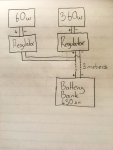
I have installed the new panel and mounted the new regulator next to my first one. I was about to run another wire to the batteries but figured I may not need to. The wire going to the batteries from first original controller is AGW 10 (2.6mm dia).

Could I just connect the two battery outputs on the regulators and therefore share the cable to the battery This would be the same as leading two cables right?

From a 3m cable run and a total of 420w panels, I calculate that with my cable of AGW10 I'd get 2.5% loss which is acceptable and be ok up to 44amps.

Is this all right?

IMG_9270.JPG
 
Last edited:
Can someone check this for me?

I have installed the new panel and mounted the new regulator next to my first one. I was about to run another wire to the batteries but figured I may not need to. The wire going to the batteries from first original controller is AGW 10 (2.6mm dia).

Could I just connect the two battery outputs on the regulators and therefore share the cable to the battery This would be the same as leading two cables right?

From a 3m cable run and a total of 420w panels, I calculate that with my cable of AGW10 I'd get 2.5% loss which is acceptable and be ok up to 44amps.

Is this all right?

10 AWG would only be suitable ( 3% volts drop) over the distance you indicate up to a maximum of 15 amps

I guess you are hoping for rather more than 15 amps. Between 25 and 30 perhaps

I would be looking at using AWG 8 or maybe even AWG 6. It is the connection between the regulators and the batteries where volts drop is the most critical because that will directly affect your charging rate.

Hve you forgotten to double the 3m ( ie 3m there and 3 m back again) in your calculations.

If possible though I would have put the regulators closer to the batteries, rather than use heavier wiring.
 
I agree with Vic, the cable is definitely too small. I'd also agree with having the controller closer to the battery if possible.

A note on cable sizes, AWG is an American gauge and we don't use the wire diameter, in the UK we use cross sectional area in square millimeters. I would recommend that you use 10mm2
 
How do they do that ?

If the 60w controller is outputting 14.4v, this is what the Victron controller will see, it has no way of differentiating between battery state and controller output.

If this were the case everyone using multiple controllers direct to a charging bus would be wasting their time. During bulk charging both controllers will throw all they can at the battery. After that they work on a timer function.
 
If this were the case everyone using multiple controllers direct to a charging bus would be wasting their time. During bulk charging both controllers will throw all they can at the battery. After that they work on a timer function.

Can you explain then, how a controller that is connected to the battery can differentiate between the actual battery voltage and the voltage input from a second source ?

The answer is, they can't. So if one controller thinks the batteries are charged, because it sees the output from the other controller, it won't start. More sophisticated systems use networked controllers to overcome this. The OP also has the issue of using PWM and MPPT controllers, which i don't think is a good mix.

When the Sun comes up the PWM controller will start charging before the MPPT controller, so the MPPT controller will monitor the "battery" voltage (it will actually be monitoring the voltage output from the PWM controller), so it won't start. This is what the OP is seeing.

The best chance of running two controllers in parallel is if the controllers are as close to identical as possible. Two MPPT controllers can work if the voltage and profile settings are the same, but you can't do that with one PWM and one MPPT.

The OP could try getting the profile voltages as close as possible and see what happens, or perhaps lower the settings on the PWM to allow the Victron to start.
 
Can someone check this for me?

I have installed the new panel and mounted the new regulator next to my first one. I was about to run another wire to the batteries but figured I may not need to. The wire going to the batteries from first original controller is AGW 10 (2.6mm dia).

Could I just connect the two battery outputs on the regulators and therefore share the cable to the battery This would be the same as leading two cables right?

From a 3m cable run and a total of 420w panels, I calculate that with my cable of AGW10 I'd get 2.5% loss which is acceptable and be ok up to 44amps.

Is this all right?

View attachment 70620

No, this is not right. You need to run the cables to the batteries.

If your two battery banks are connected to a VSR it would be worth connecting the Sunware controller to the engine bank.
 
I guess I'm being really dim here ..... but surely he has run the cables to the batteries? :confused:

Richard

I think PR means he should run separate cables from the two controllers rather than, in the OP's words, "share the cable to the battery".
I wondered about that when I responded in #13 but decided not to comment
 
I think PR means he should run separate cables from the two controllers rather than, in the OP's words, "share the cable to the battery".
I wondered about that when I responded in #13 but decided not to comment

But surely as long as the cables are thick enough, it's better to use one run of correct cable ..... and I thought you'd covered that?

Richard
 
Top