Installing a dedicated engine start battery - what size/type

skyflyer

Well-Known Member
Joined
26 Jan 2011
Messages
1,433
Location
Worcester, UK
Visit site
I would like to re-arrange my electrics from the present 2x 190Ah bank that through a 1,2,both, off switch are completely interchangeable (whichever battery is selected supplies ALL power to the boat) Normally we start on 1, run on both, and when engine is off, run the domestics off 2. However i feel the 190Ah is a waste for an engine start battery and could be better utilised to complement the house battery

Engine is Yanmar 3GM30. with a 90A alternator controlled by an Adverc system.

Space being at a premium I would like the smallest battery that will enable easy starting, given that there will be an emergency link to enable house batteries to cross-start the engine if the engine start battery fails.

Any particular advantage to AGM, Gel, etc? (for this specific purpose, I am aware of differences generally)

Anyone have a similar set-up they could recommend.

(By the way, I am not ditching the two 190Ah for some completely new combination - they are brand new!)
 
Car/van batteries are expressly designed for starting engines (oddly enough). Your Yanmar handbook should suggest a minimum CCA figure for the battery it needs. 80Ah is probably more than enough in terms of capacity (but, again, the handbook may advise). Absolutely no need for AGM or gel. You will have the option of 'sealed' or 'open' (i.e. you can top up with water); if your existing 190Ah jobs are sealed, you'd be wise to make the starter battery the same, since both will require the similar charging regimes. Similarly, if the 190s are 'open', wise to make the starter the same.
 
I did something similar but on a smaller scale last year: combined 2 x 65Ah into a house bank and added an engine start for my 1GM10. A Red Flash would have been nice, but they are very expensive, so I used a spare car battery I had knocking around. It's a bog standard 063, as fitted to lots of things. Forty quid delivered from Tayna, less if you shop around, 360CCA, 40Ah.
 
I've just bought one of these. http://www.mdsbattery.co.uk/shop/productprofile.asp?ProductGroupID=8557
I am lucky to have a wet locker next to my main battery bank so I have made a very inconspicuous false floor under which I can lay this battery on its side.
The boat engine is winterized at the moment,
The other day the battery was flat on my car, so I used the odyssey battery to jump it .
It had no problem turning over the 3.2lt diesel, so I hope my VP 2002 should not give it too much of a challenge.
 
If space is at a premium then a Red Flash 1100 would be ideal. Otherwise a car battery for a small diesel around 70 ah will be fine at half the price. Also ditch the 1 2 both and fit a VSR and a means of paralleling the house to the engine. Various ways of doing, I use BEP Marine switch clusters.
 
if your existing 190Ah jobs are sealed, you'd be wise to make the starter battery the same, since both will require the similar charging regimes. Similarly, if the 190s are 'open', wise to make the starter the same.

I don't think that aspect is very critical. I have used a AGM Red Flash 1100 as starter battery in combination with first open and then sealed domestic bank. No problems during 9 years.

Also, no need to ditch 1,2,both,off if you are happy with it. But if you fit VSR, let it switch the starter battery, not the domestic bank.
 
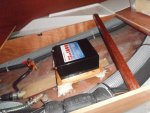
I have just finished fitting a small Red Flash 1800 above the prop shaft in the rear quarter berth it sits on a plywood base and I will have a couple of straps around it for security. Very slim I made a model from cardboard to see where I could fit this. The engine is a 3GM20 Yanmar. The 1800 battery would be enough for your larger engine. Look up the spec. I also fitted a VSR much simpler fully automatic for the re-charging. The battery is about 52Ah with 1115 CCA. The picture shows the installation I went a bit mental with the Epoxy first time I’ve used it.

Red start 4.jpg
 
Space being at a premium I would like the smallest battery that will enable easy starting, given that there will be an emergency link to enable house batteries to cross-start the engine if the engine start battery fails.

Any particular advantage to AGM, Gel, etc? (for this specific purpose, I am aware of differences generally)

AGM, etc, tend to be smaller, and can be fitted wherever.

Your plan sounds similar to mine a couple of years ago; 2*85Ah and a new Odyssey (can't remember the model,I bought it for a motorbike, but it didn't fit). No problems with BEP VSR replacing old 1-2-both switch. I don't think that ~25Ah (but many CCA) AGM at 13.8v has any problems being charged in parallel with 190AH wet cells at much lower voltage, IYSWIM.

http://www.merlinequipment.com (I think, read their website anyway, and add some monitoring) sell nice custom-length thick, terminated cables.
 
I'm using a Red Flash 1100 to start a Yanmar 3GM30F, which it does faultlessly. I suspect I could have used a RF 1000 instead but the 1100 would just fit the space, so I bought that. I know of two people who use the 1100 to start 4-cylinder Yanmars very successfully.

I combined my previous 2 x domestic and 1 x starter batteries, all 110 Ah leisure types, into the domestic bank. They were all of different ages but lasted quite successfully for several years. I retained the 1-2-all-off switch, which I prefer.
 
>I am not ditching the two 190Ah for some completely new combination - they are brand new!)

You haven't said what they are but start batteries are normally Cold Cranking Amps and house batteries are deep cycle like golf cart batteries.
 
The 190Ah are supposedly 'leisure batteries' but from what I have read, unless you pay a LOT of money these are rarely true deep cycle batteries and generally fulfil a dual purpose role.

In general terms I perhaps haven't explained my reasoning.

In a car, especially a diesel engined car, the single battery has to supply the glow plugs, crank a meaty 100-170HP engine and supply all ancillaries. You may drive three hundred yards to the shop, switch off and have to re-start a short while later. In other words there is a fairly high demand on a single battery, which, as we know, is ledom recharged more than about 70% of full capacity due to the inefficiencies and losses in a conventional alternator charging system.

In a boat, with a separate house bank and an advanced charging system, with a 28HP 3 cylinder engine, I do not believe that this needs a battery of the same rating as the example above!

This is especially the case if you have an 'emergency link' to connect the house bank to the starter if required.

By way of example, think of these type of devices that are used for emergency starting - the battery in these really cannot be that large can it, but it says good for starting a 2400cc diesel!

shopping


I would like a physically small battery so I can site it where I can minimise the heavy duty cable runs needed to carry that amperage and minimise cable losses.

The real question is, will a battery of this small size last years or are these emergency packs designed to be used only once or twice a year?
 
I'm using a Red Flash 1100 to start a Yanmar 3GM30F, which it does faultlessly. I suspect I could have used a RF 1000 instead but the 1100 would just fit the space, so I bought that. I know of two people who use the 1100 to start 4-cylinder Yanmars very successfully.

I combined my previous 2 x domestic and 1 x starter batteries, all 110 Ah leisure types, into the domestic bank. They were all of different ages but lasted quite successfully for several years. I retained the 1-2-all-off switch, which I prefer.

Vyv, that sounds exactly what I want - am I correct that your 1/2/off will now select the start battery or the combined house bank?
 
You are correct. A dedicated starter battery has an easy life, particularly if you have a split charging system that automatically recharges it first before the house bank. The suggested small car battery will last very well in that environment. A Red Flash even better but twice the price.
 
You are correct. A dedicated starter battery has an easy life, particularly if you have a split charging system that automatically recharges it first before the house bank. The suggested small car battery will last very well in that environment. A Red Flash even better but twice the price.

If the starter battery has an easy life, a VSR will in practice not recharge it first before the house bank, but instead in parallel with the house bank. Only if the starter battery has become substantially depleted (engine starting problems?) will it have "priority" for more than a few seconds.
The OP has two 190 Ah batteries to form a house bank plus an emergency switch to be able to start the engine from this bank. If he decides to ditch the off,1,2,both for a VSR, I see no downsides with setting it up to switch the starter battery, that is, giving the house bank priority.
But two benefits: Lower current through the relay and zero risk of relay "chatter".
 
Some of those ultra-light starter batteries have very thin lead plates in them.
They are great for starting a race engine, but can fail quickly if used wrongly, such as cranking for too long to prime a diesel system.
I have heard of problems when people put high-tech lead acid batteries in off road vehicles, which they sometimes do to free up the 'big' battery for the winch.

I'd rather have a suitable size car battery.
 
Some of those ultra-light starter batteries have very thin lead plates in them.
They are great for starting a race engine, but can fail quickly if used wrongly, such as cranking for too long to prime a diesel system.
I have heard of problems when people put high-tech lead acid batteries in off road vehicles, which they sometimes do to free up the 'big' battery for the winch.

I'd rather have a suitable size car battery.

My understanding is that a large number of thin plates is EXACTLY what makes a starting battery a starting battery, rather than thick plates that are required for deep-cycle batteries?

Perhaps the issue you describe is more to do with the amount that the battery is discharged, rather than the rate of discharge?

However you make a good point about priming the engine; not too bad if you can de-compress the cylinders I guess.

I guess another way to tackle my 'problem' is to fit one of this devices that isolates the battery when it gets below a certain voltage. That way i could run my domestics happily of both batteries, safe in the knowledge that once it gets to a certain minimum level (which obviously needs to be enough for starting the engine) one of the batteries will isolate itself.
 
I guess another way to tackle my 'problem' is to fit one of this devices that isolates the battery when it gets below a certain voltage. That way i could run my domestics happily of both batteries, safe in the knowledge that once it gets to a certain minimum level (which obviously needs to be enough for starting the engine) one of the batteries will isolate itself.
If you keep the two banks separate and fit a VSR the start battery will never be used for house unless you have ameans of paralleling them. Sound reason for ditching the 1 2 both switch which if you are forgetful could drain your start battery.
 
The problem is that I want to use the start battery for house! I have a 190Ah battery that I effectively keep just for engine starting. Whenever the engine is off, we run off just the No2 battery not 'daring' to run No 1 down!

If the two batteries are connected by a VSR then they will drain equally until both reach the 'cut-off' voltage (12.8v?)and then the remaining battery will continue to drain until flat, if you let it!
At 12.8v the battery is nominally 100% charged - in other words the VSR will disconnect 190Ah battery almost immediately any significant power is drawn from it! Even allowing for variations and errors, I'll be lucky to get 10Ah out that battery before it is 'disconnected'!

Hence the desire to install a third battery, as per my original post, which needs to be powerful enough to turn the engine, bit ONLY has to turn the engine, but small enough o fit in the space available.

So far the Red Flash 1000 or 1000 looks like it will do the job nicely
 
Top