Installing 38 mm transducer in place of 57 mm thru hull one

slawosz

Well-Known Member
Joined
26 Sep 2018
Messages
625
Location
London
Visit site
Hi,
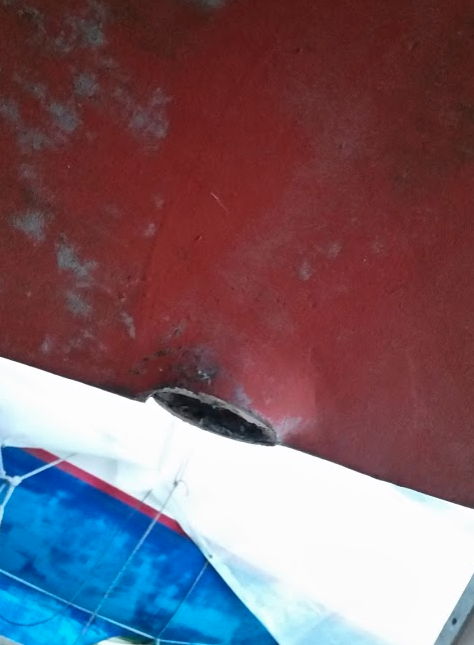
I got rid of old 57 mm (around) thru hull transducer remains. Very similar or identical to Raymarine one. They were in front of keel. Now I have hole in hull, and would like to make a fiber glass flat plug, around 10 mm thickness, and use epoxy to install Nasa transducer tube on top of this plug. I will make sure there is no air in plug and between plug and transducer tube. Does is sound reasonable or should I take something else into account?
 
To repair a hole in the hull you need to grind back and feather the edge of the hole and gradually build back the laminate with successive and smaller patches of gas mat to the same thickness as the original hull simply trying to put in a plug especially in a below waterline critical area is not to be recommended. What you do after repairing the hole is another matter. There is plenty of information on the web and you tube about how to repair holes in fibre glass and West Systems supply or did such information.
 
Hi,
I got rid of old 57 mm (around) thru hull transducer remains. Very similar or identical to Raymarine one. They were in front of keel. Now I have hole in hull, and would like to make a fiber glass flat plug, around 10 mm thickness, and use epoxy to install Nasa transducer tube on top of this plug. I will make sure there is no air in plug and between plug and transducer tube. Does is sound reasonable or should I take something else into account?
Simplest way is often to install the new transducer in a thru-hull which fits the hole in the hull. Either Bronze or reputable plastic.
I would avoid grinding back the existing hole and all that. That is a method for when it's desirable to end up with a repair the same thickness as the original hull. With a 10mm laminate thick ness you will end up with a very big section of amateur GRP for no gain.
If you decide to glass in a plug, you will need a decent overlap of backup material around the old hole but you're not replacing any of the essential structure of the hull, since there's always been the hole there.
 
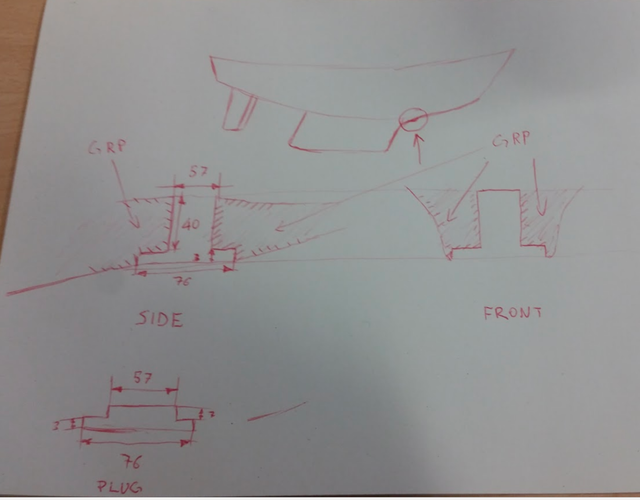
So I was not clear enough. The hole is in front of keel. It is very solid build boat. For better understanding, I created a 'technical drawing', which will help to understand how the hole looks like and how the plug could look like. Plug would be glue in using epoxy, plus, I would connect bottom with one of 2 layers 200 fiberglass stripes. Or more, if it could be required.
Or as an alternative, I could use nasa dedicated thru hull transducer attachment, but then I would have permanent hole in hull, which is less ideal.
All diamentions in mm.

 
To repair a hole in the hull you need to grind back and feather the edge of the hole and gradually build back the laminate with successive and smaller patches of gas mat to the same thickness as the original hull simply trying to put in a plug especially in a below waterline critical area is not to be recommended. What you do after repairing the hole is another matter. There is plenty of information on the web and you tube about how to repair holes in fibre glass and West Systems supply or did such information.

For the reasons you state, I just left the old transducer in place and mounted the new one inside the hull nearby. Simple.
 
People often get quite good performance from a depth sounder working through some GRP, but in that situation I would be concerned that any degradation of the sounder's beam shape will give returns from the keel..
Having the working face of the transudcer in the water is least risk and best performance.
With that thickness of material, filling the excess space with a mix of epoxy and glass should be amply strong, provided the old grp is clean and dry.
I'd want the actual seal between grp and transducer to be Sikaflex or similar though, not relying on epoxy as a seal against whatever the transducer housing is made of.
 
People often get quite good performance from a depth sounder working through some GRP, but in that situation I would be concerned that any degradation of the sounder's beam shape will give returns from the keel..
It is factory prepared place to install transducer, I would say there is not a real risk for wave degradation. All Achilles 24 tranducers are being mounted there.

Having the working face of the transudcer in the water is least risk and best performance.
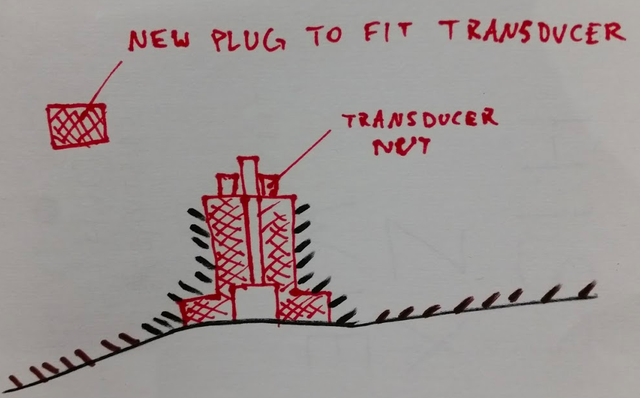
In such case, I would need to use special transducer antifauling, right? In such case I would need to make 'plug' in proper shape to insert transducer. Something like drawing below. Additional advantage is bigger area to glue plug to a hull. Also, what I could use for sealant in this case - transducer should fit tight in plug. Or, to make my life easier, I could use Through hull transducer mount kit - Nasa Marine Instruments ?

With that thickness of material, filling the excess space with a mix of epoxy and glass should be amply strong, provided the old grp is clean and dry.
I will make sure that grp will be clean. I am planning to do some groves to extend contact area as well.

I'd want the actual seal between grp and transducer to be Sikaflex or similar though, not relying on epoxy as a seal against whatever the transducer housing is made of.
So this would be case of glassed in plug, right?

 
Last edited:
That will work.
It is quite a mass of resin, so could generate a fair bit of heat as it sets, whther it's epoxy or polyester. So maybe fill it in 3 sessions?
One trick is to cast the plug around a dummy transducer former made of soft wood, then when it's all set, drill out the wood and fit the transducer with a little sikaflex, or even a neoprene gasket above it.
If the transducer doesn't work, you want to be able to remove it.
Maybe you could just fill the upper part of the hole, mount the transducer and then fill around it?
Many ways to sort the details....

I fitted a Nasa sounder about 20 years ago, I mounted it in a plastic thru-hull with polyurethane sealant and plastic spacers, not heard of that boat sinking yet....
 
Thanks. I have also other option - my friend has a lathe, end he offered to create a bronze plug. Now, I wonder if it would make sense, or should I stick to the original plan, GRP plug?
 
With a lathe, I'd consider modifying a skin fitting if that helped.
To machine that from solid is quite a big piece of bronze and won't be cheap.
 
Thanks. I have also other option - my friend has a lathe, end he offered to create a bronze plug. Now, I wonder if it would make sense, or should I stick to the original plan, GRP plug?
I made a steel plug like your GRP one for my steel boat. Sealed in with sikaflex and setscrews.

I think your original GRP plug would be in order glued in with thickened epoxy.

You could then fit the new transducer into the resultant hole with some thin oil as internal transducers have been fitted.

Look here

Shoot Through The Hull
 
With a lathe, I'd consider modifying a skin fitting if that helped.
What you mean by skin fitting?

To machine that from solid is quite a big piece of bronze and won't be cheap.
There are scrap pieces of bronze in acceptable price on ebay. I just wonder if it won't cause any interference, especially that I don't know what could be inside alloy.
 
I echo your approach, I'd roughen the exiting tube, make make a dummy (very slightly larger out of plastic, split tube) insert and fill the gap with good epoxy filler. When expoy filler is set Remove Dummy , bed in new transducer tube with suitable sikaflex or equivalent.
 
Top