
Inconsistent Dipstick Reading/Oil Pressure Alarm

dial-a-monkey

Well-Known Member
Joined
30 Sep 2013
Messages
99
Location
Home Port: Lyttelton, New Zealand
Visit site
Yanmar 3J4H3 29KW - 500 hours oil grade CD

When in a marina on a completely flat day, engine cold, I get inconsistent dipstick readings between successive readings - so when the boat is not moving at all. I pull the dipstick, wipe it clean then leave it in for about 5 seconds, then pull and check the level. I'm reading the oil level as the bottom of the convex curve of oil that forms on the dipstick when pulling it out.(I'm assuming, wrongly? that there is oil on the sides of dipstick tube that sticks to the dipstick when I pull it out - hence the curve?)

Since day one, when checking the oil level with the dipstick in the morning, engine cold, it initially reads at or very near the high level mark.

Wiping off and immediately re-installing the dipstick leaving it for 5 seconds or so..it reads much lower perhaps as much as 1/3( between high and low) . When I go through giving it 5 min intervals between readings - they start to become consistent sometimes higher sometimes lower than the high mark..

I'm presuming it's not an engine fault as it's consistent in how inconsistent it is. The engine does smoke a little( it is diesel after all) - but no signs of oil problems, so no oil in the coolant or coolant in the oil, overheating or anything else - Although recently the oil pump has taken slightly longer, perhaps 1 or 2 seconds longer, to get up to operating pressure before the alarm stops - so i was wondering if the oil level is low?

Does anyone else get this behavior.?

When the boat is bumping around on anchor I just check to see if the oil level isn't definitely low, as it's sloshing around it always reads high. .

Thanks again for any advice - it very much appreciated.. It's been bugging me for ages but I never got to asking around.
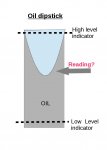
 

Attachments

  • dipstick.jpg
    dipstick.jpg
    31.2 KB · Views: 0
You're not taking these readings when the engine is running are you? If you are, then that's the reason for the inconsistancey. The oil is sloshed about as the pistons go up and down with the varying air pressure.
If that's not the case then I haven't a clue! Oil is sticky stuff and the maniscus you've drawn should be a lot shallower than that. Usually the diff between upper and lower fill marks is about a pint of oil,- say about half a litre. For it to fluctuate that much when stationary is very puzzling.
Mike
 
How about changing the oil? Measure how much you get out and compare to the manufacture's oil capacity. You will never get evry last drop out so allow say 10% for that. Refill with new oil an measure how much you put in checking a few times agaisnt the dipstick and expected quantity. obvioulsy let it drain for a few minutes before using the dip-stick. Changing the oil will give some more oil pressure and new oil should cling better to the bearing surfaces (you would see evidence of this on a classic car with a good oil pressure guage).

It won't hurt to overfill slightly say 4 or 5 mm over on the dipstick. Some of the smaller engines don't hold a lot of oil so I would dunt if the differnce between upper and lower marks would always be as much as a pint.

Other than this it's bit of puzzle!
 
Thanks for the input - dave_gibsea and Vegable
Nope, I'm not making the readings when the engine is going, I found one other person who also had this happening ( http://boatdiesel.com/Forums/index.cfm?CFAPP=3&Forum_ID=37&Thread_ID=52938) but I cannot see the answers - even after registering.

Yea I'm just don't understand either I have a diesel van that is always at a solid level..

I just had a thought - but other's must have noticed this too??.. when you inset the dipstick in a Yanmar engine it goes into the sump at an angle - as there's a bend in the tube - so if you read the back of the dipstick it's a much higher reading than on the front - perhaps my dipstick is twisting sometimes when I put it in... Hmmm

When I changed the oil a few months back it took the correct amount of oil = 5 Liters to get to the "High" level. I had to top up a few times just smal/tinyl amounts to keep it on high - one time it looked like it needed a lot of oil, but after letting it settle and running it the next day it was way over - so I sucked some out - hence the confusion now.
 
Last edited:
Really grasping at straws now. I don't know the engine at all so my next thought is that there's too much oil in the sump and oil is getting trapped in the internal casting webs of the engine body and moving the dipstick around dislodges air traps.? ! Next thought is that the dipstick tube bottom is sitting in the sump oil so the depth varies in the tube much more than that in the sump. As you're taking the dipstick out you're raising the level of oil in the tube. I haven't even convinced myself with the first thought but I do recall that you can get funny things happening with an overfilled sump. Have you tried running the engine with the oil at the low "fill me" level and seeing what happens then? There'll still be plenty of oil left in the sump.
Mike
 
Just a quick question - if the engine is not lying level to the waterline - i.e. it is angled fore and aft (sometimes by as much as 7 degrees) the way the dipstick is going in means that it goes forward and gets a 'lower' reading and if it goes in aft it gets a 'higher' reading.

I would rather measure the oil by the manufacturers recommended amounts. Don't go by the dipstick. On my last engine - also a Yanmar (2Gm 20) and its installation the correct oil level was well over the 'high' mark on the dipstick.

Regards

Donald
 
Last edited:
Thanks everyone for the advice - I will have to do another oil change soon, will have a go at measuring what I get out to check how much remains and therefore how much to put back in.

Last time I changed the oil twice/flushing as my engine only needs cheap CD low additive grade oil.
 
Last edited:
I don't know if this might be helpful ........

On my cat I have two 3YM30s. When I pull out the dipstick one always shows completely empty whilst the other shows the correct level. The first time I pulled out the dipstick on the empty engine I almost died of shock! However, the second time it is pushed in it shows the correct level but it is a bit variable.

I believe that one dipstick is making an airtight seal around the top of the dipstick tube and after the engine has been running and the oil level has dropped below the bottom of the tube, an airlock forms and, when the engine is stopped, the oil cannot flow back up the tube until the airlock is released.

It might therefore be possible that if the airtight dipstick is pushed in quickly or at a certain angle, it might pressurise the air slightly in the tube, pushing down the oil level a little. This will be variable depending on how quickly / accurately the dipstick is inserted.

Just a thought.

Richard
 
If at all possible, next time the boat is laid up in a fixed attitude drain the engine oil as much as possible, inc filter, then when surely empty, smear oil around the new filter seat where it interfaces with the engine, and if the position allows pre-fill the filter with the new oil.

Put in prescribed amount of new oil to engine.

Leave to settle a minute or two.

Note level on dipstick.

In a perfect world, turn the engine over 1-3 times without running.

Leave to settle.

Note level on dipstick.

Run engine then leave to settle.

Note level on dipstick.

That is your datum level to go by.

Overfilling engine oil is not a good thing ( unless it's a really shagged engine running on an almost ' total loss ' basis ! ) and may lead to mess from the crankcase breather, so usually best to keep near but not over the max mark on the dipstick, once you've got to know where that is for your installation.
 
Last edited:
Thanks RichardS It sounds like you're seeing a similar behavior to what I'm seeing - Good idea, I will try "breaking the air lock", leaving it and then checking the level.. Interesting..

I'll be changing the oil in a week or so so can make the benchmark then ..(thanks seajet) - The oil filter is on it's side on the 3j4he - so cannot be prefilled.
 
Last edited:
Changed the oil and did some testing - and now I'm getting a consistent oil level again..!

Also noticed (perhaps it's obvious to others ;)??? that the dipstick has a pre-bend in it - so it looks like it needs to go in exactly one way - with the "hoop" bit pointing exactly forward - otherwise I get different levels..even if it's off just 10 deg..
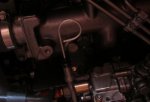
 

Attachments

  • dipstick.jpg
    dipstick.jpg
    88.1 KB · Views: 0
I've seen this on petrol engines - I assume it applies to some diesels too.

Pressure can build up inside the crankcase which pushes the oil further up the dipstick tube. Taking the dipstick out can release the pressure. Alternatively, if the engine is cool the pressure can be lower than the atmosphere pulling the oil down the dipstick tube.

Now I always take the oil filler cap off about 10s before checking the oil and I get a consistent reading. Trick is to remember to put the cap back on - oil thrown over an engine is hard to clean up...
 
Martin_W_Brown your comment made me think - well I just realised when you push the dipstick "fully home" to make a reading( is this correct - you must push it in fully? - I know the screwed transmission dipstick is just placed into the hole) the top of the dipstick is VERY airtight and will push oil out of the tube, So I guess you MUST open the oil filler cap to let the oil settle back into the tube and give it enough time to settle(return) or it will never read the correct level..hmm seems weird that it's not mentioned in the engine manual?

Which makes me think perhaps the engine oil dipstick also shouldn't be pushed home?!
 
Last edited:
Martin_W_Brown your comment made me think - well I just realised when you push the dipstick "fully home" to make a reading( is this correct - you must push it in fully? - I know the screwed transmission dipstick is just placed into the hole) the top of the dipstick is VERY airtight and will push oil out of the tube, So I guess you MUST open the oil filler cap to let the oil settle back into the tube and give it enough time to settle(return) or it will never read the correct level..hmm seems weird that it's not mentioned in the engine manual?

Which makes me think perhaps the engine oil dipstick also shouldn't be pushed home?!

I think I covered this in Post 9.

If there is a slight pressure build up in the dipstick tube then releasing the oil filler cap is not going to make any difference. In fact, it could make the erroneous reading worse as there is even less pressure on the filler cap side to balance the pressure on the dipstick side, although this is unlikely to happen in practice as the rocker box is probably vented into the air intake anyway.

If this dipstick pressurisation is a realistic occurence, the only solution would be to stop the dispstick rubber collar being airtight by cutting a small notch in it, or wiggling the dipstick around a bit as it's pushed home to release any pressure.

As I said in #9, one of my dipsticks does make an airtight seal but I'm not losing any sleep over it. :)

Richard
 
Top