
In Mast Reefing

ostell

Well-Known Member
Joined
12 Jan 2011
Messages
703
Location
Hayling Island
Visit site
My new (to me) boat has in mast reefing. I'm having difficulty getting the main to come out using the lines. At the mast I can pull on the sail and it comes out freely (and also goes back in without problem). It is rigged correctly looking at other boats and looking at reference material on the internet.

Using the lines in the cockpit I can't easily pull the sail out. If I temporarily trap the trolley on the boom to the aft end of the boom then everything appears to work but I don't think it should be like that. What state should the kicker, main sheet and topping lift be in to get the sail out smoothly and easily? Any other suggestions? No instructions at all in the docs that came with the boat.
 
I have found that the distance between the trolley and the block on sail, usually limited by the size of the bowline is quite critical. The sail should furl and unfurl parallel to the boom so kicker height, if gas filled, or topping lift should hold the boom at such an angle as to allow the sail to do that. If the bowline is too tight the outhaul will pull the sail down and cause the leach to jam as the sail leaves the slot. If it is too slack there is insufficient tension to pull the sail out and slide the car along the boom. Practice makes perfect (or nearly so).
 
If it is the basic Selden gear, then the problem is likely to be the slider sticking in the groove. Wash it all thoroughly and spray the groove with silicon. There is also a lot of friction in the outhaul rope and the sheave in the outboard end of the boom is likely to be seized. Can be replaced, but think you will find a spare sheave already there which you can use. If you have a continuous reefing line make sure the clutches are both off when setting the sail.
 
Thanks for that. Everybody keeps telling me that the boom should be horizontal. My own mind says that what you describe should be more logical, so that the pull on the outhaul stays in a horizontal direction.

So this would suggest that the boom remains parallel to the foot of the sail while in use. Or is this part 2 of "How to use an in mast reefing main"?
 
If it is the basic Selden gear, then the problem is likely to be the slider sticking in the groove. Wash it all thoroughly and spray the groove with silicon. There is also a lot of friction in the outhaul rope and the sheave in the outboard end of the boom is likely to be seized. Can be replaced, but think you will find a spare sheave already there which you can use. If you have a continuous reefing line make sure the clutches are both off when setting the sail.
Every thing checked, and sprayed, for minimum friction. All lines and blocks external.

With the boom horizontal then after the first couple of feet the angle of the outhaul changes the pulling force on the sail from horizontal to approaching vertical as the clew approaches the car. KK's comment seems to make logical sense.

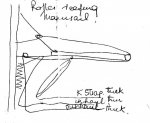
This is the diagram I found for the reefing.

Main Reefing001.jpg
 
Last edited:
Not the same as the Selden method. The outhaul goes from the front of the car to a sheave at the clew and then through a block on the top of the car back to the sheave at the end of the boom. So the outhaul pull is always horizontal.
 
Should the boom be truly horizontal? I was told by a sailmaker to have the boom at about 8 degrees up from the horizontal. The reason is that the sail is cut so that the when the sail furls, the foot makes a nice spiral going up. In other words the bottom seem should not roll on top of itself, but should make a nice helix rising up as the clew of the sail approaches the mast. This keeps the thickness down. If the foot of the sail rolled upon itself it would end up quite thick

TudorSailor
 
Not the same as the Selden method. The outhaul goes from the front of the car to a sheave at the clew and then through a block on the top of the car back to the sheave at the end of the boom. So the outhaul pull is always horizontal.

This is how my Z Spars system is rigged, would have thought the block on top of the car was essential.
 
Last edited:
Sorry, should have been this photo.

Just a thought, might be worth pulling the sail down and washing out top and bottom bearings with fresh water then using something like Mclube on them?
 
Last edited:
Tried rigged as per diagram I found on the boat and the "Selden" way. Problems with both.

Taking the car to the back of the boom, and tying it temporarily, lets the sail come out without problem. This would show that there minimal friction in the components.

Basically should the boom be allowed to come up to meet the clew of the sail? I think that should solve the problem but it is strange to have a non horizontl boom.
 
Your furling menchanism looks like mine, a sparcraft unit. One line for outhaul and another line for the furling "screw" (very similar to how a genoa works).
Don't really bother about the boom angle, just make sure that the main sail sheet is a bit loose. While furling/unfurling you will notice that the sail actually lifts the boom itself. Provided the sheet is loose of course. The biggest problem with this setup is the friction of the car along the boom. If you unfurl without pointing to the wind, provided your blocks run well, you will notice that the sail unfurls very easily with the wind (make sure you control the "furling screw") but pulling the outhaul is hard due to the increased friction from the side wind on the main sail. So, just make sure you point directly towards the wind.
You have mentioned "Taking the car to the back of the boom and trying it temporarily lets the sail come out without problem". EXACTLY, by doing this you have eliminated completely the friction of the car. So the solution is to maintain everything clean so they run well and point directly towards the wind when unfurling (or you can use the winch to pull the outhaul).
 
Reading through the answers I see that nobody has said anything about the backstay possibly being too tight. If there is too much backstay tension the furling gear inside the mast bends and it then becomes difficult to pull the sail in and out.
Just another thing to try.
 
Reading through the answers I see that nobody has said anything about the backstay possibly being too tight. If there is too much backstay tension the furling gear inside the mast bends and it then becomes difficult to pull the sail in and out.
Just another thing to try.
No problems at all pulling out the sail while standing next to the mast. Mast is straight.

@cmedsailor That's what it might be. Next time I'm out I'll try slackening off the kicker and sheet. Was going to be tomorrow but with the forecast for thunderstorms I might just give it a miss!
 
We found that too much tension in the halyard also causes the sail to pinch in the slot when unfurling. I suspect that too much halyard tension takes the loading off the foil and lets it be pulled towards the slot? Easing halyard tension just enough did the trick for us.
 
We found that too much tension in the halyard also causes the sail to pinch in the slot when unfurling. I suspect that too much halyard tension takes the loading off the foil and lets it be pulled towards the slot? Easing halyard tension just enough did the trick for us.

read all of this and its interesting stuff, but I have been there and bought the tee shirt many times . . . my 2p worth

take the sail off and see how flat it is - there lies the problem I think
 
read all of this and its interesting stuff, but I have been there and bought the tee shirt many times . . . my 2p worth

take the sail off and see how flat it is - there lies the problem I think

But the OP reports it comes out freely if the car is already at the back of the boom, so it is not a problem with the reefing gear or the sail shape, but friction of the car and/or the sheaves. I have the same, but relieved by spraying the car and having a free running sheave. Still easier to let the weight of the wind get the sail out and wind in the outhaul to flatten the sail, rather than using it to pull out the sail.
 
Dont know if this helps, instructions for Maxiroach furling.

From the fitting instructions for a fully battened Maxi Roach mainsail


Setting up the system
First make sure the kicker is off i.e plenty of slack.Make sure the mainsheet has sufficient slack to enable the boom to rise at least 14 inches.Pull thesail fully out until the foot and the leach are of a similar tension i.e. basically flat.Go to the kicker and tension it to that angle.Do not over tension.This should be the last time you ever need to adjust the kicker.
Now roll the sail in and set the boom horizontally to the mast,when you bring the sail out next time it will automatically slack off the topping lift.


When bringing the sail out it is important that the sail is tightened around the spar.This is done by pulling the reefing line and snugging the sail up around the spar before attempting to haul the sail out.BUT it is not necessary to roll the sail in tightly as you go when furling it away. You can let the clew go but keep control so that it does not flog into the center of the sail, and roll the sail in as loosely as you want.The main thing is, before you bring the sail out again, take hold of the reefing line and pull it hard. Ifyou have not got the strength to pull it hard, then put it on the winch and turn the winch no more than one and a half times. Do not over winch.
The sail should never be over tensioned, you should only need to tension the sail until the wrinkles in the luff disappear.

Nicked from elsewhere on the forum as my sheet is on the boat.

I set up as per at beginning of season and haven't had any probs... Touch wood, stroke rabbits foot and buy heather from nice gypsy crone.
 
Dont know if this helps, instructions for Maxiroach furling.

From the fitting instructions for a fully battened Maxi Roach mainsail

I set up as per at beginning of season and haven't had any probs... Touch wood, stroke rabbits foot and buy heather from nice gypsy crone.

That looks like the information I was looking for. The boom rising 14" is interesting.

Thanks
 
But the OP reports it comes out freely if the car is already at the back of the boom, so it is not a problem with the reefing gear or the sail shape, but friction of the car and/or the sheaves. I have the same, but relieved by spraying the car and having a free running sheave. Still easier to let the weight of the wind get the sail out and wind in the outhaul to flatten the sail, rather than using it to pull out the sail.

Beg to differ, have seen loads of sails that will only come out if you go to the mast and give them a tug, several of mine among them. In ALL cases ALL the above, friction, blocks, travellers and tracks have been fettled and lubed, rigging has been tweaked, trimmed and tensioned, booms have been measured with protractors and the like - and still the sail is too shy to come out. In the end the sail shape was the problem.

but as I have I said before what the hell do I know?

Its the same old issue, things work OK IF there is a lot of wind about when the sail is furled and unless everything is "right" when there is no wind when the sail is furled - there will be trouble - not today maybe but there WILL be trouble.

Since being away from the UK in 2010 EVERY troublesome rig I have "attended" has had in mast furling and in EVERY case sail condition was the main culprit.
 
Top