If it wasn’t for bad luck................

Ha ha :) .
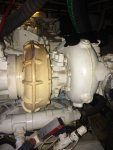
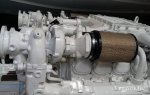
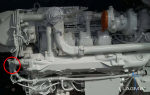
Wrong side , that’s the paint on the air side it does yellow with heat due to the compression, remember that hot air is then sent through the CAC .
The business end , the exhaust is water cooled ( see the jacket ) still white .
Interestingly the bearing between the two “wheels “ Is oil cooled see the pipes .
Yesterday I running 580 C EGTs at 28 knots .
CAC temps about 30 ,
Oil about 90- 100 C
water 84 .
Boost 1.8 bar
rpm 1780
Load 78 % .....nice and relaxing purring away
etc etc etc ....

That’s the thing I can see what’s going off ....make rpm / speed adjustments appropriately in the interests of longevity and holding on to £ .

View attachment 96199
Porto, when your EGT’s start to rise, how long before you see the water temps start to rise, my engines run at just over 80, rising to between 85/88 at full throttle, even when struggling to get on the plane, it never went above 90.
 
I'm afraid that's not a meaningful question Chris, because if EGT goes through the roof due to an engine load above 100% (which sounds like an oxymoron, but is a realistic possibility with diesel engines - particularly while running well below max rpm, as I suppose you did when struggling to get on the plane), the engine can suffer several types of damages well before the cooling system begins to not keep up anymore with its duties.

That said, you might be interested in some details related to our engines temperatures, which I gathered from a few MAN engineers in the last 3 years:

1) the VDO analogue gauges and their senders are crap.
Do NOT trust them blindly, and get an IR thermal gun to cross-check them. Easily the best 20 quid you will ever spend for your boat.
I appreciate that going into the e/r to check temps isn't something you are willing to do regularly while cruising, but you must at least get a baseline, to keep in mind when looking at the VDO gauges.

2) the cooling circuit has an alarm, completely separate from the senders that feed the VDO gauges.
Its shape and size is akin to a match box, and you can see it under the heat exchanger, on its right side looking at the engine from the belt pulleys side.
There is a plate on it, with the specs and the s/n. In my engines (and I can't think of a reason why it should be different in yours), it says that it's set to go off at 93°C. It might be worth to have its functionality and wiring checked,

3) Back to the IR gun, aside from checking the consistency of the gauge value by pointing it at its sender, there are several other points worth checking, at least occasionally. In fact, it even allows you to make an approximate and at the same time very detailed EGT check.
Approximate because you can only point the gun to the metal and not to the exhaust gas obviously, but very detailed because you can check each cylinder separately, which is unheard of even in the displays of electronic engines.
This can give you an early warning about one injector not working as it should.
Hard to explain all the points worth checking, but any half decent MAN technician should be able to tell you everything about them.
 
I'm afraid that's not a meaningful question Chris, because if EGT goes through the roof due to an engine load above 100% (which sounds like an oxymoron, but is a realistic possibility with diesel engines - particularly while running well below max rpm, as I suppose you did when struggling to get on the plane), the engine can suffer several types of damages well before the cooling system begins to not keep up anymore with its duties.

That said, you might be interested in some details related to our engines temperatures, which I gathered from a few MAN engineers in the last 3 years:

1) the VDO analogue gauges and their senders are crap.
Do NOT trust them blindly, and get an IR thermal gun to cross-check them. Easily the best 20 quid you will ever spend for your boat.
I appreciate that going into the e/r to check temps isn't something you are willing to do regularly while cruising, but you must at least get a baseline, to keep in mind when looking at the VDO gauges.

2) the cooling circuit has an alarm, completely separate from the senders that feed the VDO gauges.
Its shape and size is akin to a match box, and you can see it under the heat exchanger, on its right side looking at the engine from the belt pulleys side.
There is a plate on it, with the specs and the s/n. In my engines (and I can't think of a reason why it should be different in yours), it says that it's set to go off at 93°C. It might be worth to have its functionality and wiring checked,

3) Back to the IR gun, aside from checking the consistency of the gauge value by pointing it at its sender, there are several other points worth checking, at least occasionally. In fact, it even allows you to make an approximate and at the same time very detailed EGT check.
Approximate because you can only point the gun to the metal and not to the exhaust gas obviously, but very detailed because you can check each cylinder separately, which is unheard of even in the displays of electronic engines.
This can give you an early warning about one injector not working as it should.
Hard to explain all the points worth checking, but any half decent MAN technician should be able to tell you everything about them.
Thanks, I’ve got thermal image camera I use for work, I’ll take that down with me and check temps once I’m back up and running.
 
I totally agree with MapisM re crapiness of VDOs. Only it's not exactly a VDO issue, I guess all of them are crap.
Had a go in the winter to open them all up (oil press, coolant temp, voltage, turbo boost) and see what's going on. Well, v.simple devices, getting non stabilised Voltage with values going approx where they should be. FE, turn on the dash lights, values change, rev up, more voltage from alternators, values change, etc.
Basically what they do is they measure voltage drop due to the resistance within the sender. So giving them ACCURATE and stabilised Voltage is a must...
Ended up adding a buck converter to stabilise input voltage to the VDO gauges at 24V. Values reported much closer to real. Reminds me, I've done stbrd engine, have to finish off port as well next winter :-)

cheers

V.
 
Porto, when your EGT’s start to rise, how long before you see the water temps start to rise, my engines run at just over 80, rising to between 85/88 at full throttle, even when struggling to get on the plane, it never went above 90.
Almost instantaneously movement of the EGTs , with the levers up or down ...say 1/2 sec lag tops .
Boning set up with sensors , one of which is just before the turbo , exhaust side so it measures the combo of all 6 cylinders .
In relation to water temp , with something like 30 L ++ of coolant in circulation I notice this rising slowly.
Mine never risers above its normal 84/85 , more like 84 now after 25 hrs thus far this season .WOT it does not budge up .
They drop at marina tickover speeds to 79/80 .

So late June when we finally got to the boat , it’s missed it’s annual and if remember in the “ Med boaters thread “ I took it out to see where I was re it’s annual ,
Felt sluggish in the marina and I could feel excess vibration due to unequal growth on the rotating shaft / props .

I tend to wait until I see 60 on the water temps before gunning it .You just push a bow wave @ slightly above D speed .

Right so what happened was this .....
As I attempted to plane , I had one screen page to see the load , and the other to see the EGTs .

I got to 1490 / 1500 rpm , 21/22 knots , the load went to 100 % and the EGT ..I saw 650 - maybe more .
I eased it down a fraction to 98 % load .
Idea was to shake off some of the crap .Remember it’s only doing 21knots .( planes 18/19 )
All pretty bow high as not enough lift at the stern at this speed .Flaps just shoved up the EGT and load .
5 mins later The stb engines alarmed and this came up “ load exceeded overload “ and it automatically reduced itself to 1200 rpm , Boat dropped off what little plane it had .
The L/ hr goes sky high as well .


Started to get “ EDC failure “ on the stb engine for the first 1/2 dozen start ups .
I presumed maybe I had damaged a injector ...
I dropped down , pulled both levers back and nursed it / pootled to a sandy anchorage.
Dived in with my bottle on and scrubbed the props rudders , examined the rest .

On the way back I got 25 knots at 95 % load and 590 EGTs a few more rpm maybe 1650 ? “ EDC failure “ warning disappeared .
As said I never push it the levers as far as they will go .Fuel was abnormally high something like 100 + L/ hr maybe 120 ...it’s was ridiculously elevated due to the fouling .

Coincidentally the marina diver was doing the boat opposite.€300 and 3 hours later ....total underwater scrub ....as new again .

The EGTs are now 570/580 at 1780 rpm speed 27/28 knots everything else good .Fuel 90 L/ hr , load around 78 %
I always set my cruise @under 80 % load ...something I picked up on an American forum .They run em for 1000 s of hours .

The suggestion with MANs is run below 600 EGTs , so use that as well .
Try and find some pics .
 
So in summary the EGTs with prop / hull fouling will be elevated instantly when attempting to plane ,They could enter dangerous levels waaaaay before the circulation coolant temp see any significant rise .

So it’s best not to wait until you see 90 or what ever before taking action .
 
Thanks, I’ve got thermal image camera I use for work, I’ll take that down with me and check temps once I’m back up and running.
Great, the thermal camera is even better for spotting anything overheated, even without knowing exactly where to look. (y)
 
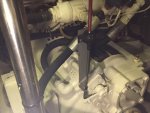
Just out of interest here’s where the EGT sensor is .
Its under the small intermediate connector between the turbo and E manifold .
You can just about see the wire on one pic .
It might be worth looking under that part for a blanking hole / access point ?
If so investigating ( suggest via MAN ) if you can retro fit the sensor .
4 needed for a pair of V8 .

582C0622-9E60-4137-9ADD-CBAA1A5C2297.jpeg
E627FFB7-DD4B-4CEA-B5AB-917D50DB8CA0.jpeg
Under that short intermediate sq section pipe that connects the manifold to the turbo .See the blue line .
 
It might be worth looking under that part for a blanking hole / access point ?
If so investigating ( suggest via MAN ) if you can retro fit the sensor .
4 needed for a pair of V8 .
No need to investigate a lot. I can confirm that in the V8/800 there's nowhere to attach an EGT probe in the pre-turbo section of the exhaust, also because it's completely jacketed for cooling.
But there is a place at the very beginning of the post-turbo section, right at the top of the flange where the exhaust pipe is bolted.

That's where also the MAN dealer that made the warranty activation checks should have attached his instruments for the first sea trial upon delivery.
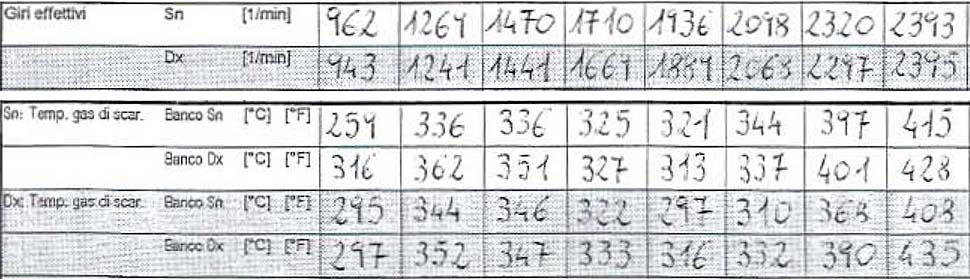
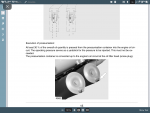
I believe I already posted the pic below, which shows a small abstract from the 8 pages of the MAN "Protocollo di messa in esercizio" (first start protocol) for my boat.
Unfortunately, some dealers had the habit of not handing it over to the first owner unless specifically requested.
But Chris (and anyone else of course) should be able to get it from a MAN official dealer, specifying the engines S/Ns.
They were in fact all archived by the IT distributor (Ranieri & Tonissi), and I believe also in Germany.

If Chris could manage to get this report for his P52, it would be interesting to compare the numbers, considering that the engines are the same but the type of boat and installation are radically different.
dOSp6bZL_o.jpg


PS: the first two rows show the actual RPM for port and stbd engine (white and grey respectively).
The following four rows show the EGT in C, measured for each cylinder bank and each engine.
 
Yes the whole exhaust is jacketed inc the E turbo .
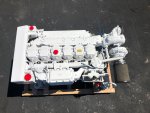
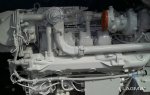
How ever here are some pics i think of the 800 Hp V8 , 14.6 L circa year 2001 .
The blue lines I have edited on .....wonder what they are ?
31F94477-6E9C-4D52-85C3-9EB3D00BEE6A.jpeg
9FE0E059-C57F-4FD7-A6C0-7749053E80E1.jpeg
 
Nice clean engine, PF. Rebuilt, surely?
The reason why I'm saying this is that one of your pics gives me the opportunity to show where exactly is the matchbox-like alarm sensor that I mentioned at point 2 of my post #82 - see circle in red below.
Trouble is, they sprayed in white also the specs plate bolted to it!
A minor sin if the rest of the job was well done of course, but something about which I would have complained a bit, anyway.

Back to your question, as I recall that cap is meant to drain completely the jacketed part of the exhaust manifold, but I'm not 100% positive about it.

1597084169731.png
 
I had good results with this .Lidl ( a German co remember ) is your friend .
I have not used it on the airside turbo in the pics above .Btw .
But I works fine in the CAC ....ie does not go yellow.
The CAC pipes that go from the airside turbo to the CAC do yellow a bit with OEM .
There OEM stuff is notoriously known to yellow off .

6E18D2EF-43CE-479C-9110-4684401AF37C.jpeg
D2A6201F-2253-4731-A3CA-52043EDCD264.jpeg
6118E3F4-FB1C-40B1-BADF-E905EB098321.jpeg
Here is an example of it , with a brush .....it’s got great anti rust properties.
 
glad you’re getting sorted.

That’s strange. Found them very good in the past. They are Borg Warner agents but I guess many places are so prices can’t be far apart. All they do is order from Borg Warner who ship direct (did with me anyway)

handy site though...gives all the references etc....
 
I had good results with this .Lidl ( a German co remember ) is your friend .
I have not used it on the airside turbo in the pics above .Btw .
But I works fine in the CAC ....ie does not go yellow.
The CAC pipes that go from the airside turbo to the CAC do yellow a bit with OEM .
There OEM stuff is notoriously known to yellow off .

View attachment 96492
View attachment 96493
View attachment 96495
Here is an example of it , with a brush .....it’s got great anti rust properties.
I can get some enamel paint mixed, just need a RAL number.
 
Once the new turbo is fitted I want to check there is oil to the bearing, is there an easy way of turning the engine over without starting, solenoid to the fuel pump or something like that.
 
Once the new turbo is fitted I want to check there is oil to the bearing, is there an easy way of turning the engine over without starting, solenoid to the fuel pump or something like that.
They approach it a different way .
They pressure up the system via a pressure bottle , or you could use the oil suck out pump .
It connects to that bolt on the filter housing .

You could do it now with the turbo off and watch for the oil as you apply pressure .Needs an adapter.Its a 14 mm bolt .

FF12FBFA-1365-4827-AF80-7F650A0295ED.png
failing finding a suitable adaptor ( plumbing section of DIY ) , as a good measure pour some oil in before you connect up the feed pipe .
Anyhow correct method is to pre prime through the oil filter canister .

The pic above is taken from a rebuild manual and refers to priming / checking the main crank bearings , so they want to v8sualky see oil dripping out from them ....hence they are priming with the sump pan off for that .

How ever pressuring it up will work for the turbo feed pipe before you re connect it .....which I think you are asking how to check ?

But even if you can not physically see oil spurting out of the feed pipe , a drop in the bearing should be ok because when you start it .....in the few seconds to build pressure , the turbo is only blowing in the wind so to speak , its not spinning up at 100000 rpm @1400 rpm upwards .

Even so I can see where your anxiety is coming from re oil supply .
 
Top