I need an idiots guide to using ....

peter2407

Well-Known Member
Joined
11 Sep 2008
Messages
1,064
Visit site
A voltmeter, multi purpose digital (cheap) job as I only use it for volts, not for all of its other capabilities, its Aameter, continuity, ohms but i dont really know how to use it.

One thing I would like specific help with is - how do Icheck that the shore powered charger (Sterling job that I just installed, well swapped really) is charging other than waiting an hour for the measured voltage to rise?

TIA
 
It's easy. Switch to the 20 volt DC scale, put the two probes where you want to measure the voltage +/- doesn't matter, it will just say - if they are the wrong way around.

Now you need to sit down and read a good book on electrikery to interpret what you find. That's the hard part. Sorry not to be more helpful!
 
To check that it's charging, select the DC Amp range and connect it between the charger and the disconnected battery positive. Be sure to select a high range, 10A at least. Sometimes there's a special probe socket for Amps, or high Amps. The specification of the charger should indicate the maximum current output. If it's greater than the meter range, then the internal fuse will likely blow, so make certain you have spares and you know how to change them. Use a digital meter unless you understand which way round to connect it. If you don't understand, it's probably best to pay somebody who does.
 
If you have a charger and want to know if it is charging I suggest that instead of trying to check it with a multi-meter, just install a voltmeter. The article here will show you how. http://sailing.about.com/od/equipmentgear/a/How-To-Install-A-Voltmeter-On-Your-Boat.htm

There are plenty on e-bay including waterproof ones, and one of these would probably be fine http://www.ebay.co.uk/itm/Latest-12...t=LH_DefaultDomain_3&var=&hash=item5b0a3416c3 If you don't want it on when you leave the boat just put a small switch into one of the wires, which simply go to the battery terminals.

EDIT. You could just put the negative connection to the battery and the positive to the main switch, but what you really want to measure is the actual battery voltage which will only be guaranteed to be accurate if you measure at the battery terminals.
 
Last edited:
The trouble with a voltmeter is that it doesn't show whether the battery is being charged, which I understood was the original question.

That's a fair point in that you wouldn't know how much current is passing to the battery. But I'd expect that if the battery reads, say, 12.6 volts with the charger off, this should increase to a reading of around 14 volts when the charger is on. Depending on the battery state and type of charger, it might be a slow rise.
Corrections from more savvy electrical experts welcomed!
 
A voltmeter, multi purpose digital (cheap) job as I only use it for volts, not for all of its other capabilities, its Aameter, continuity, ohms but i dont really know how to use it.

One thing I would like specific help with is - how do Icheck that the shore powered charger (Sterling job that I just installed, well swapped really) is charging other than waiting an hour for the measured voltage to rise?

TIA

SEE Tony Brooks' TB-Training website .. specifically the boat electrical notes.. http://www.tb-training.co.uk/

all basic stuff for the beginner
 
Last edited:
That's a fair point in that you wouldn't know how much current is passing to the battery. But I'd expect that if the battery reads, say, 12.6 volts with the charger off, this should increase to a reading of around 14 volts when the charger is on. Depending on the battery state and type of charger, it might be a slow rise.
Corrections from more savvy electrical experts welcomed!

It might show an imperceptibly slow rise, depending on several factors. The proper way to measure charging current is using an ammeter, which will always show the true rate of charge (or discharge).
 
Understanding how to use a multimeter is inherently about understanding electricity and your system. Just persevere ad keep asking questions and you will get on top of it or at least learn more about it all. good luck olewill
 
Yes, agree with others, plenty of good books and online help out there. Electricity not as scary as you think. If inexperienced I would try and avoid the current (amps) ranges. Even those of us who should know better sometimes take out fuses and do damage to meters using amps ranges. It is the only facility on a multimeter that you can inflect self harm relatively easily.
A simple voltage check across the battery terminals should, at least, give you a fairly reliable indication that the charger is at least connected and trying it's best. Ok no indication of actual charge rate but at least a simple go/no go test. Assuming it is the service (house, domestic, whatever your term for it) battery you are charging, switch on cabin lights, wait couple of minutes and switch on charger. Battery volts should show a small (1 volt at least) jump on the meter. The lights could also show a small, but marked, increase in brightness. This is a simple visual test I often use, it does not even require a voltmeter ! Have used it to simply check alternators on cars. Switch on headlights, watch beam on wall and then blip throttle. Should see increase in brightness. Probably a better test on slightly older cars - modern ones with better regulators maintain a steady output even at idle revs. But it is still a useful trick that works on boats.
Good luck, may the power of electricity be with you !
 
This technique depends on your wiring and the sensitivity of your multi-meter.
It's quick and easy to do.

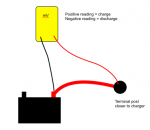
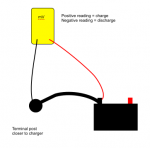
1. Select the most sensitive voltage range, probably mV.
2. Place negative meter probe on battery positive terminal.
3. Place positive meter probe at the other end of the charging cable (IE closer to the charger). This works best if there is a single wire leading from the battery.

A positive reading indicates charge.
A negative reading indicates discharge.
A bigger number indicates a bigger current.
You do not know what the actual current is, only it's direction, charge/discharge.
P.PNG

This works because you are using the battery cable (which has a small resistance) as a shunt.

It will also work on the negative side.

N.PNG

John
 
It might show an imperceptibly slow rise, depending on several factors. The proper way to measure charging current is using an ammeter, which will always show the true rate of charge (or discharge).
You should get an instant rise in battery voltage when you switch on the charger. ...typically from 12.7 to 14 volts or more. My Sadler has a built-in voltmeter which can be switched between the two batteries and I always check it immediately after starting the engine just to be sure that everything's OK.
 
....
View attachment 50293

This works because you are using the battery cable (which has a small resistance) as a shunt.

Clever - buy I fear MUCH too clever for most people on this site! Does the OP know what a shunt is?

Your diagram and description doesn't work on discharge, especially if the loads go down another cable which they should do.

Battery voltage is much easier. If the voltage is below 12.7v then it may be discharging, or not actually charging. If it is above 12.7 volts after at least a minute then it is charging. Some chargers, like external alternator regulators, have a built in 45 second delay before charging starts to allow the oil to get up to pressure.

I've long been an advocate of measuring voltage along a piece of wire or across a circuit breaker to find faults. 100 mV across a switch or breaker suggests a high resistance and dirty contacts. It should be less than 10 mV or 0.01v

As I said in an earlier post using a multimeter is easy, interpreting the results is a special skill.
 
Clever - buy I fear MUCH too clever for most people on this site! Does the OP know what a shunt is?

Your diagram and description doesn't work on discharge, especially if the loads go down another cable which they should do.

Battery voltage is much easier. If the voltage is below 12.7v then it may be discharging, or not actually charging. If it is above 12.7 volts after at least a minute then it is charging. Some chargers, like external alternator regulators, have a built in 45 second delay before charging starts to allow the oil to get up to pressure.

I've long been an advocate of measuring voltage along a piece of wire or across a circuit breaker to find faults. 100 mV across a switch or breaker suggests a high resistance and dirty contacts. It should be less than 10 mV or 0.01v

As I said in an earlier post using a multimeter is easy, interpreting the results is a special skill.

Thank you.

But I answered the OPs question, not the subsequent drift.

My instructions don't require any knowledge of electricity to determine if a charging current is flowing.
What could be simpler than applying the meter probes just long enough to take a reading on the meter?
No need to do anything other than hold the probes on for a few seconds.
No waiting for the battery terminal voltage to rise.
No need to clip the probes on while the charger is turned on to register the voltage rise.

I made reference to the charging cable to ensure charging current would be monitored. Many installations (including my own) have a single short cable from the battery post to a terminal post, it makes an ideal place to use this technique.

The OP doesn't need to know what a shunt is but might be interested.

John
 
I coiuld certainly write an idiot's guide. that is my speciallity.
BTW I bought an analogue multi-meter a few years ago instead of a digital one.
I had buyer regret after the purchase and thought I should have got the digital one. However, using the analogue one I find it not only gives a reading but also the movement of the needle and the position on the scale gives me more indication of what i want to know than a flickering display of figures.
 
bin the meter you have and go for a DC clamp meter on ebay or somewhere similar.......20-30 squids and its done!
 
Top