Hydraulic autopilot woes *Solved*

[3889]

...
Joined
26 May 2003
Messages
4,139
Visit site
Edit: Problem was clutch power line conductor at course computer not in the terminal so relying on casual contact for the last year. Glad it wasn't me who paid the professional a 4 figure installation fee. Thanks for responses and the lesson that all autopilots have a clutch somewhere.

My AP has stopped working. Pump operates but ram does not move. I had a similar problem when I first bought the boat last year but running the pump for 2 minutes cleared it and have done 500+ hours since without issues.
The problem arose overnight in a rolly anchorage where, though lashed, the wheel developed about 10 deg of constant movement. There are no oil leaks in the system. I've tried running AP opposite to full lock several times with no success. The noise level of the pump does vary quite a lot during this process, louder at the start of each cycle.
Any clues on what to try next?
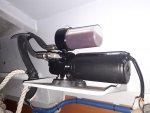
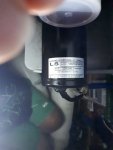
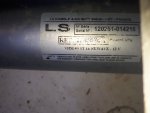
20210422_142457_copy_1152x864.jpg20210422_142339_copy_1152x1536_1.jpg20210423_121910_copy_1152x864.jpg
 
Last edited:
Sounds like there is air in the system between the ram and the pump, when you turn the wheel with the AP engaged you say there is some give. Can you see any returning bubbles into the reservoir? Disengage the AP and try starting the test with the wheel hard to stbd and to port and see if any fluid enters or leaves the reservoir. Can you hear the click of the clutch solenoid?
 
Sounds like there is air in the system between the ram and the pump, when you turn the wheel with the AP engaged you say there is some give. Can you see any returning bubbles into the reservoir? Disengage the AP and try starting the test with the wheel hard to stbd and to port and see if any fluid enters or leaves the reservoir. Can you hear the click of the clutch solenoid?
Enganging AP does not affect manual steering, I can still turn the wheel but the pump for the ram runs. I don't really understand the system very well. Must there be a clutch? I thought the ram moved in response to wheel input until the pump ran and took over.
 
Thanks for responses and the lesson that all autopilots have a clutch somewhere.

hm, new to me this clutch thing!
why, and what does it do?
unless you imply the fact that when a/p is not powered/in use, fluid wont go over one way or another, so that the helm movement makes the oil push the ram rather than go about inside the a/p pump doing bugger all

V.
 
The clutch, simply put, engages and disengages the AP.

Simple test, AP off, easy to turn wheel as clutch not engaged. Turn AP on, wheel should lock, clutch engaged.

Have you never heard a 'Solent Coastguard, Solent Coastguard, yacht Sunsail 45, we have siezed steering!'

The CG's reply is " Have you checked the AP is turned off........................!"
 
The clutch, simply put, engages and disengages the AP.

Simple test, AP off, easy to turn wheel as clutch not engaged. Turn AP on, wheel should lock, clutch engaged.

Have you never heard a 'Solent Coastguard, Solent Coastguard, yacht Sunsail 45, we have siezed steering!'

The CG's reply is " Have you checked the AP is turned off........................!"
OK, so you have a hydraulic a/p to ram living together with a chain/shaft/whatever steering.
Sorry, my f/b mobo has hydraulic steering all around and a/p on or of obvs has no effect on the rest of the steering.

often forget to turn on the vhf, but been 1200nm from the Solent, I doubt I'd get the comms :)

V.
 
OK, so you have a hydraulic a/p to ram living together with a chain/shaft/whatever steering.
Sorry, my f/b mobo has hydraulic steering all around and a/p on or of obvs has no effect on the rest of the steering.

often forget to turn on the vhf, but been 1200nm from the Solent, I doubt I'd get the comms :)

V.


How does that work then?

AP is off, you control the wheel. Your input turns the rudder/rudders.

AP is on, AP controls it, taking your input out. You cannot move the wheel as the clutch has engaged the AP and is holding the course set. Manual input is unable to overcome the ram pressure holding the preset course.

My yachts have had both hydraulic and linear ram Raymarine kit.

When the AP is on, you cant turn the wheel. It is under the control of the AP.
 
from my observations during the rebuilt:

think two pipes from f/b helm, moving down, teeing off to pick up the two pipes from the lower helm.
the two pipes continue to the ram moving the the rudder(s).
just before reaching the ram, two more tees to pick up the a/p pump hoses.

What to my understanding this does:
ANY device of the three can pump hydraulic fluid down the one or the other pipe.
Funny things happen if someone on upper helm turns to port and someone on the lower turns to stbrd: ram turns to the side that gets more fluid through :)
BTW, the recommended way of bleeding the system is to get the a/p to turn to port and you on lower helm turning to sbrd.
Forgot to mention there's a non pressurised hose as well doing the "return" from a/p to lower and then upper helm.

It seems that the main point is no device gives a path of least resistance to the hydraulic fluid:
Turning a wheel to port, fluid (pressurised) moves down the one hose towards the ram.
IF fluid can go through the a/p pump manifold and go up the other way towards the helm, you're doing nothing.
So my understanding is that a/p when off wont let fluid move through it, same as helm pumps.

Not so sure I grasp the concept of clutch in the yacht context. I assume it's something interal to the a/p pump (mine is a garmin 1.2ltperwhatever)

My experience on sailing yachts is rather small, I've only checked (for another reason) the steering assembly/ap on a 90s Bavaria 42 so things may be a bit different there.

cheers

V.
 
When your AP is 'on' does your wheel move?

Quite possible it does, but having no effect on steering - by a bypass in the hydraulic system.

I would be interested in a hydraulic flow diagram.

In a previous life I was heavily involved with old time torque converter automatic gearboxes, specialising in fault diagnosis and classroom instruction for technicians.
 
well, garmin also has a "shadow drive" which is basically a small pressure sensor put inline on one of the two pipes but closer to the helms rather than ram.
What that does is temp put the a/p in hold, giving control to the user when one of the two wheels is turned a bit.
Pretty sure with it disabled and a/p on, I could turn the either wheels and then a/p would react trying to revert to set course.

So to answer your Qs
yes wheels move
when they do the do have an effect on steering.

hydraulic dia is more or less what I typed above. Check diagram on p.6 below:
01337 LOW POWER COMMUNICATIONS TRANSMITTER User Manual USERS MANUAL Garmin

it's exactly what I have and same layout!

cheers

V.
 
Top