How to repair fibreglass/ gel coat

ClareSkea

New Member
Joined
15 Apr 2018
Messages
4
Visit site
Hello,

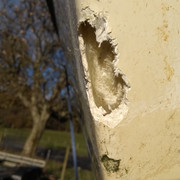
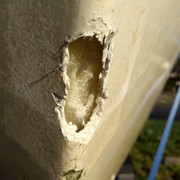
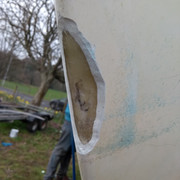
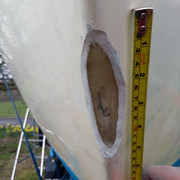
I'm looking for advice on how to repair this damage to the bow of my Prelude 19.
This injury happened when the anchor came loose and swung from it's chain while the boat was on the mooring. The first 3 photos are how the damage looked initially. The second 2 are how it looks now I've sanded it back with a dremel. It's not right through the fibreglass but its a fairly deep gouge. What would be the best way to repair this?

Thanks in advance.
 
Assuming this is not right next to a highly stressed area, e,g, where the foresta is attached.
I would get it dry.
abrade.
fill with a mix of resin and chopped up glass, to slightly below surface level.
fill to surface with gel coat , with wax added /topcoat then sand back to shape.
Then you are into restoring the surfce in the whole bow area, a lot of scratches to fil and/or polish out.
 
Epoxy would be much better, mixed with glass or kevlarr rovings chopped up with scissors. Also needs cleaned out a bit more as there is still a bit of dirt there. Would be a good idea to strengthen from behind too
You don't need gel as it doesn't stick to epoxy well., and try to get a good colour match. The gel does seem to be very thick there as it serves no purpose in strength
 
I think epoxy will be best as said. However it will need to kept warm while hardening or wait for a warm day. Polyester resin might be OK. Much cheaper and can be made to harden at lower temp with more hardener but may not adhere as well. Beware too much hardener will make resin go off with smoke and heat in the pot.
It looks to me like that is foam on the inside. This can be used as a back up so that resin and glass is laid onto the foam then built up to the ultimate outside profile. However much better if you can access the inside You lay up several layers of f/glass with resin so it attaches to good grp on inside over lapping the hole. You then lay more layers of glass in the hole. The next layers are added just as the inside layers go firm enough to support the next layers. This gives a chemical bond with the still hardening inside layers. You should chamfer the outside of the hole say 10mm larger than the hole so some layers of glass sit over the hole and extend over the sound grp but are still within the desired profile. Last layers will have a filler added like micro balloons.
The ideal is a layup of grp that is like a yoyo. ie a layer over lapping on inside, the actual hole filler then a layer on the outside so mechanically locked in the hole. Adhesion to the old grp then is a bonus.
Allow it all to harden then sand down to correct profile. Adding more resin and filler if needed. You could try getting a pigment to match the colour if you use polyester resin however if you use epoxy it must be painted over.
This job will take a full day of applying resin and glass. Waiting until it is firm enough to work on top of earlier layers. If you go to next layers too soon it will collapse into the boat. If you leave it too long it will not adhere to earlier layers. (as well as it should) So timing is every thing.
It may be worth trying some test/practice lay ups to get timing and application right first. good luck oloewill
 
Top