How to repair damaged toe rail (wood)

Phototropic

Member
Joined
28 Apr 2014
Messages
34
Visit site
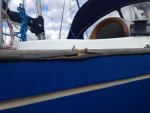
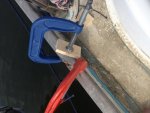
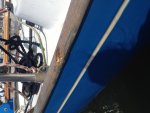
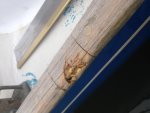
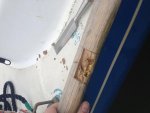
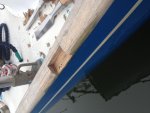
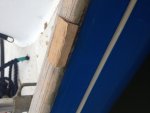
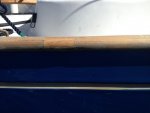
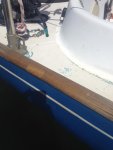
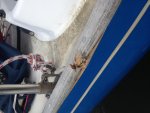
I am looking for advice on the best way to repair the damaged toe rail on my Contessa 26. The boat was out on a mooring in Chichester over winter and recently I noticed something has hit the toe rail, cant have been a big boat or hard as there is (fortunately!) no damage to the fibreglass hull rather the wood has been dented and split between two bolts. (See pics) What is the best way to repair?
1.jpg222.jpg3333.jpg


My first thought was to clean it up and tap it back together then seal the long split with glue and clamps (not sure which glue, I would use PVA on land but doubt its any good in marine environment) then spread over exterior wood filler and shape and sand when dry.
Any thoughts would be highly appreciated?

thanks
 
Proper way is to scarf in a new section of teak. There will be enough meat left after you have cut back to get a good thing surface for the glue. Easiest glue to use would-be a polyurethane such as Gorilla Glue.
 
I am looking for advice on the best way ...................
Any thoughts would be highly appreciated?

thanks

If it was just a case of gluing and cramping while the glue sets I would use an epoxy or the Original Gorilla glue ( not Gorilla wood glue, which is PVA).
 
Looks like you have been lucky, well not lucky exactly but you know what I mean.

The toerail is still in very good order but the thin part has split - it is shaped like a hockey stick and sits over the edge of the hull. I think your suggested plan is good but I think you ay have lost some splinters of material. In which case you need to glue in long "feathers" of teak made for the job; tackle the long thin splits first and you need clamps in the vertical as well as the horizontal in order to close it up. Open up the splits in order to get the glue right in there. You may want to take a chisel to the gap in order to make it more regular and suitable for your repair strips. The more wood on wood contact you have the better, it will be stronger and avoid think glue lines.
The repair strip will be sticking out by 1/4in or so for making good later.
It is not necessary to fill those long gaps in one go but you must clean out any glue residue, when wet, if you are going to have a second or third go.

Once the holes have been filled with your teak strips, and the glue has dried, you can plane the lot down and see what you have. Done carefully, pretty much all you should see is teak with minor glue lines. You will notice it but it will not be unsightly.

I have done a few small repairs (worse then yours) and they can look good and will last. On one I reconstructed it and then routed out an area for a long teak plug - but that was a desperation job.

Don't use anything as a filler except wood.

I normally use Cascamite for this sort of work, it's a resin you mix from a powder. Other stuff will do the job though.
 
Last edited:
Gorilla Glue is a polyurethane glue. When exposed to moisture, the adhesive reacts and creates a foaming action that fills whilst it sticks. Gorilla Glue has an open working time of 20 minutes. The glue is brown in colour, but dries a tan colour, and is totally waterproof. Gorilla Glue is incredibly strong, bonding all types of wood, including pressure treated wood. It also bonds stone, metal, ceramics, foam, glass, leather and more. Once dried the product is sandable, stainable, paintable and can also take a varnish. Due to its foaming action the glue gives greater coverage - up to 3 times the coverage of other glues. This glue is unaffected by extreme hot and cold and will not break down when exposed to rain and snow.
 
The polyurethane glues are very good on clean fresh planed timber and some come with speeds for going off, e.g. 5mins etc..

My son has used it in the stair making trade and as long as you have clean fresh timber, a good fit and no gaps its bonding is as good as most.

Gaps will be filled with the maturing process but in those gaps it will have nearly zero strength.

If you try clamping together in situ, then clean out loose splinters first.
You will obviously need to do a 'dry clamp' with no glue to see if it will come together and to see if any of the strained and flexed fibres are obstructing it from pulling back.
A very solid cross section of timber on top with as strong as you can manage to fit in the underside for clamping could be a challenge!

It depends on the value you put on your boat and if it is in generally good condition, it may pay to scarf a new piece of timber in there.

If the boat will generally look no worse off for an average diy job then to thoroughly dry the timber out, wash with acetone, dry again and pull it together with an epoxy could be a strong job and the epoxy filling the gaps would have some strength.

After curing it could then be sanded to finalise shape.

best of luck,
S.
 
The polyurethane glues are very good on clean fresh planed timber and some come with speeds for going off, e.g. 5mins etc..

My son has used it in the stair making trade and as long as you have clean fresh timber, a good fit and no gaps its bonding is as good as most.

Gaps will be filled with the maturing process but in those gaps it will have nearly zero strength.

If you try clamping together in situ, then clean out loose splinters first.
You will obviously need to do a 'dry clamp' with no glue to see if it will come together and to see if any of the strained and flexed fibres are obstructing it from pulling back.
A very solid cross section of timber on top with as strong as you can manage to fit in the underside for clamping could be a challenge!

It depends on the value you put on your boat and if it is in generally good condition, it may pay to scarf a new piece of timber in there.

If the boat will generally look no worse off for an average diy job then to thoroughly dry the timber out, wash with acetone, dry again and pull it together with an epoxy could be a strong job and the epoxy filling the gaps would have some strength.

After curing it could then be sanded to finalise shape.

best of luck,
S.
PVA or cascamite worked for me on stair making & much less messy PU is over rated
 
thanks for the responses everyone!
I think initially I will clean it up and try to pull together with clamps and see what I have, if it holds with gorilla glue I'll leave it as is and if not I will do a dovetailed scarf joint with a new section of teak...fortunately I have the tools for the job as a make traditional furniture with hand tools...but I'd rather not cut a whole section out if I can avoid it as it's more work and would be rather unsightly given the aged nature of my existing toe rail.will see how it goes in next few days!
 
Definitely use Gorrila glue, it does not matter if a bit damp, the instructions say to damp one side of the glue line - but make sure you get the correct grade. It's excellent, I've just repaired the gunwale on my tender, cut out the old rotten wood, spliced in a new piece, well clamped overnight and then profiled to suit and then coated with woodstain. You have to look hard to see the joins.
 
Be interesting to see some more pictures showing a step by step repair if you're up for it??

I will give it a go. Took some pics today as I used gorilla glue and clamped the long split back together. To get an aesthetically pleasing finish I'll need to sand it down and then problably splice in a small section to the top half of the rail to cover the impact dent. Pics to follow soon.
 
Well ive got it glued up in one peice and gave it a cursory sand -
photo 1 - Copy (4).jpgphoto 2 - Copy (4).jpg

next stage will be to cut out a section from the top and splice in a piece of teak between the cut out - im hoping I can cut a fillet out to the depth of damage and retain long grain wood underneath for strength of gluing.
 
Ok so I spliced in the new teak section as follows;
*Mark up the section to be cut out
*Cut shoulders with a fine saw (20tpi in this case)
photo 1.jpg
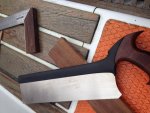
*Use a super sharp chisel to chop out from above and the side to form a square edge inside the recess. By not cutting right across the rail I retain 2 sides of long grain for gluing although this does make the cut out section more tricky.
photo 2.jpgphoto 3.jpgphoto 4.jpg
*Now measure exactly the recess you have and translate to your teak piece for sawing with suitable margins to be able to plane down the excess. The length of the piece is crucial to get to mm correct but a nice tight fit...the long grain sides will be proud but dont leave yourself to much timber to remove.
photo 5.jpg
*Finally check fit and trim as appropriate. A good fit needs light mallet taps to sit right. Now apply gorilla glue and leave to dry;
IMG_4182.jpg

Fun bit to follow when I get back onboard.
 
Yes thanks my tools are very well cared for and in the case of my chisels very expensive- main risk is not dropping them in the drink!

photo 1.jpgphoto 2.jpgphoto 3.jpg

Final stage was to plane flush, sand and finish with LeTonkinois natural oil/varnish. Only thing I couldnt do and didnt properly consider was the possibility of better aligning the grain. But I quite like the odd patch as it reminds me of a well completed repair.
 
Top