How to Hang a Stackpack?

Joined
20 Jun 2007
Messages
16,234
Location
Live in Kent, boat in Canary Islands
www.bavariayacht.info
I ... have a stackpack held up by lazyjacks...
The "Lazyjacks, stackpacks" thread in Scuttlebutt reminded me that I'm still trying to optimise the shape of the lazyjacks holding my stackpack. The topic came up in "Cruisers Forum" [sic] but I couldn't get a sensible answer: Done right, the shape is the same as the moon in [Crescent] phase. A concave arc from the 2/3 point of the boom, up to the lowest set of spreaders. Much like the shape formed by an anchor chain's catenary, when it's under no load...

I replied: I'm beginning to get the idea (although the crescent moon is a pair of arcs, whilst the chain is a parabola) but I don't get how to achieve it.

When I bought the boat, it had two lines from the spreaders which then split a number of times. One end of each split then went to the most forward available of the four attachment points, and the other end split again. There were no blocks or thimbles.

I simplified the above by keeping the original spreader lines, adding a thimble to each (although I see this as an ideal use for a low friction ring) and adding two lines to attachment points 1-4 and 2-3. I'm not happy with this arrangement, as the aft end of the stackpack sags to one side, but it did so with the original lazyjacks as well.
 
I benefit from a in-mast furling main (sneer ;)), but have played around on boats with the "spiderweb made by spider on LSD" type arrangement.

To keep the aft end of the pack erect, you need to have a) tension on the aftmost leg of the spiderweb and b) as large an angle to the boom as possible, meaning the line needs to exit the mast as far up as possible (but not so high it can catch a batten end).

You cannot achieve a crescent shape with the legs being able to slide, thus adding thimbles (or low-friction rings) were a mistake if that is your goal. To get that shape, the point where the lazyjacks split must be fixed, and set up so both legs are under sufficient tension when the whole thing is tensioned.

Here's an example which I've sailed on that worked fairly well (apart from crew disagreements about how to flake the thing, as this one has only lazyjacks without a stackpack). It has the arc you describe:

1b2ca4d6-2d93-4eee-af64-c6d470f4bbd9.jpg


If you squint a bit you can see the lazyjacks exit the mast way higher than the first spreader and the angle from there would be really quite bad. If you move the mast exit points further up, it will help a great deal with making the stackpack stay up (because too low an angle will just pull the aft eye of the pack forward instead of up).

Alternatively, if you want to keep your sliding (thimble) setup, you can forget about the arc and simply set it up so the aftmost lines all form a straight line from the rear stackpack eye to the mast exit point. This again in combination with moving the mast exit point further up. Looks much like this (the block/ring with a single line is a nice touch btw - found it on image search):

lazy3.jpg


Happy weaving :biggrin-new:
 
That is the conventional way to rig lazy jacks and mine are done that way but I have 2 extra pairs lines one at the aft end upto the A topping lift and at the fwd end of the boom up to a block on each side of the mast about a metre above the top of the stackpack.
 
I'm not fussed, I just want a system that supports the stackpack and doesn't get in the way of the battens.

On mine I connected a line through the lower rings on each side so that I can pull the lazy jacks towards the mast so I can raise the main without the battens catching on the lazy jacks.

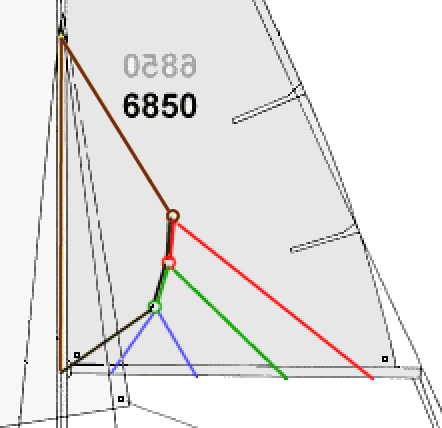
Another way to hang lazy jacks

lazyjack-1.gif
 
Last edited by a moderator:
nigelmercier;5741791I replied:[I said:
I'm beginning to get the idea (although the crescent moon is a pair of arcs, whilst the chain is a parabola) but I don't get how to achieve it.[/I]

An anchor chain is definitely a catenary, which is the curve followed when you have a uniform loading per unit arc length. To get a parabola you need to apply a uniform loading per unit span, as on a suspension bridge - assuming that the deck weighs a lot more than the cables.

That aside, I have endless fights with my lazyjacks, because the outer ends of the battens catch on them going up and the inner ends of the battens catch on them coming own. On that very limited evidence I would say that the optimum shape probably depends strongly on the size and position of the battens.
 
Top