
SeaAndSea
Well-Known Member
We need to lift or old teak deck, but once done what do we fill the hundreds of holes with? Is epoxy plus gel coat enough?


Epoxy will do ?We need to lift or old teak deck, but once done what do we fill the hundreds of holes with? Is epoxy plus gel coat enough?



Thanks for this. How deep did you take the countersink?I put a countersink drill bit on the end of my drill and opened the holes out.
Then poured Epoxy into the larger hole that the countersink bit had created.
I think, just trying to fill a small hole won't give the Epoxy a chance to plug any future water ingress.
I don't remember the Epoxy running through so my old screws holes probably didn't go all the way through.
I remember sanding them off after to get a nice smooth finish.
But I'm please that I spent the time filling them properly.
View attachment 141377
View attachment 141378

Don't be fooled.Educate me
What are the holes for. I thought the teak was just Sika‘ed (or similar) onto the GRP.
Educate me
What are the holes for. I thought the teak was just Sika‘ed (or similar) onto the GRP.
I suppose about 10mm to 12mm at the deck surface - tapering down to nothing.Thanks for this. How deep did you take the countersink?


Back in La Napoule the HQ for Sunseeker .Fr and many others inc Fairline a very new FL 48 towed up beside me in a rental berth .Educate me
What are the holes for. I thought the teak was just Sika‘ed (or similar) onto the GRP.
ThanksDon't be fooled.
The boat builders tend to screw down the bits that don't stick very well.
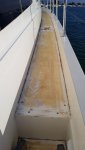
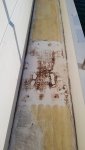
Here's an example (same on both sides) where the teak side decks where 2 factory panels didn't stick very well.
Water got underneath - hence the brown colour.
But you can also see where they had tried to screw them down as well.
I was shocked and pleased that I've now covered it all with plastic teak after repairing the screw holes.
More sanding was done after that pic.
View attachment 141409
Looks like a lovely job. Thanks for sharing the photos. I think our approach is going to be to remove a few (6?) planks at a time and then making good the holes .. of course we won't know if there's any surprises waiting for us till we get started. The reason for this approach is so we don't end up with hundreds of holes to fill in one go and then it's starts raining ...I suppose about 10mm to 12mm at the deck surface - tapering down to nothing.
It felt as though it was a good job - the epoxy set well and sanded back nicely.
EDIT - all covered up now - with plastic teak so very unlikely to leak anyway.
View attachment 141410
I wasn't aware of any leaks until I took the screws out.Looks like a lovely job. Thanks for sharing the photos. I think our approach is going to be to remove a few (6?) planks at a time and then making good the holes .. of course we won't know if there's any surprises waiting for us till we get started. The reason for this approach is so we don't end up with hundreds of holes to fill in one go and then it's starts raining ...
Can you see any issues with this cautious approach.
Cheers


Are you replacing or just repair.Looks like a lovely job. Thanks for sharing the photos. I think our approach is going to be to remove a few (6?) planks at a time and then making good the holes .. of course we won't know if there's any surprises waiting for us till we get started. The reason for this approach is so we don't end up with hundreds of holes to fill in one go and then it's starts raining ...
Can you see any issues with this cautious approach.
Cheers

Most probably there will be some rot in sections of the deck substrate material, plywood/foam combination, from water ingress through the screw holes (hopefully minimal of course), rectified by the top GRP layer cut away, replace core material, then re-attach the old GRP layer or build a new top layer.In the olden days, each teak plank had a screw into the grp every 18" or so. Our boat is from Taiwan from the late 80s
Right now i just want to get the old teak up and get the holes sealed. I appreciate i might need to replace some of the core if there are problems, but im hoping i can leave that till another day....o
Are you replacing or just repair.
Thanks for the tip. we've also watched a lot on good old YT - Sail Life goes into quite a bit of detail as does Andy on Boatworks. We need to learn this stuff and learn more about the boat.Most probably there will be some rot in sections of the deck substrate material, plywood/foam combination, from water ingress through the screw holes (hopefully minimal of course), rectified by the top GRP layer cut away, replace core material, then re-attach the old GRP layer or build a new top layer.

that's a lot of woodIf you are replacing the teak , this is how BruceK did it on is Formula , what could go wrong.View attachment 141864View attachment 141864
