How to empty holding tank - Fairline Phantom 50

chopperflyer

New Member
Joined
3 Nov 2015
Messages
9
Visit site
Hi folks, it's time to empty the black water holding tank on my Fairline Phantom 50. There's a pump-out facility at the marina and I have found my deck fitting. So far so good....

In the Phantom 50 owners handbook, it suggests that there is a selector lever which decides whether the contents of the tank travel to the deck fitting or get discharged to the sea. Despite all my best efforts lifting carpets and hatches, I can't find a selector lever for this anywhere.

Do any Fairline Phantom / Squadron / Targa owners know where this particular selector might be? Is the manual wrong (ie there is no selector)?

As it is right now, if I operate the black-water pump (without finding and switching the lever) then the holding tank will discharge to the sea. If I were to hook-up the vaccuum at the marina and suck from the deck-fitting, do you think that the tank will empty anyway? Or am I going to end-up damaging / collapsing my pipes?

Thanks in advance for any advice readers may have.
 
My understanding is that there should be a vent fitted to prevent pressure or vacuum in the holding tank.

Normally the discharge valve opens and closes the sea cock for the electric discharge pump. I would imagine it has an electrical switch to prevent the discharge pump operating when the sea cock is closed. There is probably a selector valve or a second discharge sea cock for your manual discharge pump.

When not in use any discharge sea cocks should be closed to prevent sea water entering the holding tank when traveling along. You also want to operate them regularly to prevent seizure.

Finally there will be diverter valves for each toilet to select whether the discharge into the holding tank or out to sea.

The electric discharge pump will have nothing to do with dock side holding tank emptying. This is done using vacuum not pressure. If you are going to empty the holding tank under pressure using the discharge pump on the marina pontoon I beg you to video it. Jimmy the builders scooter key incident will pale into insignificance.......

As for where all the valves are how old is your boat?

Henry :)

Edited to say it's been a while since Fairline ownership. I know the Princess system very well but from memory the principles are the same. I got to know the Targa 35 / 37 holding tank set up extremely well :)
 
Last edited:
I'd suggest having a look at the top of the black tank and figuring out where all the pipes go. All the fittings will be on the top of the tank, and you'll probably have an inlet for each head plus an overboard discharge which goes via a pump to a seacock, all probably very close to the tank, plus a pipe up to the deck fitting, and a pipe up to a breather skin fitting. At a guess then, five fittings in total.

Dockside pumpout is just a big hoover; as Henry says the selector lever you're referring to is more conventionally located in the output line of each head so you can route the black water to either the tank, or overboard. So to pumpout at the dock, just undo the deck fitting, insert the pumpout nozzle and away you go.
 
my guess and its only a guess is that you connect up the dockside fitting and then the vaccume pump on the dock will suck the contents of the tank out without the need to look for any other valves.
 
my guess and its only a guess is that you connect up the dockside fitting and then the vaccume pump on the dock will suck the contents of the tank out without the need to look for any other valves.

On my Ferretti the valve at the bottom outlet of the tank need to be closed when vacuuming through the deck fitting. Otherwise the content is only replaced by sea water. Leaving the valve open when wacuuming is a good way of flushing the black tank. On my Phantom 38 there was no need to close valve as it had an impeller pump macerator tha blocked this route when it was not running.
 
I would have thought that the best way to find the valve is first to locate the black water pump and then when you've found it trace the pipe back from there. To locate the pump, switch it on for a short time and follow the noise. Don't leave it running for more than a few seconds because running it dry won't do it any good. It could well be that the valve is already switched to pump discharge so have somebody look over the side when you are doing this to check for the tell tale brown stuff and odour. Because of this, probably best to do this exercise when the marina is quiet
 
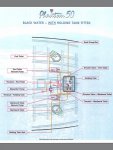
Hi all, thanks for the comments so far. To answer Henry's question, its a 2005 Mark II Phantom 50. The handbook schematic shows a vent and (as Jimmy suggests), with 5 fittings in total. Just need to check the top of the tank looks the same! Here's the schematic:
IMG_0412.jpg
So if I understand correctly, close the sea-discharge sea-cock (just for good measure) and just vacuum from the deck fitting. Is that right?
 
Yep, that schematic shows that the diverter valves are dealing with the output from each toilet, not the output from the tank.

Your understanding about the pumpout is correct. Personally I keep the holding tank seacock closed all the time except when emptying overboard.
 
Yep, that schematic shows that the diverter valves are dealing with the output from each toilet, not the output from the tank.
Yup, I misunderstood the original question because I thought the OP had a valve isolating the pump from the holding tank (as my boat has).

Not sure I agree with keeping the pump seacock closed all the time. IMHO if you have a fault with a toilet and flushing water leaks continuously into the holding tank or some idiot puts water into the holding tank deck fitting instead of the water tank one (happened to me once!) or your guests simply use the toilets too much, eventually you're going to get sewage coming up through the toilets:disgust: My boat has an auto pump function just for this purpose in that if the holding tank gets to a certain level, the pump will operate automatically, unless you have specifically disabled that function. I'd rather have sewage appearing at an embarassing moment from the side of my boat than have it coming up through the toilets;)
 
if [...] you have a fault with a toilet and [...] your guests simply use the toilets too much, eventually you're going to get sewage coming up through the toilets
I agree with all you're saying, but just in case you never noticed, I'm 99% sure that this can't happen in your boat.
Mind, I'm saying 99% because there's a slight chance that I'm confusing with another Ferretti I've been on (590), but even then, I can't see why the system should be different between two models of similar age, both equipped with Tecmas and the factory automatic/manual choice for emptying the holding tank.

Anyway, the point is that even if you leave the pump switch on manual, when the control light goes from orange (early warning) to red (tank full), you get a red light also on the WC control panels, and they don't work (i.e. flush) anymore.
Of course, some guests unaware of what that red light means could still dump whatever they please in the bowl, but in that case the stuff is going to stay there till the tank is emptied, the WC panel warning light returns green as normally is, and eventually the flush works again.
Admittedly, not a much better scenario... :ambivalence:
...but at least there's no chance of reverse sewage, as long as the system works as designed.

PS: still stuck at the yard ATM.
Just by coincidence, I tried the anchor winch and discovered that the thing, after 20 years of reliable service, decided to give up. Probably some broken gear inside, we'll see tomorrow after opening it.
Aaarumph!
 
Last edited:
Anyway, the point is that even if you leave the pump switch on manual, when the control light goes from orange (early warning) to red (tank full), you get a red light also on the WC control panels, and they don't work (i.e. flush) anymore.
Of course, some guests unaware of what that red light means could still dump whatever they please in the bowl, but in that case the stuff is going to stay there till the tank is emptied, the WC panel warning light returns green as normally is, and eventually the flush works again.

Yes you are right, my boat works like that too, but we have had one guest who upon seeing the red light tried to flush the toilet using water from the shower. Also its a system which is dependent on a float valve in the holding tank to ascertain the liquid level and one day that will stop working. I would still rather leave the seacock open:)


Just by coincidence, I tried the anchor winch and discovered that the thing, after 20 years of reliable service, decided to give up. Probably some broken gear inside, we'll see tomorrow after opening it.
Aaarumph!
Much better you find that out when Andrea is around than when you are trying to anchor in Guide with a boatload of guests! I trust and hope it is an easy fix
 
Yes you are right, my boat works like that too, but we have had one guest who upon seeing the red light tried to flush the toilet using water from the shower.
Haha, he/she was obviously unaware that the only possible result was filling the bowl...! :D :D

Much better you find that out when Andrea is around than when you are trying to anchor in Guide with a boatload of guests! I trust and hope it is an easy fix
Absolutely.
Fingers crossed for tomorrow, but should any hard to find part be necessary, I'm thinking to cross to CF anyway.
Since we are only staying for a few days this time, having no anchor ain't a big issue.
This way, the winch can be repaired with no hurry, and eventually reinstalled by the time we'll be back.
As an aside, sometimes in the past I wondered why some boats (albeit much bigger than mine) with pocket anchors have two winches, considering that a) one horizontal winch can easily handle two anchors independently, and b) even when deploying two anchors, the maneuver is always done one at a time.
Now I know the (actually rather obvious) answer to my own question... :ambivalence:

...with apologies to the OP for the O/T.
 
You don't want to have the holding tank discharge through hull fitting open all the time. Any failure in the pipe work and your boat sinks.

There should never be a time when the contents of the holding tank is automatically discharged overboard. Discharge is strictly regulated. And you need to be some distance offshore. If you emptied the contents of your tank into my marina you would be vacating your berth with immediate effect.

What this thread does highlight is the need for people to know where all the through hull fittings are on their boat and regularly operate them to ensure they are functioning and they seal / open as expected. If one seizes up then change it. To have it stuck in the open position is the very worst possible scenario. It means you boat may sink. If you can't show that you regularly check the fittings (the corrosion will be such that your claim of checking it a few weeks ago will be dismissed) then you might find the insurance company declines to pay out and you are left with a wet boat and a very expensive salvage bill.

So no, don't leave the holding tank discharge through deck fitting open all the time.

By the look of the schematic the holding tank through fitting on the Phantom 50 is in the centre of the boat between the 2 bathrooms under the forward of the 2 hatches. Pull the carpet up and have a look.

Henry :)
 
Last edited:
Mission accomplished - tank now empty! Thanks for everyone's advice. Biggest learn is that my owners handbook contains contradictions regarding the BW system. The schematic I posted is exactly what we've got on board. Previous page describes a selector valve downstream of the BW discharge pump which decides if the doo-do goes either to the deck or the thru-hull. But it's nonsense. Thanks again!
 
You don't want to have the holding tank discharge through hull fitting open all the time. Any failure in the pipe work and your boat sinks.
Well, that's true for just about any seacock.
Do you close/open all of them upon each and every departure/arrival, on your boat?
Mind, I'm not saying it isn't a good practice, but the reality of my experience is that I have yet to meet one single boater who does.
And needless to say, I also don't, fwiw...
 
Well, that's true for just about any seacock.
Do you close/open all of them upon each and every departure/arrival, on your boat?
Mind, I'm not saying it isn't a good practice, but the reality of my experience is that I have yet to meet one single boater who does.
And needless to say, I also don't, fwiw...

No I don't but I regularly check each and every one of them for free movement. I have a check list for the boat as part of our commercial operation which lists amongst other things all the through hull fittings.

In the case of rarely used fittings like the holding tank discharge they remain closed. Others remain open subject to time to next use of the boat in the knowledge they are operational and can be closed.

I think the key is regular checking. If someone doesn't know where seacocks are they won't be checking them !

As boats get older stuff gets fitted such as water makers, air con and stabilisers meaning the original schematics will be out dated. The easiest way to know where everything is is to look at the hull when she's out of the water having her annual clean and service.


Henry :)
 
Top