How much alternator capacity desirable for 210ah battery charging?

LittleSister

Well-Known Member
Joined
12 Nov 2007
Messages
20,379
Location
Me Norfolk/Suffolk border - Boat Deben & Southwold
Visit site
It is commonplace these days to 'upgrade' to larger capacity (or additional) alternators. I have an ancient low-output (can't remember offhand exact rating) Paris-Rhone type alternator on my Bukh, so have wondered about the how advantageous, if at all, that would be in real life.

My main query is in how much current would my domestic batteries - 2 x 10⁵a sealed lead-acid batteries in parallel - actually accept when charging?

I don't have a smart charger.

Obviously, I need to consider other demands there may be on the alternator at the same time, but they are generally modest and I have ratings for the various kit.

Thanks in anticipation.
 
Firstly, a higher-output alternator won't necessarily put any more current into your batteries. Batteries self-regulate the amount of current they can accept. I'd think your 2 x 10⁵Ah batteries might accept 30-40A when they're fairly discharged, dropping to just a few amps as they become more charged. So putting a bigger alternator on won't help much.

One thing which does affect charge is the actual voltage reaching the batteries. If you measure that when the engine's running and the batteries are well-charged, you should see 14.4v or more. If it's much less than this, an alternator booster (Sterling, Adverc, etc) might help; it will also compensate for voltage drop in the cables under high-current charging.

Larger battery banks accept charge more easily, so adding one or two extra batteries in parallel would help.
 
The current they will 'accept' depends on the voltage they 'see' and how flat they are.
Modern cars frequently put around 70A into a single battery for short periods, but they crank up the volts to do that.
Most boat installations will have some voltage drop when the current is high, so charge rates fall off quite quickly.
It's not desirable to charge at very high currents for a long time anyway, due to heat build up.
The main gain with a big alternator IMHO is to shove in a fair bit of charge in say 30 minutes motoring, when the battery is quite low. Then solar takes over when you're sailing.
We can put about 30A into a single battery for that 30 minutes if it starts of about 60% charged? But we are using about 14.8V at the battery.
Different makes and ages of battery will vary noticeably.
So reading the data sheet for your exact battery is a good start.

To get fully charged takes time, having high current at the start doesn't shorten the whole process all that much. If you want to do the whole thing on alternator, it still takes several hours and most of that time the current will be a lot lower.
 
The problems of charging lead batteries

however I would say that larger alt can maintain its output for longer. as they get hot they loose efficiently and therefore charging diminishes.

That said.

the cables are usually the biggest loss, I fit 35mm2 on most yacht installs I do at 12v and this usually suits the 70 odd amp alts quite well with minimal voltage loss.

There is a victron toolkit app that helps visualise cable losses quite well.

my dehler 34 came with an adverc charger, which someone had fitted, due to the woeful charging from the 55 amp alt. I doubt they were a happy customer as the domestics were connected with a 10mm2 cable and a voltage loss of nearly volt! - the adverc was also installed with the battery sense on the starter lug so doing very little to help!

cable change and walla much improved system (that actually charges!)
 
The problems of charging lead batteries

however I would say that larger alt can maintain its output for longer. as they get hot they loose efficiently and therefore charging diminishes.

That said.

the cables are usually the biggest loss, I fit 35mm2 on most yacht installs I do at 12v and this usually suits the 70 odd amp alts quite well with minimal voltage loss.

There is a victron toolkit app that helps visualise cable losses quite well.

my dehler 34 came with an adverc charger, which someone had fitted, due to the woeful charging from the 55 amp alt. I doubt they were a happy customer as the domestics were connected with a 10mm2 cable and a voltage loss of nearly volt! - the adverc was also installed with the battery sense on the starter lug so doing very little to help!

cable change and walla much improved system (that actually charges!)

I did an engine bay rewire on a large, twin engined, motor sailor a couple of years ago. She was fitted with 125 alternators and Balmar regulators, the Stb regulator was connected to the alternator, but no connections to the battery!! The owner insisted it must be connected, because the battery monitor showed it charging. The idiot who wired it all up had also connected the two engine batteries in parallel! It had been like it since the guy had bought the boat, 12 years previously o_O
 
I did an engine bay rewire on a large, twin engined, motor sailor a couple of years ago. She was fitted with 125 alternators and Balmar regulators, the Stb regulator was connected to the alternator, but no connections to the battery!! The owner insisted it must be connected, because the battery monitor showed it charging. The idiot who wired it all up had also connected the two engine batteries in parallel! It had been like it since the guy had bought the boat, 12 years previously o_O

Wow now that’s a bit special!
 
Be wary on a small engine such as a Bukh that a large alternator say 90a with increased output via some sort of smart charge controller, could take a substantial amount of the available engine power. Might be OK on a Bukh 20, but nothing more than 50 a output on a Bukh 10. The Bukh 10 I had on my Sabre in 1995 had an awful 35a Marshal brushless alternator, most of the time it barely put out even 20a.
 
Be wary on a small engine such as a Bukh that a large alternator say 90a with increased output via some sort of smart charge controller, could take a substantial amount of the available engine power. Might be OK on a Bukh 20, but nothing more than 50 a output on a Bukh 10. The Bukh 10 I had on my Sabre in 1995 had an awful 35a Marshal brushless alternator, most of the time it barely put out even 20a.
A smart charger should actually help.
A big alternator can actually prevent a small engine from starting, a smart charger should keep the load reasonable until the engine has reached idle speed.
A decent VSR should also have a small delay to allow the engine battery to take a lot of current for a few seconds before switching in the house batteries.
A decent alternator should give 50A when loading the engine with 1HP, and most engines do not need many RPM to give a couple of HP.
If pushing the limits, consider the belt/pulley ratios. 'Modern' alternators can put out a hefty charge, and hence load the engine a lot, when a car is ticking over. You don't want that load to kick in while the starter motor is still turning the engine.

Really modern car alternators get around all this with ECU control of the field current.
 
Thank you all for your replies. That's filled in some gaps in my knowledge, and confirms some of the related stuff that I thought I knew.

The engine's a Bukh 36 - somewhat oversized for the boat - so I shouldn't be short of wallop to drive a bigger alternator. TernVI's point about starting load noted.

The current (arf, arf!) alternator is a Paris Rhone/Marechal type. I've seen disobliging remarks about these, but I've never been clear why, apart from modest output, that should be. (They were fitted to Porsches at one time!)
 
'If pushing the limits, consider the belt/pulley ratios. 'Modern' alternators can put out a hefty charge, and hence load the engine a lot, when a car is ticking over. You don't want that load to kick in while the starter motor is still turning the engine. '

interesting point, my alternator is not producing many amps at low revs, as in when the engine is being started
what sort of 'modern' alternator would i need to reduce the stress on the starter ?
 
interesting point, my alternator is not producing many amps at low revs, as in when the engine is being started
what sort of 'modern' alternator would i need to reduce the stress on the starter ?

Typically, the alternator won't put any stress on the starter; the alternator needs to be spinning faster than starting speed before it begins to generate (and therefore to place a load on the engine).
 
....

interesting point, my alternator is not producing many amps at low revs, as in when the engine is being started
what sort of 'modern' alternator would i need to reduce the stress on the starter ?
The alternator is unlikely to directly load the starter unless extreme pulley ratios are used.
Most boats have fairly slow turning alternators, compared to cars, but some people have played with that to get more current at low engine RPM.
What is more likely to happen is the alternator kicks in while the engine is firing on one cyclinder at some speed between the 400rpm or so that the starter spins it and the 900 rpm or so of slow idle, this might knock it back down to the speed of the starter. Should not happen with an engine in perfect order of course.
I used to have lots of data on various Bosch alternators. Some will give over 80A at tickover and 130A at whatever a petrol Mondeo revs to (6500rpm?) but I don't recall how many rpm the alternator is doing. Some older style alternators will only do a few tens of amps at idle.
 
I used to have lots of data on various Bosch alternators. Some will give over 80A at tickover and 130A at whatever a petrol Mondeo revs to (6500rpm?) but I don't recall how many rpm the alternator is doing. Some older style alternators will only do a few tens of amps at idle.

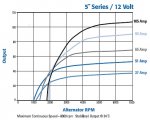
I fitted a Prestolite alternator on my last boat, as their alternators tend to have decent output at lower revs. Here's the output graph for their small-case alternators.

prestolite 8MR2069TA.jpeg
 
Thank you all for your replies. That's filled in some gaps in my knowledge, and confirms some of the related stuff that I thought I knew.

The engine's a Bukh 36 - somewhat oversized for the boat - so I shouldn't be short of wallop to drive a bigger alternator. TernVI's point about starting load noted.

The current (arf, arf!) alternator is a Paris Rhone/Marechal type. I've seen disobliging remarks about these, but I've never been clear why, apart from modest output, that should be. (They were fitted to Porsches at one time!)
Just to add my 2p - I had a Bukh 36 and added an Adverc, the small mod to the standard alternator and a diode splitter. The engine can easily take it and the smart regulation of the standard alternator transformed matters for the better. I think I had 3 x 110hrs and a separate engine start battery. No issue re starting load as the Adverc has soft start - in fact it is quite nice to start up and then, after a few minutes, you can hear the engine go under load as the charging proper starts. I had very good voltage and current monitoring but, in fact, you can hear it working
 
I just read quite a nice piece of sales pitch on the master volt website about their alpha pro regulators

they recommend 30 to 50% of battery capacity for the alt and I would agree that’s about right
 
My boat came with three 70 A/hr batteries and a 70 amp alternator, one of the batteries being the starter. I added a further service battery and the system works satisfactorily, though I have not actually tested it.
 
I just read quite a nice piece of sales pitch on the master volt website about their alpha pro regulators

they recommend 30 to 50% of battery capacity for the alt and I would agree that’s about right

On my last boat, I had 660Ah of domestic batteries and a 90A alternator. It all worked fine.

I'd have struggled to fit a 200-300A alternator!
 
If you have a 12v outlet in the cockpit ,could you back charge the batteries by plugging a solar panel in when engine off sailing ?

Yes, providing the panel is small enough not to need a controller, but such a panel would have a very minimal effect on charging.

If it does need a controller, that would have to be outside with the panel, in which case you'd be better off installing a dedicated socket for the panel, with the controller below decks.
 
Last edited:
Top