
How many Ah would you expect to get from a 400W solar bank?

Polly1

Well-Known Member
Joined
2 Nov 2009
Messages
110
Location
Singapore
Visit site
I ask as I am disappointed with my setup.
A 100W panel at 20V, which is what I measure in the sun, could give 5 Amps, 4 panels in parallel, 20 Amps. However they are connected to a 12V battery bank resisting the current flowing in, so not a short circuit condition. I assume the 100W refers to short circuit connection. I have an MPPT controller and 450 Ah of batteries
On the minus side the panels cant be tilted to follow the sun, there is some shading from the boom, which I lift out of the way with the topping lift in the marina and they were cheap from China.
Here they are
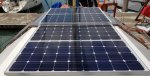
Capture.jpg
After watching them work I would say the top current is 10A with 5A being much more common and I struggle to get back from 35Ah below during a day. I live aboard, the fridge works quite hard and the average draw is about 70Ah in a day. It is strong sun on the equator but often overcast.
The only alteration I thought of was to wire them in series
I just wondered what sort of figures others were getting?
 
We have 340W of panels (4 x 85W) on a boat with modest consumption for a liveaboard: a large but well-insulated fridge, LED lighting, limited use of inverters. Boat is in the Aegean. Peak measured input is 25A at a nominal 12V and the batteries (440Ah of Trojans) are usually fully charged by early afternoon. (As indicated by battery monitor and, from time to time, confirmation by electrolyte readings).

They are wired in series giving a nominal 80V, although for shadowing reasons I have in mind to wire them 2 x 2 for 40V.

My first question to you would be the settings on the MPPT controller. Depending on your battery type it should be putting in at least 14.4V, perhaps 14.8V for efficient charging. Also, if the batteries are open, do they gas? (And, related to that, do they need topping up with water?) Do you have any means other than the battery monitor for assuming the 35Ah deficit you mention is accurate?
 
As Mac says, wire them in 2 pairs in series, so each pair is giving you 100w at 40v. If it's a Chinese MPPT controller, swap it out for a Victron.

Make sure you cables are big enough and keep the length of the runs down t a minimum (although the hgher voltage helps with this).
 
> they were cheap from China.

That's the problem. Talking to a solar panel fitter he said that they are cheaply made, produce low power and don't last long, he went to say the only ones to buy are German.
 
> they were cheap from China.

That's the problem. Talking to a solar panel fitter he said that they are cheaply made, produce low power and don't last long, he went to say the only ones to buy are German.

Are you Seajet in disguise?
 
Are you Seajet in disguise?

Would be great to put them both in the same room with a short list of subjects to discuss.

Interesting how one anecdotal comment from one unknown person suddenly becomes fact, but I guess xenophobia helps the process!
 
240W of panels give me 11A maximum. That's with optimum conditions - very thinly shaded sunshine at midday in UK. Typically 7A in average sunny conditions. Wired in parallel through BlueSky MPPT. German expensive panels.
 
My 400w rigid panels in parallel into a PWM controller produce around 14 amps in the right conditions. Shading has little effect, but angle does. Unfortunately I can't change the angle. These ones seem to be Chinese.

Likewise my two 110w semi rigid panels with an MPPT controller, are more effected by angles than shading. They produce between 5-8 amps. Again they can't be moved. Interestingly they yield the same amount regardless of whether in series or parallel. These ones are Italian.
 
And mine!

Ditto for 2x100W but other 2 are ex. UK stock.

The PVGIS utility (http://re.jrc.ec.europa.eu/pvgis/apps4/pvest.php) gives following average daily output for 400W flat on deck, unshaded, in Ionian area:

Month....Daily Ah
Jan...…….45
Feb...…….60
Mar...…….96
Apr...…….116
May...…….138
Jun...…….161
Jul...…….154
Aug...…….144
Sep...…….110
Oct...…….79
Nov...…….50
Dec...…….37

I'm getting around 140Ah/day from 345W which is pretty much what the utility gives. My setup isn't ideal (MPPT for 2x100W on arch & PWM for 2x40 + 1x65W under boom.

Unfortunately, the utility only has data for EU region, not for Singapore. Approx. 35Ah per day is certainly very low.
 
I think the OP needs to test each panel individually with a load. A 100 w panel should give around 20 v with no load and with an amp meter on amps get around 5 amps short circuit in full unshaded sun. Alternatively connect each panel directly to the batteries via an amp meter. You should get again around 5 amps straight in. (regardless of battery charge level.) Assuming all panels give results similar to above then problem must lie with the controller the batteries or the expectations. Essentially you would only expect full solar panel current if batteries are low so taking a lot of charge plus max possible load on the 12v system. ie fridge running water pump running lights on. Actual amp hours per day into the batteries might depend on charging voltage of the controller.
Re Chinese solar panels no problem that I am aware.
good luck olewill
 
Really useful replies, thanks!
My batteries are 2 new Trojans, and an identical older one, they are open and not bubbling much. The controller is a Victron 75/15 controller that doesn’t appear to have many settings. I haven’t thought of checking the battery monitor, it works off a shunt connected in the Earth return line.
It sounds like I need to do some investigating, which is what I needed to know
 
Really useful replies, thanks!
My batteries are 2 new Trojans, and an identical older one, they are open and not bubbling much. The controller is a Victron 75/15 controller that doesn’t appear to have many settings. I haven’t thought of checking the battery monitor, it works off a shunt connected in the Earth return line.
It sounds like I need to do some investigating, which is what I needed to know

The Victron controller has lots of settings and will give you a lot of information about what's going on with the panels, but you need to connect it to a Bluetooth device, using the Victron Bluetooth dongle, or to a PC with the Victron USB cable. IMO, the Victron controller should not be used without one or the other. If you fit one, you will be able to see what the panels are doing and what is actually getting to the batteries.

I would connect the panels as two pairs in series, connected in parallel. Try to make sure that each pair doesn't get shaded together. With the dongle, or cable, you can see the effect of any changes easily.

Also, what size cables are connecting the panels to the controller and controller to batteries ? How long are the cable runs ?

As most have said, your yield is very low. But it is also a very valid point that solar yield will vary with state of battery and level of load. I was looking at mine yesterday, for instance, the batteries were charged and the controller was in float mode, putting 0.8a into the batteries, but also matching the load. So if i turned things on and off the controller would increase or decrease the output to maintain the load, whilst still putting the same 0.8a into the batteries.
 
My batteries are 2 new Trojans, and an identical older one, they are open and not bubbling much.

You don't specifically state whether they ever need topping up, but they should. The amount of water needed by open Trojans obviously varies with depth of cycling and capacity of bank, but should probably be very roughly in the region of 0.5 to 1.0 litre per month. If it's not, your batteries may never reach full charge, which will not help their longevity. (Unless they're getting periodic full charges on shorepower.)

And +1 to Paul's comments, above. Additionally, given the very high ambient temperatures where you are, tailoring of charging is doubly important. (Conceivably a battery temperature probe deals with that automatically?)
 
Last edited:
Ditto for 2x100W but other 2 are ex. UK stock.

I'm getting around 140Ah/day from 345W which is pretty much what the utility gives. My setup isn't ideal (MPPT for 2x100W on arch & PWM for 2x40 + 1x65W under boom.

Unfortunately, the utility only has data for EU region, not for Singapore. Approx. 35Ah per day is certainly very low.

My Victron performance history does not record Ah per day but records 24 hour yield in watt-hrs. The maximum I have achieved since changing around my parallel/serial configuration for my 4 x 100W semi-flexible panels is 1300 Wh although that was in the Med in late September and the sun was getting lower.

I wonder what the relative advantages are between assessing performance in Ah or Wh. Unfortunately, the Victron software does not record peak current during each 24 hour period which is a pity, although it does show instantaneous amperage in the live display and I think I've seen close to 20A. Why doesn't the software record this I wonder?

Richard
 
My Victron performance history does not record Ah per day but records 24 hour yield in watt-hrs. The maximum I have achieved since changing around my parallel/serial configuration for my 4 x 100W semi-flexible panels is 1300 Wh although that was in the Med in late September and the sun was getting lower.

I wonder what the relative advantages are between assessing performance in Ah or Wh. Unfortunately, the Victron software does not record peak current during each 24 hour period which is a pity, although it does show instantaneous amperage in the live display and I think I've seen close to 20A. Why doesn't the software record this I wonder?

Richard

Richard, Wh divided by 12 gives you Ah (or close enough **). It can be handy to know the Ah yield, if you know your Ah usage from the battery monitor.

The Victron software is, IMO, essential, but it could do much more.

** The formula is : Ampere hour = Watt hour / Voltage. The voltage varies a little, but dividing by 12 is close enough for what we are discussing.
 
Last edited:
Top