

You are using an out of date browser. It may not display this or other websites correctly.
You should upgrade or use an alternative browser.
You should upgrade or use an alternative browser.
How long from Falmouth to Plymouth
- Thread starter jimi
- Start date
jimi
Well-Known Member
well that's b#ggered Metcheck's server then!

jhr
Well-Known Member
Looks like you'll have a cracking sail, though I'd rig a gybe preventer if I were you....
Last edited:

Lady Campanula
N/A
"Are we there yet...?"

Ex-SolentBoy
Well-Known Member
Sorry, I dont get it. Looks like a nice sail.


Twister_Ken
Well-Known Member
About 5 foot bugger all in your case Jimi!

lustyd
Well-Known Member
Looks like you'll have a cracking sail, though I'd rig a gybe preventer if I were you....
A Boom preventer does not prevent Gybes and is therefore not called a Gybe preventer. They are there mainly to stop the banging of the boom from the motion of the ocean and in no way help with accidental gybing.
The only time they actually do prevent Gybes will be when you're too close to the land and need to Gybe but can't because you tied the boom in place!
Cheers
Dave
jimi
Well-Known Member
Sorry all got caught at work
this was the reason for the post ;-)
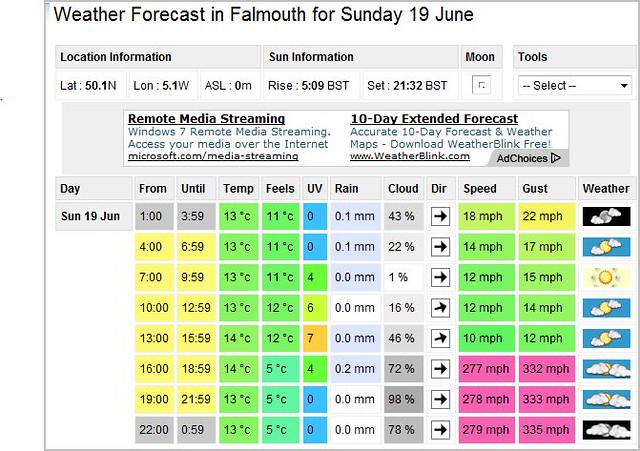
this was the reason for the post ;-)
jhr
Well-Known Member
A Boom preventer does not prevent Gybes and is therefore not called a Gybe preventer. They are there mainly to stop the banging of the boom from the motion of the ocean and in no way help with accidental gybing.
The only time they actually do prevent Gybes will be when you're too close to the land and need to Gybe but can't because you tied the boom in place!
Cheers
Dave
OK; fair point.
However, I'd still want to rig a preventer to try and reduce the impact of a 300 knot breeze from astern bringing the boom into contact with my head as the result of an accidental gybe...

lustyd
Well-Known Member
OK; fair point.
However, I'd still want to rig a preventer to try and reduce the impact of a 300 knot breeze from astern bringing the boom into contact with my head as the result of an accidental gybe...
Quite right too. I just posted because lots of people read these forums who don't know the difference so it's important sometimes to be pedantic if it's going to help someone be safer

jhr
Well-Known Member

bbg
Well-Known Member
IMHO - a preventer can and will prevent the main from gybing in a lot of conditions. It will keep the boom outboard. Prevent it from swinging towards the centerline. It is often (always?) the case that a boom on or near the centerline will gybe before one that is all the way outboard. That is, you have to turn farther through the wind to get the outboard boom to gybe.A Boom preventer does not prevent Gybes and is therefore not called a Gybe preventer. They are there mainly to stop the banging of the boom from the motion of the ocean and in no way help with accidental gybing.
The only time they actually do prevent Gybes will be when you're too close to the land and need to Gybe but can't because you tied the boom in place!
Cheers
Dave
In marginal conditions keeping the boom outboard will prevent it from gybing. If it were allowed to flop in, the different angle of attack - together with the momentum of the boom - will permit it to gybe.
Why not call it a gybe preventer?
jimi
Well-Known Member
In marginal conditions keeping the boom outboard will prevent it from gybing.
Crikey, if you call 300 knots of wind marginal, what conditions do you normally sail in!
bbg
Well-Known Member
Crikey, if you call 300 knots of wind marginal, what conditions do you normally sail in!
Faster, faster, 'til the thrill of speed overcomes the fear of death!
lustyd
Well-Known Member
Why not call it a gybe preventer?
As I've already said, because it doesn't prevent a gybe and lots of new sailors read these forums. I personally would rig one to stop the banging and the boom movement but the only thing that will prevent a gype is not turning the boat and making sure you keep the wind in the right place.
It's dangerous to suggest that a piece of rope will make being on a run safe - it won't. A new sailor might feel more comfortable with the preventer rigged but if and when they do gybe, that piece of rope will stop them sorting out the resulting mess quickly. I'm just saying be careful who the audience is when giving out advice like that.
jimi
Well-Known Member
Couple of things:
1) I see you sail a 20' boat , a gybe on that is a different kettle of fish on a 35' boat
2) A gybe preventer will prevent a gybe if rigged properly, and if led back to the cockpit can be easily released.
3) You can sail backwards with a gybe preventer and genoa poled out properly.
1) I see you sail a 20' boat , a gybe on that is a different kettle of fish on a 35' boat
2) A gybe preventer will prevent a gybe if rigged properly, and if led back to the cockpit can be easily released.
3) You can sail backwards with a gybe preventer and genoa poled out properly.
lustyd
Well-Known Member
Couple of things:
1) I see you sail a 20' boat , a gybe on that is a different kettle of fish on a 35' boat
2) A gybe preventer will prevent a gybe if rigged properly, and if led back to the cockpit can be easily released.
3) You can sail backwards with a gybe preventer and genoa poled out properly.
1) Incorrect, I OWN a 20' boat. I sail boats of all shapes and sizes - if you read more of my posts you'll see that. I have gybed a 40' racing yacht with running backstays which had to be swapped during the gybe, trust me I know how to gybe and it's consequences.
2) A preventer will not prevent a gybe EVER. It will calm the boom at most.
3) I'm sure you could but not in a F7 with a rolling sea.
4) you're STILL missing my point that new sailors will read this and they will assume (until they read my rantings) that you know what you're talking about and therefore tying a rope from boom to bow will protect them from gybing. Please feel free to keep suggesting this is the case, but bear in mind that people could get hurt with this bad information.
robp
Well-Known Member
Anyway, you had better do it at 1600hrs because the wind increases at 2200...
jimi
Well-Known Member
2) A preventer will not prevent a gybe EVER. It will calm the boom at most.
4) you're STILL missing my point that new sailors will read this and they will assume (until they read my rantings) that you know what you're talking about and therefore tying a rope from boom to bow will protect them from gybing. Please feel free to keep suggesting this is the case, but bear in mind that people could get hurt with this bad information.
Beg to differ on 2) and on 4) if all our posts should be tailored to new sailors and geared up to preventing them hurting themselves , then this will become a very quiet forum indeed.
It is intended as a vehicle to exchange information and views not for the self appointed to lecture others on what they should or should'nt be saying (touch of hubris there ..)
BTW tying a rope from boom to bow is not how I'd rig a gybe preventer , I'd rig it end of boom through bow cleat or similar and then back to a sheet winch, I then grind it in hard and in opposition to the mainsheet the boom ain't going anywhere until I release it off the sheet winch. Why don't you try that method yourself sometime?
Twister_Ken
Well-Known Member
BTW tying a rope from boom to bow is not how I'd rig a gybe preventer , I'd rig it end of boom through bow cleat or similar and then back to a sheet winch, I then grind it in hard and in opposition to the mainsheet the boom ain't going anywhere until I release it off the sheet winch. Why don't you try that method yourself sometime?
Did that once. It's a very easy way to split a mainsail!
