How do I remove these? Cap shroud mast-fixings

Robert Wilson

Well-Known Member
Joined
23 May 2012
Messages
8,053
Location
Second Coast, Ross-shire, overlooking Gruinard Bay
Visit site
DSC_0637_zpssu7zswqk.jpg


DSC_0639_zps9pqi7dbp.jpg


DSC_0638_zpslonqqii3.jpg


The wire main halyard has worn through the pin&sleeve of my cap-shroud fixings, so that it and my other rope halyards are catching and jamming.
I have removed the pin, but how do I remove these fittings so that I can replace the sleeve?
The sleeve seems to be either an integral part of the external fittings, or is somehow slotted into the two s/s "washers".

All advice gratefully received.
 
Last edited:
My guess is that the sleeve is in 2 halves held together by the pin you have taken out.
It may be corroded into the ally mast.
Try hammering a wedge between the plate and the tang, that may shift it.

Plank
 
Sailspar can supply external tangs however if you grind off you may find you just need a new compession tube and a long bolt to hold it all together, the compression tube stops you crushing the mast, looks like the tang plates are fitted with 1/4 rivets, you will need a good rivet gun to fit them back on, possibly an old S&S mast (Since long gone!).
 
I can't make out what this part is meant to do as mine are very different. It looks like the wire rope has an eyelet which fits between the two plates and has a clevis pin to hold it. If you need to take off the whole fitting it looks to me like you just drill off the pop rivet heads and punch the rest into the mast, where they will fall out of the bottom. It may be useful to tap out the mandrel ( centre part of rivet, made of steel) before drilling. I would be tempted to use Monel rivets when you replace the fitting.
 
Mostly it's that I don't understand the question :)

Which "pin" and "sleeve" are you talking about, and what does any of it have to do with halyards?

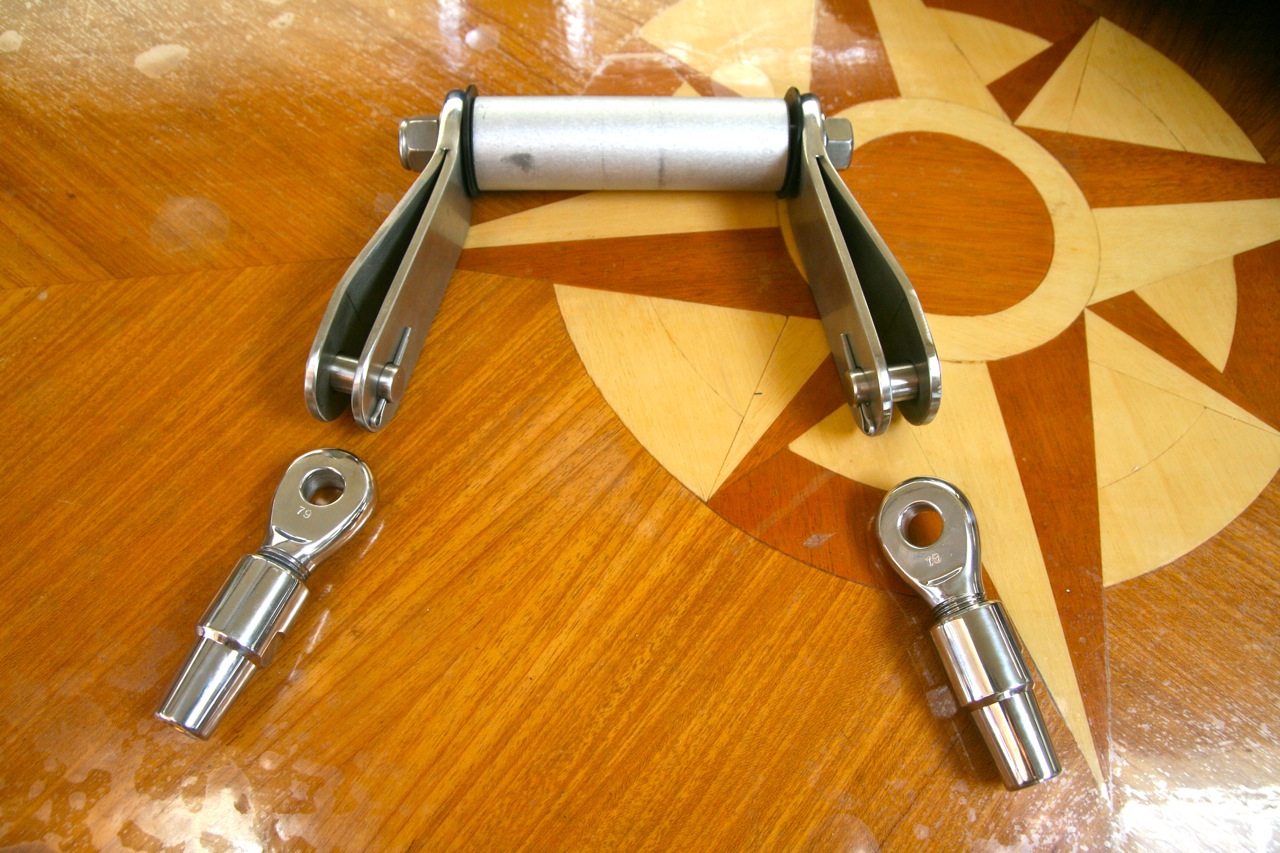
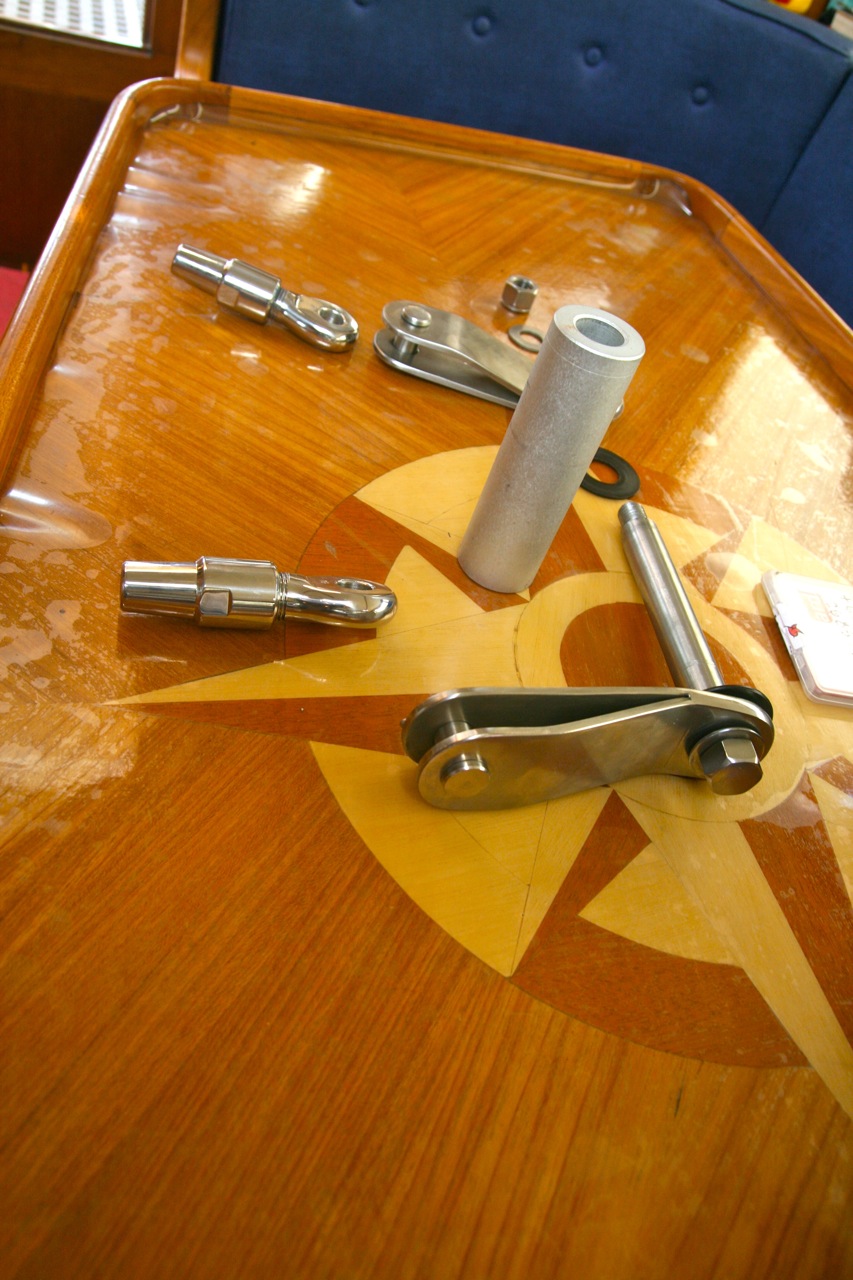
The external tangs have a compression tube between them, and are then retained by a long bolt through the mast (the compression tube stops the mast being crushed). From what the OP says, the wire halyard inside the mast has damaged the compression tube, making it rough, thus leading to subsequent damage to halyards inside the mast. There's a similar arrangement shown in these pics...

new-tangs-and-eye-toggle-complete-set.jpg


second-detail-of-new-tang-pieces.jpg
 
I would remove the rivets and see if the thing lifts out before drilling the stainless bit. It is probably not necessary to drill that part. It was probably a complete assembly slotted in mechanically, possibly in a shaped hole before being riveted.
Phil
 
I would remove the rivets and see if the thing lifts out before drilling the stainless bit. It is probably not necessary to drill that part. It was probably a complete assembly slotted in mechanically, possibly in a shaped hole before being riveted.
Phil

Is there any rotational movement ? If not then it may be that the tangs are heavily swaged to the centre boss and removing the rivets should allow the whole plate to be lifted away. It looks a bit like a cycle crank arrangement and its difficult to imagine how it could be assembled otherwise.

The rivets look easy.
 
Last edited:
From what the OP says, the wire halyard inside the mast has damaged the compression tube, making it rough, thus leading to subsequent damage to halyards inside the mast.

Ah ha! Thanks.

I knew about the various parts of the assembly, but I hadn't twigged that he was talking about damage inside the mast :)

Pete
 
Looks a different system to the one in PVBs photos: as far as I can see the sleeve comes right through the fitting unlike PVBs where the sleeve butts up against the inside face of the fitting. Is it possible to tap it out? It must be possible to release it some way. If it cant be knocked out, drill out the rivets one side and see if its possible to lift the plate and tangs off the sleeve. If so it should then be possible to release the fitting the opposite side and draw the assembly out of the mast. In theory the damage should have reduced the diameter so it should be reasonaby easy to draw it out of the mast.
 
The external tangs have a compression tube between them, and are then retained by a long bolt through the mast (the compression tube stops the mast being crushed). From what the OP says, the wire halyard inside the mast has damaged the compression tube, making it rough, thus leading to subsequent damage to halyards inside the mast. There's a similar arrangement shown in these pics...

new-tangs-and-eye-toggle-complete-set.jpg


second-detail-of-new-tang-pieces.jpg
I reckon that's exactly what is going on inside the mast, only the compression tube/sleeve looks a little less in diameter.
Both the tube (sorry, not a sleeve) and the bar/pin are gouged through by the wire halyard. These gouges are catching on the rope halyards (jib, spinnaker, etc)

Sorry not to respond to all replies, thank you all, but it appears this tube/sleeve needs to be punched out, somehow.
There is no rotational movement, everything is solid, which probably due to corrosion.

If all else fails, it's grind off and replace - if I can first find replacements!!

Thank you all.
Robert
 
It looks to me like the compression tube is also the equivalent of the bolt right through. I would not rush to drill out the rivets rather I would take to the end of the tube on one side or even both sides so that the tang comes off. Then look at bashing the tube out. However it may have a step in its diameter such that the plate on one side at least must be removed. ie the tube is bigger than the hole in the plate. It this is the case then you will need to find some tube ali or SS tha tis the correct size in diameter and cut it to precisely the length from inside one plate to inside the other. Tyen I would suggest a long bolt or thread each end rod to bolt the tangs on tot he plates again.
Actually I am not so convinced of the need for compression tube. Using a bolt onto plates on the ali as you have increases the surface area of the bolt load onto the ali mast (so onto SS) and nyloc nuts will stay tight without huge compression on the mast.
My mast on 21fter has a SS wrap around fitting rivetted on, that includes a forestay attachment. thus your 2 plates become one wrap around in mine. It then just has a long bolt about 8mm I think. No concerns when dismantled 3 times for mast replacement over 35 years. good luck olewill
 
Olewill, thanks for your advice. I was surprised when I looked inside the mast (with a borescope) to see the damage done to the sleeve by the wire halyard - lesson to all you others who have wire halyards, "All may not be well in there" - but due to corrosion a simple job of removing will now be a sod of a task. It pays to dismantle such items from time to time and not leave them for thirty or so years:(

I'll have to try to see how the sleeve is fitted into the external fittings, but I reckon it will have to be a grind-off. I may be lucky with punching out but that will probably cause "collateral damage" and result in replacement anyway.

I'm not doing anything until I'm sure I can replace the whole assembly!

At least I now know what has been causing the jamming and chaffing of my main-halyard and topping lift!
 
Olewill, thanks for your advice. I was surprised when I looked inside the mast (with a borescope) to see the damage done to the sleeve by the wire halyard - lesson to all you others who have wire halyards, "All may not be well in there" - but due to corrosion a simple job of removing will now be a sod of a task. It pays to dismantle such items from time to time and not leave them for thirty or so years:(

It occurs to me that your wire main halyard may have been routed the wrong side of the tube.
 
Now that's something I hadn't thought of.
If that is correct, it may have been my fault when I replaced the halyards three years ago, but to be fair, the damage to the sleeve looks like it's been going on for a long time, there are even gouges in the s/s pin too.
I used messenger lines to to re-reeve, so I have a possible "get out" :(

The chaffing of halyards has been going on since I bought the boat in 2010, so it's possible some long-ago re-reeving has been the fault.
 
Top