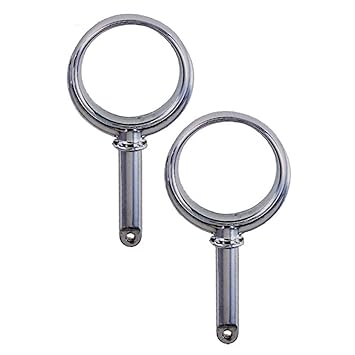
How can I secure my rowlocks?

Burnham Bob

Well-Known Member
Joined
18 Jul 2009
Messages
1,803
Location
Burnham on Crouch
Visit site
I leave my rigid dinghy on the rack at the boatyard. Last season some scrote pinched one of the rowlocks. I managed to find an old one but is there a way to secure them? Only solution I can think of that's really secure is a split pin through the hole and epoxy over the end of the pin to create a bulge big enough to stop the rowlock coming through the socket but that seems a bit extreme. Taking them off is nt really an option - I'd probably leave them at home and there is no secure storage at the yard.
 
In the shaft of the crutch theirs a hole a length of 2mm 7x7 through the hole and crimped together padlock the two crutches together

John
 
I leave my rigid dinghy on the rack at the boatyard. Last season some scrote pinched one of the rowlocks. I managed to find an old one but is there a way to secure them? Only solution I can think of that's really secure is a split pin through the hole and epoxy over the end of the pin to create a bulge big enough to stop the rowlock coming through the socket but that seems a bit extreme. Taking them off is nt really an option - I'd probably leave them at home and there is no secure storage at the yard.

I always tie mine to the oars . If I've left the rowlocks at home I've left the oars there too so don't need them.
 
Maybe just keep the rowlocks in your car's glovebox?

Or I suppose you could always fit drop rowlocks. They could still be unscrewed, but it would take a thief a bit of time.

rowlocks-drop.jpg

Or try to find some vandal-proof-head screws for them, to make it even harder. But I'm always a bit chary of presenting vandals with a challenge -- they tend to want to pick up any gauntlet you throw down.

I think on balance Vic's answer is probably the right one.

Mike
 
A jamming cleat attached to a wooden block beneath the hole: a short length of rope, thin enough to go twice through the hole (or, better, drill another hole a couple of inches away) knot one end, other end back through the hole to the jamming cleat, oar in the loop. Put the oar through the loop, tighten the rope in the janmmer, start rowing. Rope diameter may need experimenting for best results.
Not as efficient as a rowlock, so not so good if you have a long way to row, but little to lose. We have used this system for 10+ years after having rowlocks "disappear".
or; thole pins- if you can fit them?
 
I usually put them in my jacket pocket along with the boat keys. But I have also considered putting a couple of clips under the thwart and storing them there - not technically secure but out of sight...
 
In the shaft of the crutch theirs a hole a length of 2mm 7x7 through the hole and crimped together padlock the two crutches together

John
Crimp the other end of the wire around something glassed into the dinghy.
Have the wire long enough you can flick the rowlock out of its socket into the dinghy when coming alongside your yacht.

It helps to have rowlocks that are incompatible with everyone else's dinghy....
 
Maybe just keep the rowlocks in your car's glovebox?

Or I suppose you could always fit drop rowlocks. They could still be unscrewed, but it would take a thief a bit of time.
rowlocks-drop.jpg

Or try to find some vandal-proof-head screws for them, to make it even harder. But I'm always a bit chary of presenting vandals with a challenge -- they tend to want to pick up any gauntlet you throw down.

I think on balance Vic's answer is probably the right one.

Mike

Not if you use security screws so a special tool is required for removing them
 
Not if you use security screws so a special tool is required for removing them

Well, that's what I said, more or less --

... try to find some vandal-proof-head screws for them....


The other thing I could have added is, if you eye-splice a lanyard around the collar immediately below the horns with a long enough lanyard, you can use it not only to tie off to the rising (or around a thwart) while rowing so you don't lose it overboard accidentally, you can also use it to tie the rowlock to the oar when removing both from the boat.

web14.jpg

... specially important with those circular rowlocks in Post #11 in action, as they can jump out of their sockets without a moment's notice if they're not tied down.

(And don't be fooled into thinking you can use that hole drilled in the bottom of the rowlock's shaft for anything. That serves no useful purpose whatever -- it's there purely for decoration.)

Mike
 
Last edited:
(And don't be fooled into thinking you can use that hole drilled in the bottom of the rowlock's shaft for anything. That serves no useful purpose whatever -- it's there purely for decoration.)

I find them useful to secure them to the boat when underway - same function as your cord tied round the collar, but somehow neater in my eyes. A short length of thin cord has a stopper knot in one end, and passes through the hole in the bottom of the rowlock shaft, it then goes though a hole in a length of dowel about 6" long and thin enough to pass through the hole the rowlock sits in (the correct terminology escapes me for a moment) and has another stopper knot on the other end. The dowel is pared down on one side (can be from the hole to one or both ends), so both the dowel and cord can pass through the hole. The dowel is passed down through the hole and drops down below when the rowlock itself is inserted in it. The rowlock is captive, so won't be lost over the side, but can be lifted and left dangling on the cord if,say, coming alongside, but is ready to be reinserted at a moment notice. To remove the rowlock from the boat, the dowel just has to be lined up to pass upwards again through the hole.

It has taken me longer to describe than it would take to make one up!
 
Oh yes, you could certainly do that. I tried something similar once, many years ago, but I gave it up in short order as being far too fiddly.

Our rowlocks come without the hole nowadays, as I think the foundry and I share the same thoughts about it --

rowlocks-plain.jpg


If you're buying new rowlocks nowadays by the way (of whatever sort), make sure they have that collar below the horns -- not only to fasten a lanyard to should you want to, but also to provide a good bearing surface on the mounting-plate. (I've seen rowlocks without them, so I know they're around.)

Mike
 
Top