How big is a Number 3 Genoa ?

BlueSkyNick

Well-Known Member
Joined
29 Apr 2003
Messages
11,766
Location
Near a marina, sailing club and pub
Visit site
Not for any particular boat's dimensions, but in proportion to I, J and forestay length ?

Is it the same as a yankee with a high clew ?

I have often yearned for a smaller headsail I can hank on to a temporary inner forestay, rather than a heavily furled overlapping genoa (which is 120%). The late Tome swore by his set up when the wind was up to F5/6 or more.
 
Not for any particular boat's dimensions, but in proportion to I, J and forestay length ?

Is it the same as a yankee with a high clew ?

I have often yearned for a smaller headsail I can hank on to a temporary inner forestay, rather than a heavily furled overlapping genoa (which is 120%). The late Tome swore by his set up when the wind was up to F5/6 or more.
Sounds like you want a Solent jib
 
My No 3 is about 90% full height, set inboard of genoa, on its own track. The sheeting angle is 7.5 degrees. It's excellent up wind. When the wind over the deck is more than 30/ 33 knots, I have thought it a bit big, and may have a reef added as its easier to reef it than set the storm jib, which is nor good for beating anyway. It's the same area as the working jib on the sail plan but the working jib is high cut.
 
How long is a piece of string? Depends on the boat. On some boats with non-overlapping jibs, the 1,2 and 3 are all the same size.
E.g. Farr 40

No 1:
resizeImage.aspx


No 2.
resizeImage.aspx


No 3.
resizeImage.aspx
 
Not for any particular boat's dimensions, but in proportion to I, J and forestay length ?

Is it the same as a yankee with a high clew ?

I have often yearned for a smaller headsail I can hank on to a temporary inner forestay, rather than a heavily furled overlapping genoa (which is 120%). The late Tome swore by his set up when the wind was up to F5/6 or more.

I don't believe there's a hard and fast rule although I'd generally expect it to be a jib rather than a genny. Prob just under 100%. We race with a light no.1, a heavy no. 1, a no.3, a no.4 & a storm jib. Both no.3 and no.4 come down to the deck although the latter has a short foot. The storm jib is a yankee cut, mainly because we couldn't get the cars any further forward for it to be otherwise.
 
Ours is 100% and has some pretty serious battens. We use it from around 12 knots true and start reefing the main at around 20. Our #1 is 150ish% and strictly for the light stuff. The boat is only small so we haven't bothered with a #2 so far.
 
These days I would say a number 3 is full length luff - or close to it - and about 100-110%.

That said I am not entirely sure what the difference is between a #3 Genoa and a working jib :)
 
These days I would say a number 3 is full length luff - or close to it - and about 100-110%.

That said I am not entirely sure what the difference is between a #3 Genoa and a working jib :)

Well, this is how I understand it. The No3 Genoa will have a foot cut quite close/sort of parallel to the deck Genoa fashion and the working jib will have the foot cut at a steep angle away from the deck, Yankee style. The tack of the working jib is usually connected high off the deck, say, above pull pit height and it is preferred if it is connected with a tack tackle. The working jib would be hoisted high then sweated down on the tack tackle for luff tension. The high position of the clew cut on the working jib allows existing tracks to be used and in conjunction with the high tack allows a clear gap for waves, spray and visibility in addition to allowing crew to work on the deck when maneuvering under sail; it will sweep above their heads. The jib is more of a cruising sail compared to a performance sail. Working jibs can also have a reef point on the luff and clew to shorten them further. I can’t recall if I have seen a reef on a No 3 Genoa. I am sure there are also COE considerations of a Genoa over a jib for close hauled efficiency as it would be further back than the jib’s – I don’t really know about this aspect, just musing. I guess the term jib is now used for the small genoa.
 
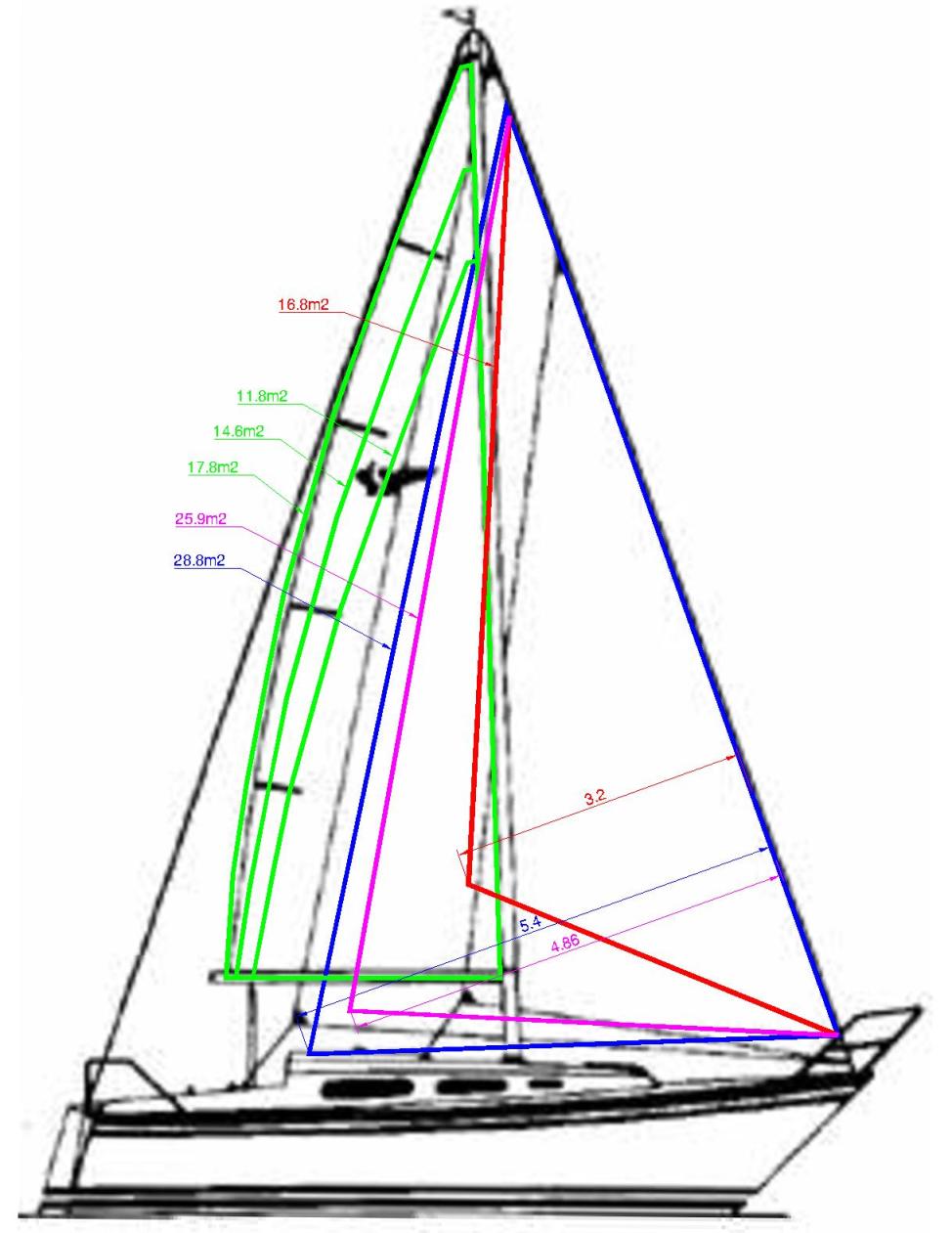
Well ours looks like this.

Sails1-Model.jpg


Blue is the original No.1. Magenta is the newer No.2. Red is the No.3. All use the same tracks and I think the areas work out about 150%, 135%, 90%. We choose the sail for the day. But I have occasionally changed up at sea - never changed down though.
From about 18 knots apparent I think we are better off with the No.3 than the reefed No.2. One thing I noticed when we first got the small headsail was that we started breaking fittings on the main and had to beef up a few shackles as we were carrying full main in a lot more wind.
 
The full hoist, 100% J No.3 genoa known by the Froggies as Le Solent. Being the place wot invented it.

Incidentally, the large overlapping headsail is called a Genoa, because it first appeared there on 6 Meters in the 1920's.

(Anorak mode off)
 
An interesting question I have pondered often. I don't know the answer.

I think you will find it varies with the boat.
years ago when considering bying a new boat from sadler there were two options for sails.
1st a No 1 No 2 and No 3
Or
Roller furling
They cost the same,

I think if you want the answer for your boat check with the original manufaturer or designer.

I confess my understanding of sail percentages is a bit vague.
My current boat has
A 150 laminate . In my garage.
A 120 on my furler.(furler is a harken,foil has two slides and a removable drum)
A 100 with battens. listed as a No 2 in my cockpit locker. does not furl, foot is just above deck, works great with 1st reef up to f5 f6.
Under FWd berth a Storm jib looks to me like a No 3. Not sure what percentage but its white very small, very high foot. and not as heavy as a true storm gib.

When I used a No 3 in the distant past, lacking a full understanding of percentages, my rough guess was a No 3 was about a 3rd the sise of a No1 a No 2 about 2/3rds the sise of the No1 and then we had a big genny for light winds.

This would equate to rougly 40% for a No 3.

which odly is close to the sise of a storm gib.

As for shape if I hoisted a No 3 up side down it would not be the first time.

It still worked.

I used to find a No 3 and a 3rd reef worked realy well right up through gale force and in the very few times I encountered storm force.

On the one and only ocasion I was caught out in something aproaching huricane force 12. ( It was probabaly only a 10 or 11 but 12 sounds more impresive)We gave up on sails all together, I had steerage way to beam reach with bare poles. No it was not a huricane.
 
Last edited:
My No 3 is about 90% full height, set inboard of genoa, on its own track. The sheeting angle is 7.5 degrees. It's excellent up wind. When the wind over the deck is more than 30/ 33 knots, I have thought it a bit big, and may have a reef added as its easier to reef it than set the storm jib, which is nor good for beating anyway. It's the same area as the working jib on the sail plan but the working jib is high cut.

How do you reef it, actually? I would love to have a look if you are coming down in the near future.

You have one major benefit over me in that you dear lady is happy, or at least willing, to sail in those conditions - mine would insist on being surrounded by proper walls and a roof !!! :)
 
Nor me, in fact where you say "not entirely sure" I wuld have to replace it with "really dont know"

Based on what others have written, I should really asked for the size of a "working jib". Or even a "Solent jib" whatever that is.

Full hoist non overlapping Jib, cut low to the deck.
a working jib will not be full hoist & non overlapping, clew cut higher
 
Nor me, in fact where you say "not entirely sure" I wuld have to replace it with "really dont know"

Based on what others have written, I should really asked for the size of a "working jib". Or even a "Solent jib" whatever that is.

The red one in my picture is what Mike Lucas sells as a No.3 Genoa.
 
Number 3 is commonly used now to be a deck sweeping, full hoist, 100%(or close) jib.

Of course now that most boats are specified from new to only use non overlapping jibs the number 1 is now the same size, but the 3 is much flatter.

For cruising use I'd do without the deck sweeping bit, cut it a bit higher and also do without the battens.
 
Top