Holding tank installation - any country standards to follow or do I get creative?

antaris

Well-Known Member
Joined
12 Jul 2012
Messages
249
Location
Athens, Greece
astarteginfizz.wixsite.com
Hello all,

I just got miself a 50lt tank on special winter offer - which is to be installed in our 37' sailing boat.

Are there any standards that I need to follow - in relation to emptying said tank by shore services?

I am not referring to general installation practices, but standard pipe dimensions for emptying it out, standard deck-mount fill/empty caps, etc. So, if I visit Turkey (for example) a guy will turn up with a truck and will expect to find what (I mean boat gear-wise, of course :) )?

I need to plan the whole thing from scratch, as there is no installation on our boat. Here's the rough plan that I will follow, borrowed from the ABYC leaflet:
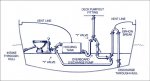
Screenshot 2021-02-17 025611.jpg

So, this "DECK PUMPOUT FITTING"... what is it? Do different countries follow different standards, or do I just allow a large diameter hose, so they can do their thing?


Cheers in advance.
 
There is a simpler installation option as fitted on my boat which is to take the heads outlet direct to the top of holding tank without any Y valve and connect the existing discharge seacock to the holding tank sea discharge.

Although this is much simpler, it has the drawback that once you need to use the holding tank (by closing the sea cock) you cannot then have the option of bypassing it until it has been emptied. The Y valve allows you to be more selective about when you take advantage of the holding tank which you may choose to only use for "solids" and not pee.

If you are a lake sailor you may have to seal off any sea discharge so this simpler installation won't work for everyone.

My pump out deck fitting looks identical to the fuel and water deck fitting. I have never used a pump out.
 
Lee Sanitation here in the UK has quite a bit on its website about holding tanks, etc. Same applies to Tec Tanks. All the fittings I have seen for pump outs on boats in the UK are the same size as fuel and water fillers. My holding tank is rigged as a gravity type with no pump out. It can be awkward to retrofit a holding tank on an old boat.
 
So, this "DECK PUMPOUT FITTING"... what is it? Do different countries follow different standards, or do I just allow a large diameter hose, so they can do their thing?

There is an ISO standard that covers it all – ISO 8099:2000 – including the requirements for deck fitting.
My own installation is somewhat similar to that in the sketch and it works well and has so for several years. Now use the deck pump out far more often than the sea discharge.
There are many variants. One possible alteration with regard to the sketch could be move the anti-siphon loop to immediately after the toilet. Also, Y-valves tend to be expensive, they can be replaced a T-piece and two normal valves.
 
Hello all,

I just got miself a 50lt tank on special winter offer - which is to be installed in our 37' sailing boat.

Are there any standards that I need to follow - in relation to emptying said tank by shore services?

I am not referring to general installation practices, but standard pipe dimensions for emptying it out, standard deck-mount fill/empty caps, etc. So, if I visit Turkey (for example) a guy will turn up with a truck and will expect to find what (I mean boat gear-wise, of course :) )?

I need to plan the whole thing from scratch, as there is no installation on our boat. Here's the rough plan that I will follow, borrowed from the ABYC leaflet:
View attachment 109452

So, this "DECK PUMPOUT FITTING"... what is it? Do different countries follow different standards, or do I just allow a large diameter hose, so they can do their thing?


Cheers in advance.
That looks a horribly over complicated diagram, with too many fittings. On my boat all the waste is pumped into the tank. There is no pipe like the one in your diagram that runs through the bilge. My tanks (there are two heads) are high enough to discharge to sea by gravity and have a pipe direct to the sea cock, with a tee to the deck fitting to allow pump out. All the hoses are 38mm. The deck fitting is marked waste, but is otherwise the same as the fittings used for fresh water inlet. I see no need for a syphon break in a waste system. If your tanks are low down and need pumping to discharge waste to sea, then fit the pump after the tee piece leading to the deck pump out. Where I sail in Turkey pump out stations use suction and a hose with a tapered rubber end fitting is pushed into your deck fitting. Deck fitting here Pump-Out Deck Fitting | Tek-Tanks
 
There are no standards, except for the pump out fitting. however you will find very few pumpout facilities in your part of the world, so mostly you will be discharging at sea. 50l capacity is on the small side, most new installations aim for 80l.

Avoid the type of installation shown in your diagram. That is very old fashioned and rarely used on new installations now. The downsides are that it is expensive to install (think of all those valves, hose, pump) and needs an extra hole in the hull for the discharge. Also do you fancy all that raw sewage running through pipes in our boat?

As already suggested look at a gravity system that is the most common type now. It requires a different type of tank than the type you have probably got, but requires no extra fittings or pump . The problem will be finding a space to fit it on an existing boat. The advantages are much simpler to operate - no extra valves, although you can fit a pair of Y valves to give the option of discharge straight overboard rather than through the tank, easier to keep clean and maintain. typically cost of fitting is around 40% less than pumped systems.

Suggest you look at www.tek-tanks.com where you will find detailed information on holding tank systems and layouts www.leesan are also a good sources. Both sell tanks and fitting equipment and Tek Tanks also make custom made tanks if a standard size will not fit. Vetus is a good source for tanks and you will find them available in Greece.

Always use Butyl Sanitary grade hose as this will minimise potential odours and is easier to manipulate than the cheap hose often used. When using the tank, only close it to hold waste when you need to, otherwise flush through and leave it open. This minimises the build up of scale and waste deposits in the tank.

Hope this helps.
 
If you can, keep it simple. Gravity, no pumps, no Ts, no Ys, fewest bends and a straight vertical line from pump out opening down to opening at the bottom of the tank for rodding. Make sure all pipes have easy access to change when smelly or full of limescale. Even this diagram doesn’t quite get it right as it lines up inlet from toilet to outlet instead of pump out opening to outlet.
 

Attachments

  • A7D9D15C-9883-4A84-B081-047352DF38E8.jpeg
    A7D9D15C-9883-4A84-B081-047352DF38E8.jpeg
    59.8 KB · Views: 67
Last edited:
GRAVITY it is: Thank you all - very much appreciated. I am actually currently looking into the pipe fittings and (since I already have an electric loo/macerator I shall go for gravity discharge.)

PUMP-OUT: So, a 38mm butyl pipe that runs from deck to bottom of tank (with the less possible bends) will be good for Marina pump-out?

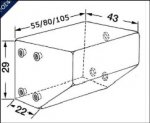
For other readers that may be in the same... situation: here's the diagram of the tank I just purchased - it has a bottom pump-out fitting:
Screenshot 2021-02-17 115144.jpg
 
Both tanks on my boat were retro fitted [no tanks originally] and have gravity discharge. The through hull discharge outlets are both above the waterline.
 
You can buy pong filters, but they arent necessary and over priced for what they are. Any box with two connections for the tubes and filled with charcoal so the air flows through the carbon will do the job. Macerator pumps can be unreliable, so well worth getting on good one, and make sure it can be removed easily because at some point it will require replacing. You are stuck without the pump as lots of places dont have deck pump out facilities. In some respects worth carrying a spare pump, but to be fair mine has been good for the last seven years.
 
It seems the ISO is now superseded by 8099-1:2018.
ISO 8099:2000
I haven't read it, so maybe that it only concerns the deck fitting. Would surprise me, though.
Yes I found that when I searched after reading your post, it looked pretty thorough to me and covered every aspect of the system. It just struck me as funny that after you quoted the standard there was a post stating there was no standard. I would imagine Tranona was writing theirs when you posted so wouldn't have seen it :)
 
Deck Pump Out Part Nos (Leesan / Tek Tanks ) 276801 /02989 is what I used. I think a standard size. I fitted a 50l tank and made it gravity emptying. The pump out was a dip pipe straight to the tank. I put in a flush out fitting too directly above the outlet so I could rod it out from above in the event of a blockage. I put the tank in the cupboard behind and just above the loo. Minimum number and lengths of pipe and only one valve (excluding the seacocks). Everything goes through the tank so if the valve is closed it fills up. If the valve is open is goes straight in and out again.
 
Last edited:
Top