Hockles in a 2:1 headsail halyard

Neeves

Well-Known Member
Joined
20 Nov 2011
Messages
14,073
Location
Sydney, Australia.
Visit site
We have a large 45^2m unstayed headsail on a bowsprit. Luff tension is produced by cranking up a 2:1 dyneema halyard. The luff itself is double dyneema. The sail stays rigged most of the time but we drop it if we have a longish period away from the boat or there is need for some TLC. The sail is on a furler with swivels top and bottom.

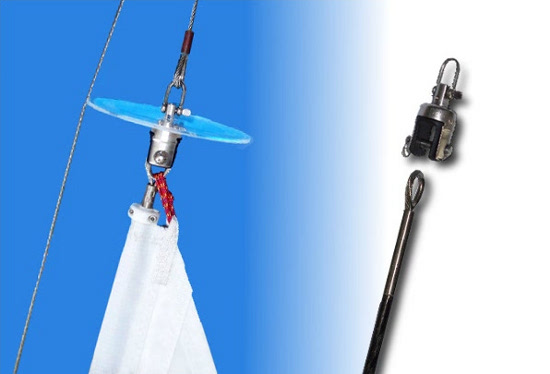
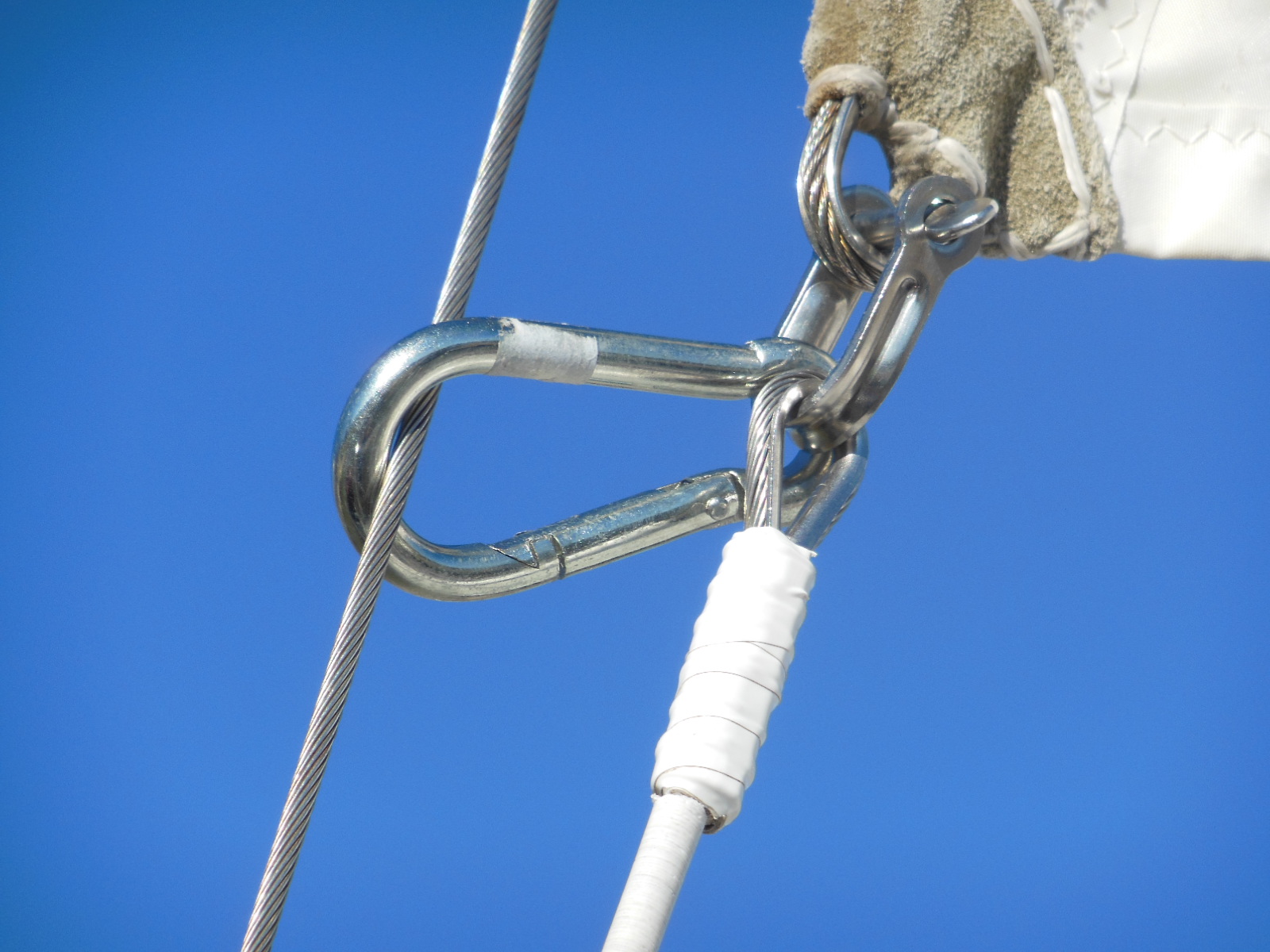
The halyard is terminated at the mast top, comes down to the swivel attached to the head of the sail, swivel is a grease filled, ball bearing race, returns to a sheave just above the termination point, down the mast to a mast based winch. Tension is applied when in use, that tension is reduced slightly when furling (and when the sail is furled).

We find that when we have had the sail down and re-hoist the halyard both twists, so the two part of the halyard, twists round each other and maybe more serious the portion passing through the sheave develops a hockle and the hockle grows (or becomes sufficiently serious) it will not pass through the sheave block. The hockle is maybe half a turn.

Current solution demands me at the mast head, take the tension off the halyard by supporting the head of the sail from the crane with a short strop - and then I can manually untwist the hockle and the twists between the 2 parts of the halyard. Once I have done the remedial work - the problem disappears until we take it down and then re-hoist.

We can mitigate the twisting of the 2 parts of the halyard by introducing a counter twist before lifting - but the hockle defeats us - and though I don't mind mastwork, at all, it is something of a nuisance.

The halyard is new, ish, and was not cheap and bought from the sailmaker who built the sail (well known, good reputation).

I'm inclined to blame the rope, the halyard, and that it has a slight twist in its construction and/or cordage is made specific for double halyard application.

Comments, and preferably remedies, would be most welcome.

Jonathan
 
Would it help if the halyard was replaced by a single part halyard? As only tensioned infrequently, could you sweat it up sufficiently without the 2:1 purchase?
If not, as the halyard is only tensioned at a specific height, could be other options such as
- halyard lock at the masthead, per race boats
- loop at bottom end of halyard at hoisted position (with thinner runner rope to pull up unloaded), then attach highfield lever or multi tackle at the bottom of the mast to tension
 
Jonathan

What kind of roller furler do you have. On mine the to hallard is not connected to the sail and only rotates when the furler turns so unless there is a swivel on the block attached to the halyard the halyard cannot rotate it the roller top that swivels when the sail is furled and a fitting at the top of the mast prevents the halyard twisting when you furl.

Have you a pic of the halyard block attached to the sail.
 
Try this theory
Sounds like you do not have a proper dynema halyard but a "cruising" dynema. The outer covering is loose on the inner core allowing it to bunch.
Perhaps if you tied one end of the halyard to a fixed point then worked the cover along the core. That might show that the cover is loose on the core allowing it to bunch forming the "hockle". If it does, work (or milk) it hard, then cut the excess outer cover away such that the core is a slight bit longer than the outer cover which would stretch the outer better. Instead of splicing any eye ( which may have started off the problem if the core had been shortened in the process of poor splicing) whip or knot the eyes or shackles.
Decent dynema has a tight cover. You might have a look at the core to see if it is a hollow braid or just a laid type to a rotation that is causing the rope to twist.
 
Last edited:
What is the construction of the rope?
I don't understand why you get this problem, the scheme seems exactly like the 2:1 halyard on my dinghies.
Just scaled up a bit I imagine.
When the sail is fully hoisted, are the two parts of the 2:1 parallel? and how long is that section?
A halyard diverter (which could be on the standing part) might help, by resisting rotation of the top half of the swivel?

In general, the first thing I suspect with a core/braided cover rope would be incorrect balance between the core and cover. usually length, but the core could be twisted relative to the cover?
 
What is the construction of the rope?
I don't understand why you get this problem, the scheme seems exactly like the 2:1 halyard on my dinghies.
Just scaled up a bit I imagine.
When the sail is fully hoisted, are the two parts of the 2:1 parallel? and how long is that section?
A halyard diverter (which could be on the could standing part) might help, by resisting rotation of the top half of the swivel?

In general, the first thing I suspect with a core/braided cover rope would be incorrect balance between the core and cover. usually length, but the core could be twisted relative to the cover?


I find it difficult to understand how just hoisting the sail could twist the halyard. It could happen if the sail being furled and as you say a halyard diverter could help or even moving the standing pat further aft.

It the block has a swivel problem with the line could cause this but there should be no need for swivel on that block
 
Quote>The halyard is terminated at the mast top, comes down to the swivel attached to the head of the sail, swivel is a grease filled, ball bearing race, returns to a sheave just above the termination point, down the mast to a mast based winch. Tension is applied when in use, that tension is reduced slightly when furling (and when the sail is furled).
Read more at http://www.ybw.com/forums/showthrea...in-a-2-1-headsail-halyard#mElOJfVtufSj1bxm.99 <Quote

For some reason ( if I have understood correctly) the furling/unfurling action is the cause of the twist imparted into the halyard- one end of that halyard is swivelled but the termination point and sheave point are both fixed.
Perhaps, if those two upper fixing points were combined into a second swivelling pulley and becket and fastened so as to stand proud of the mast so as to permit rotation the problem might disappear or be much reduced perhaps?

Edit:- If this had any merit, then it would not work since the halyard fall to the mast winch would prevent any compensating upper rotation - at the moment cannot think how to resolve that.
 
Last edited:
I see no advantage in having a 2:1 purchase - KISS

I would think it would work better ( if you insist on having a 2:1 purchase) . that the fixed end of the halyard should be higher than the lead through the mast to the winch below.
 
I see no advantage in having a 2:1 purchase - KISS

I would think it would work better ( if you insist on having a 2:1 purchase) . that the fixed end of the halyard should be higher than the lead through the mast to the winch below.

It avoids putting double the compression load on the mast, and is easier to hoist.
It reduces the luff sag in gusts due to the halyard stretch by a factor of 4. You don't want the sail getting fuller and closer sheeted in gusts.

A 1:1 halyard might have the same problem anyway, if it's the same sort of string?
 
The swivels are identical to this swivel:

https://www.ketten-waelder.com/products/cromox/cromox-lifting/swivel-load-hooks-qwhf/

minus the hook.

Ours are not Cromox, or it does not say so. Its a bowl with a lid filled with ball bearings and grease. It rotates freely - though under load they may have differing performance. I've never tested them - but certainly;y under load anchor swivels don't swivel well (at all) - but they are a very crude mechanism whereas ours are a bit more sophisticated. I know they are grease filled, I checked.

The luff length is about 20m (I've never measured it and I don't have the dimensions here). So there is a lot of rope!

As mentioned the 2:1 purchase is as LW395 says.

I'm not sure about the easier to hoist, see my first post :) but as LW mentions it allows a tight luff and helps flatten the sail. The sail itself is mylar with kevlar reinforcing - its a fairly heavy cloth and off the wind we can carry it to 35 knots (when the apparent might be less than 20 knots). The sail is pretty useless in any winds for pointing, we have conventional headsails, 150% and 95%. In multi speak they are called 'screechers' but are a similar concept to some asymmetrics (note - being highly tensioned on their own dyneema luff, ours is 2 part some are high torque rope) or Code Zeros.

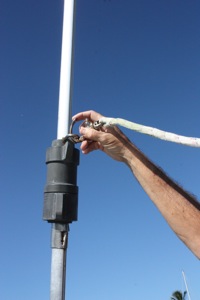
The termination point on the mast and the sheave have a separation of about 100m and the termination is below the sheave (though I cannot see how the termination height makes any difference?, distance between will be important). The separation seems fine - once its up and settled in.

As the sail is raised tension, obviously;y increases, the weight of the sail. That tension is sufficient to stop the top swivel turning and releasing the twists in the 2 part halyard. The swivel works well enough to furl and runs out like an express train to unfurl.

We can remove the twists in the halyard, the 2 parts of the halyard, by introducing a counter twist at the outset (though this should be unnecessary - it should not twist). Its the hockle that's the big issue.

I was up the mast 2 days ago - the hockle is only half a turn (and I did not have the presence of mind to take a camera/phone). Its sufficient to make it impossible to pass through the sheave box and its rock solid. I can remove it (as mentioned) if I take a strop from the sail head to the crane, release the halyard (load now on strop) halyard is loose and I can work, quite easily, the loose hockle through the sheave.

Someone did mention coiling of rope - this may be an issue and/or it might be rope construction. The hockle looks small, or not cause by much twist, but it bunches up - so if it were slight twist - how do you remove slight twist from the rope 60/70m long? I can see how to remove lots of twist but this is, I don't know - say 1 twist over the 50m with which we are working. The rope is coiled and stored in a halyard bag at the mast base.

Thoughts?

I cannot see how to improve the swivels. The sail when hoisted (with twists and hockles in the halyard) is not twisted, luff is 'straight'.

My, very, limited ideas are spend time at the mast head - undo termination point and run the halyard through my, gloved, hand top to bottom a number of times trying to 'squeeze' out any twists, aided by gravity. I'd welcome other suggestions - as I don't mind spending time at the mast head but I'd simply like to get it sorted 'once' so am willing, more than willing, to try other solutions all at the same time.

We raised the sail, last time, unfurled and it was not particularly windy but having to climb a mast with 45 ^2m of sail billowing around when the halyard is lock solid does not do the sail much good, nor my nerves.

Should we furl the sail 'by hand' and then raise? Best ways to sensibly furl? (I did think of doing this between 2 trees??)

Interestingly our main halyard is almost identical 2:1, except no swivel. Different supplier of rope, also dyneema. The headsail's halyard (the one in question) suffers wear at the clutch and we have end for ended and replaced. The original halyard had similar issues. Both halyard terminate at the top, halyard knot. No twists for main. Main just goes up and down, frequently. Halyard is coiled - hung on a hook in the cockpit. I'd swap halyards but the main halyard will not be long enough.

As an aside - 2:1 halyards can develop huge loads and the clutches tear, or wear, the outer cover of the halyard. Common practice is to leave the halyard on the winch (and locked clutch).

Jonathan
 
Last edited:
I'm afraid I don't know what the brand it is, but there's one that I dread seeing on anything I get to sail on - precisely because of this problem (although I'd never heard the word before, so thanks for that..). If yours has what I'd describe as an almost unnaturally smooth cover then it could well be the same one.
 
I don't know but think hockle is an Americanism and I have heard it used, not surprising for me, with reference to twisted chain (where the chain jambs in the windlass - or hawse pipe). I don't know of a word quite describing the same phenomena in the UK/Oz (though the phenomena is not unique to America :) ).

Jonathan
 
How about a swivel at the head of the sail ?

Also, take the halliard off and tow / stream it behind the boat for a while, the wet and ability to run out twists should help; though as mentioned the construction of the line sounds suspect.
 
How about a swivel at the head of the sail ?

Also, take the halliard off and tow / stream it behind the boat for a while, the wet and ability to run out twists should help; though as mentioned the construction of the line sounds suspect.

There is a swivel at the head of the sail.

Not seeing the wood for the trees - I has easily overlooked the streaming behind the yacht idea. It appeals, almost immensely - as its cheap :). The downside is 2 trips up the mast, one to remove, one to replace (and try to identify if there has been any improvement.

I dislike the idea of simply throwing money at the issue and buying a new halyard (as the new halyard may be no better). One thing to try.

Jonathan
 
I don't know but think hockle is an Americanism and I have heard it used, not surprising for me, with reference to twisted chain (where the chain jambs in the windlass - or hawse pipe). I don't know of a word quite describing the same phenomena in the UK/Oz (though the phenomena is not unique to America :) ).

Jonathan

Hockie

To acquire a knob in a bight of cordage, caused by twisting the line against the lay. Such damage, caused by improper coiling or rough handling, weakens the line and causes it to jam in blocks.

Do you have roller reefing and if os where is the swivel you posted attached to the sail top

This is similar to mine

HowToJib5.jpg


SeldenTopSwivel.jpg


dscn0829.jpg


The halyard is attached offset which helps to stop twist. also if the halyard is at a angle away from the forestay this also helps.

Really need to see what your arrangement look like.
 
Last edited by a moderator:
Roger,

I'd post a picture, but the object is on the cat.

Your swivel allows the sail to rotate round the foil which 'contains' the forestay. This would be a conventional furling headsail (which is how our genoa and jib operate

We do not have a forestay for this sail - its unstayed, or its stayed by itself (the halyard and luff are all dyneema).

My swivel is attached to the head of the sail and on furling the sail furls round its own luff. The halyard stays stationary, or is meant to. The swivel allows the halyard to be stationary and the sail rotates round its luff. At the tack we have the same arrangement with the drum being attached to the luff and the swivel between it and the bowsprit. Obviously the luff could twist - this is overcome using high torque dyneema cordage (very difficult to twist).

It might sound 'odd' (a furler without a forestay) but its quite or very common on cats and on newer yachts with bowsprits. It works well, we have had no issues - except this specific problem when we raise the sail.

Jonathan
 
......

...
Interestingly our main halyard is almost identical 2:1, except no swivel. Different supplier of rope, also dyneema. The headsail's halyard (the one in question) suffers wear at the clutch and we have end for ended and replaced. The original halyard had similar issues. Both halyard terminate at the top, halyard knot. No twists for main. Main just goes up and down, frequently. Halyard is coiled - hung on a hook in the cockpit. I'd swap halyards but the main halyard will not be long enough.

As an aside - 2:1 halyards can develop huge loads and the clutches tear, or wear, the outer cover of the halyard. Common practice is to leave the halyard on the winch (and locked clutch).

Jonathan

All this reeks of the cover moving over the core.
I suspect the clutches are simply wrong for the job, or the ropes are wrong for the clutches.
Once the cover is not evenly distributed on the core, bad things happen.
If it was the kite halyard on my dinghy, I'd taper the rope, get rid of the cover on most of the sail end beyond where it goes in the clutch.
I know some riggers will stitch/whip the cover and core together in the area around the clutch sometimes, you could research this perhaps, it is one or more levels above my amateur knowledge of modern ropework.
 
Just skimmed the thread and suspect lw395 is on the right track. I too set a storm and #4 jib in such a way and the some considerable force is required to ramp-up a stayless sail.

Neeves, what furling gear do you use at the head and tack of the jib and do you know the line type?

Mine is Facnor and even when set-up and maintained as specced one sometimes has to back-off tension a touch when setting and dousing the sail - especially when using small diameter lines with low torque stability. It is also essential that long runs of halyard are flaked and never ever coiled. For doing so will run twists in the line through pulleys, some of which will sit under immense tension, and depending on the gear may have excessively tight turn radii.

Toss the clutch-spec into the equation and there is every possibility the sleeve has shifted from its core - in which case the only possible solution will be de-sleeving if this is an option.

Finally, I'd go through the system's specs and operation in detail before replacing or testing with another line. Otherwise you might end up with two wrecked halyards :ambivalence:
 
LW - correct, very perceptive - its the cover moving over the core - but this can be arrested by leaving the rope on the winch. Its a common problem and strict instructions are given to people not familiar - NOT to take the halyard off the winch!! when the sail is in use.

You cannot take the cover off - because you then cannot lock the bare dyneema. You could, I assume, sew the cover to the, dyneema, core , or splice the dyneema into a non-dyneema tail - but its easier to simply use the winch and leave the halyard on the winch (basic belt and braces). We have used this system for 20 years - and we have the winches to allow it to work, 2 on the mast, 3 in the cockpit and another on the cabin (coach) roof.. If you were short of winches it would be more of an issue.


This is an article on more modern equipment than we have but the principals are the same.

https://www.sailmagazine.com/diy/furl-it-up

Instead of the continuous line furler we have an old fashioned furling drum - but otherwise the same.

Jonathan

Dom,

Another perceptive post.

It is very difficult if not impossible to furl a screecher under full tension. The halyard must be eased to furl. Facnor, and other continuous line furlers were either in their infancy or not developed when we commissioned and our system works - apart from the problem described.
 
Last edited:
Top