Hinged Mast Foot Cracked

AndrewL

Well-Known Member
Joined
20 Jun 2014
Messages
189
Location
Cowes, Isle of Wight
Visit site
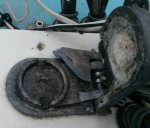
I had a bit of a problem when raising my mast today. I was using an A-frame to raise it, but it went slightly to one side. Before I could do anything the hinged mast foot cracked. I lowered the mast back into the cradle, no one injured and nothing else damaged, so it could have been worse. I did have people helping, but before anyone reacted it cracked. I don't think the mast actually moved off the centre line that far. But obviously the as the mast went off to the side the force down at the foot was very large.

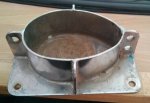
The mast is an old deck stepped IYE with a cast two part foot, a male part attached to the coach roof and a female part attached to the mast. Lugs on each part with holes act as a pivot on a stainless steel pin. Photo attached.
iye_mast_foot.jpg

I don't imagine it would be possible to find a replacement part as IYE don't exist anymore. Someone has suggested a metal fabricator locally who could make me something up.

However, before I go down that route which would involve trying to remove the foot from the mast. Am I correct in thinking that once the mast is up this broken part does not actually do anything? It appears that the male part on the coach roof will securely locate the mast.

Any helpful suggestions welcomed. After 2 months of work I was ready to raise the mast, put the sails back on, and start thinking about sailing.
 
I had a bit of a problem when raising my mast today. I was using an A-frame to raise it, but it went slightly to one side. Before I could do anything the hinged mast foot cracked.


Any helpful suggestions welcomed. After 2 months of work I was ready to raise the mast, put the sails back on, and start thinking about sailing.

If you are in a position to have the mast stepped with a derrick I would seriously consider Aralditing it back together while the fracture is still clean and unoxidised,getting on with this year's sailing and thinking about a more permanent repair nxt year.

I am always afraid of doing the same ........... I think I might get the yard to step mine this year.
 
The crack is unlikely to cause any problem while sailing as it only locates the bottom of the mast on the cabin top. The real loads come when raising or lowering the mast. Your problem emphasises the need to keep the mast central while in transit.
The problem can be averted a little by using a very sloppy fit bolt in the pivot such that there is room for mast swing without breaking the ali. The problem is that the lugs are spaced so that any swing reflects in significant movement at the lugs but with huge leverage from the mast weight.
The hinge on my boat is very successful in that the 2 lugs are welded onto the mast just 6mm apart and they pivot on a spine attached to the base plate. So any swing in the mast results ina small movement at the lugs which are pivoting on a very sloppy 6mm bolt. Now I am not suggesting that you modify the pivot design but if you retain the present style you need to improve control of the mast sideways swing.
With a mast head rig this is best achieved by extending the chain plates a piece of tubing is good up to the level of the mast pivot. This extension must be stayed pulling forward to ensure it remains vertical with mast in transit. Now the cap shroud always has tension on it right through the traverse so it can't swing.
A fractional rig where the cap shroud chain plates are set aft of the mast is much more tricky. I have used a cable clamp and ropes to a pulley forward on the gunwhale to exert a forward pull on the cap shrouds so keeping the cap shrouds tight. That much maligned MacGreggor 26 has purposes fitted inner shrouds that attach to a chain plate on the cabin top in line with the pivot so they maintain the mast on centre line all the way up. Another option I have considered.
Some local people here use 2 poles attached to a car that runs up the main sail track. The poles pivot on points on gunwhale a metre or so aft of abeam. The car runs up the main sail track as the mast comes down such that if forced up or down the mast can be raised or lowered without gin poles (A frame). They also provide a support for the mast when down. But really this method is most suited to lowering for bridges. A lot of lifting etc to remove the mast completely or refit. This is my mast base. Just a few thoughts olewill
mastbase.jpg (24.1 KB)
 

Attachments

  • mastbase.jpg
    mastbase.jpg
    24.1 KB · Views: 0
Hi Andrew,

I have exactly the same mast as you (the foot anyway). Too late now for you, but I always try to stay the mast with ropes fitted to the gin pole and to the chain plates. Simeone can then take up any slack to prevent sideways movement of the mast. My son usually guides it down from underneath, but in my case the cap shrouds will not help tension it as they end up really slack. My mast drops over the stern by half its length (30 foot mast), so it's essential to control it. Even with a thinner pin or bolt the two sets of lugs are really close together if there is any twist in the mast on the way down, or up.

As has been said, I wouldn't think you would have a problem using the mast in its condition so long as all the shrouds are properly tensioned.

Geoff
 
Thanks for all the replies. I definitely agree that if using the A-frame approach keeping the mast dead centre is essential especially at the early stages of raising while the cap shrouds are slack. Having thought about this last night I now think the A-frame method is tricky and I have been lucky in the past. On a small boat your weight makes the boat heel and then mast then starts to swing in that direction, but those ashore holding lines from the mast head need to keep the mast perpendicular to the boat, not the horizon. If the boat moves a bit because someone on board shifts their weight while winching, the mast does need to be allowed to move to follow the boat.

Anyway, the next update in this saga...
I decided to have the mast stepped on Sunday morning using the crane, however it did not go well. We got the mast located and vertical and I started to attach the rigging. Then suddenly the mast swung up, the foot had fractured and the mast was at 45 degrees. I do not know what happened as I was crouched down fitting a clevis pin. There was someone operating the crane using a remote so they were also stood on deck. At this point I decided to have the mast taken off and laid onto supports ashore while I consider what next.

I now also have a slight bend in the roller furler foil although only slight, I will speak to the rigger who fitted my new forestay about this.

If anyone has had a similar problem and had a repair made, something new made up or managed to buy a replacement it would be great to hear about it. With our first child due soon I really could do without this. I was hoping to have the boat back on her mooring today and maybe manage a few sails before the baby comes.
Thanks.
 
Sorry to hear this Andrew. My 22 footer has support legs when ashore, so not really a chance of it moving.

Seems to me that your only option now might be to have a new foot and deck fitting fitted. Problem may be finding said fitting to fit the profile of your mast. My IYE mst is now 40 years old!

Good luck in your search.
 
Hello Andrew really sorry it all went for the worse using a crane.
Back to your comments the A frame method ie 2 poles forming a gin pole are there to improve the pull angle on the forestay. They can not help at all in keeping the mast centred in its traverse. The only advantage of using 2 poles over one is that one must be stayed sideways to keep it vertical while 2 poles hold one another up.
The mast must be stayed or steadied in its traverse. No so much a concern on the hard but on the water any heel of the boat will have the mast swinging off to the side. You need to have people on the cabin top guiding for a small mast or stays as described by me above. But then you know all that now but just for anyone else contemplating mast lowering.
good luck with the new baby. An exciting time for you both. Boating might be difficult for a while but soon you will have a new crew. olewill
 
Thanks for all the replies. I definitely agree that if using the A-frame approach keeping the mast dead centre is essential especially at the early stages of raising while the cap shrouds are slack. Having thought about this last night I now think the A-frame method is tricky and I have been lucky in the past. On a small boat your weight makes the boat heel and then mast then starts to swing in that direction, but those ashore holding lines from the mast head need to keep the mast perpendicular to the boat, not the horizon. If the boat moves a bit because someone on board shifts their weight while winching, the mast does need to be allowed to move to follow the boat.

Horses, stable doors and all that stuff, but on mine - when I'm using an A frame to raise or drop the mast - I always have someone stand on the cabin roof, faced backwards (so they can keep an eye on the shrouds as the mast goes up) straddling the mast to keep it central and stop it swinging.... the reason I do this is because I had same issue a few years ago... just find yourself a local fabricator take the broken bits and he'll weld them good as knew for not very much.....
 
Horses, stable doors and all that stuff, but on mine - when I'm using an A frame to raise or drop the mast - I always have someone stand on the cabin roof, faced backwards (so they can keep an eye on the shrouds as the mast goes up) straddling the mast to keep it central and stop it swinging.... the reason I do this is because I had same issue a few years ago... just find yourself a local fabricator take the broken bits and he'll weld them good as knew for not very much.....

Tip when raising the mast with an A frame , gin pole etc :

Stand all the bottle screws up with bits of thin shock cord tied to the guard rails etc so that they cannot snag on their deck attachments.

I like to have someone available to help if needed but I prefer them not to stand where the mast will not hit them if things do wrong and it falls down again. The relatively light standing rigging on a small boat I am sure will catch on a smooth surface given half a chance. Nice then to have someone to quickly release it again.
 
The alternative to repair is contact your local riggers - they might have something in their parts bin. The mast foot was missing and long out of production when I bought my boat, but a local rigger had an old foot that fitted (8mm shorter otherwise the same) and the cost was very cheap.
 
If all else fails it is possible to make a mast foot up out of fibreglass, i did this on a Holt allen mast on my old Anderson 22 that the original foot had been bodged & corroded to the point of disintegration. I couldnt find a new one anywhere so made a one shot mould from mdf, this was covered in brown packing tape & a new foot laid up the hollow part was then filled with chopped strand mix. It was fiddly but ended up a good strong job, 12 years later its still going strong.
 
A further update. The mast was down to replace the forestay. This morning the rigger noticed that my mast was still down and called me to see if there was anything wrong. I explained the problem and he said he might be able to help. 30 mins later he called me back and said he'd left something in the cockpit. He'd found a stainless deck fitting of the correct size for the mast section. (nothing more than a satisfied customer, Mac's Rigging, Cowes 07748 118795)

new_mast_fitting.jpg

It won't be a pivoting mast anymore, but after this experience I probably wouldn't try that again anyway :-) So I just need to remove the remains of the cracked foot from the mast and find a suitable material to go under the new base to keep the overall height the same. And also try and straighten my roller furler foil.

I did find a good article on how someone else had solved a similar problem. Had I not been given this new fitting I'd probably be using this method.
http://www.thevirtualboatyard.com/2009/06/building-a-better-mast-step.html

As always, thanks for the good advice.
 
Hi Andrew,

I wish that I had read this thread before I tried lowering my mast last week. I had an almost identical problem, DOH!

I am attempting to fix the base with a stainless collar, pins and cold weld epoxy.


Bernie

Bernie
 
Sorry to hear about that. I think this kind of pivoting foot is a bad design, a slight sideways movement of the mast translates into a lot of movement at the foot. Mine also had a stainless pivot pin, which I am sure must have caused galvanic corrosion. Combined with my flawed A frame technique and it all went wrong.

I attempted to reuse my broken mast step, as it was just one of the pivot lugs which had broken. But this also formed part if the collar which locates the mast. When stepping the mast the 2nd time, using a crane this time, the other part of the foot cracked off, causing the mast to slip forward and damaged the roller furler.

In hindsight I should have replaced the mast foot when it broke instead of trying to make do. From googling I found several designs which could be DIY built, or made by any metal fabricator.

Today I had the mast stepped and everything went well. I am much happier, the rig seems really robust now.
 
Top