Help me troubleshoot my outboard motor position challenges

Patrickza the OP is used to close quarter maneuvering using throttles for steering. The E-propulsion outboard have wireless remote throttle/ahead/eastern controls so to take full advantage of this feature my suggestion in #18 is surely the best option to try at no cost.
 
Thanks all, so far I think the best answer as a few of you have confirmed is to bite the bullet and go for pods. I'm going to stick with the same brand and same power, as I think they've got plenty power for moving the boat. They claim to be 9.9hp equivalent, but I suspect that's more to do with legislation and marketing than reality.

They also claim their 3kw motor is a 6hp equivalent, and their 1kw is a 3hp equivalent. Knowing how much more efficient electrics are than internal combustion, and going by feel, I would guess the motors are at least 12hp equivalent. The amount of torque off the line is quite astounding. I've been in other cats with significantly larger motors which don't leap off the line with nearly as much authority as these electrics, they're just in the wrong place.
These claims are based on thrust as the measure of power, not the potential output of the power source driving them. It is the propeller that drives the boat, not the engine. As is very clear from your photos your outboards (and the pod drives) have much larger diameter slower turning propellers than petrol outboards with which they are compared. That is what gives the performance because it makes full use of the power that you have available.

I was heavily involved in the late 1970/early 80s in trying to create a common base measurement of thrust for outboards, mainly because it showed the products of my employer in a favourable light compared with using the potential power output of the engine - almost exclusively two strokes in those days. Not surprising we were outvoted by all the others whose main selling feature was engine horsepower. This is of course a good measure for high speed craft but inappropriate for displacement craft like yours.
 
A 6kW electric outboard will produce 8hp.
An 8hp petrol outboard will produce 8hp.
The thrust in each case depends only on the propeller rpm, diameter and pitch.
In each case you could alter the above 3 parametets to suit slow heavy displacement or light fast planing craft.
That's all there is to it if we're talking about steady state performance at max power available. An electric motor will accelerate slightly faster as it has more torque at lower rpm.
 
Before spending a lot of money on pod drives which will compromise sailing performance and lose the ability to easily access props in the event of obstruction, I would try a variation of Dunedin's idea in #3.
When you need to manoeuvre fix port outboard to starboard about 20 or 30 degrees and vice versa. This should give you much better differential steering.
Anti-cavitation plates might help too.
I have a (single) motor same as yours and agree that when moving very slowly the prop easily sucks in air in reverse.
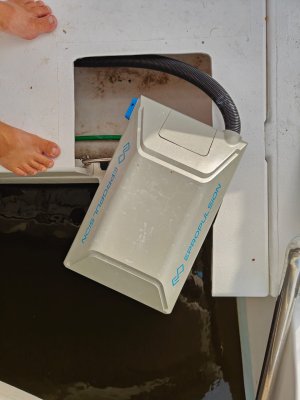
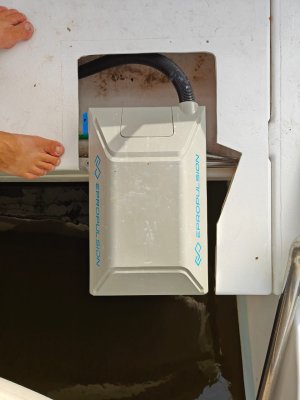
This is starting to look like a favourite solution to me. I'm thinking of giving the outboards another season, and so the 20-30 degree angle might just be the ticket. Unfortunately as you know these motors don't have a bolt to tighten at different angles. I did buy the extra piece to lock them into the forward position, so it does still mean I need to find a way to lock them at 20/30 degrees. Any ideas?
 
A 6kW electric outboard will produce 8hp.
An 8hp petrol outboard will produce 8hp.
The thrust in each case depends only on the propeller rpm, diameter and pitch.
In each case you could alter the above 3 parametets to suit slow heavy displacement or light fast planing craft.
That's all there is to it if we're talking about steady state performance at max power available. An electric motor will accelerate slightly faster as it has more torque at lower rpm.
Thrust also depends on propeller efficiency.
The OP's props don't have a huge blade area.

I don't suppose many alternative props are available to fit these motors?

As for steering the outboards, one could cobble something together using a cordless drill, some threaded rod and a few microswitches or even a potentiometer to make it a servo.
It's starting to look like a lot of controls though, two tillers or is it three, two throttles and two F/R, plus a boathook for oicking up a mooring?
 
Before spending a lot of money on pod drives which will compromise sailing performance and lose the ability to easily access props in the event of obstruction, I would try a variation of Dunedin's idea in #3.
When you need to manoeuvre fix port outboard to starboard about 20 or 30 degrees and vice versa. This should give you much better differential steering.
Anti-cavitation plates might help too.
I have a (single) motor same as yours and agree that when moving very slowly the prop easily sucks in air in reverse.
Just thought I'd post an update here. I set up the boat so I could move the motors +-25 degrees toe in on each and it's been a mind blowing difference when docking, I finally have control of the boat now. Thanks so much for suggesting it Alan!
 

Attachments

  • MotorStraight.jpeg
    MotorStraight.jpeg
    82.5 KB · Views: 3
  • MotorTurned.jpeg
    MotorTurned.jpeg
    91.3 KB · Views: 3
Top