Heavy Duty Fuse Holders for Battery Chargers?

Joined
20 Jun 2007
Messages
16,234
Location
Live in Kent, boat in Canary Islands
www.bavariayacht.info
I've decided to update the installation of my battery chargers. At present they are fused with standard ATO fuses: two domestic chargers @ 30A, one 24V charger @ 20A, and one starter charger @ 10A. The problem is that the connectors to the fuse holders are 1/4" FastOn, I don't like these at more than about 20A.

I had decided on Midi Link Fuses, but then discovered they are only available from 30A upwards.

Any other suggestions?
 
I had decided on Midi Link Fuses, but then discovered they are only available from 30A upwards.

I think 30A fuses would be OK for all four chargers, or rather the two smaller ones.
For the 30A chargers, perhaps 40A? At least, some margin.

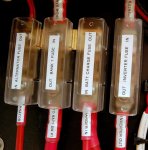
This photo shows a 30A fuse that sat in a circuit for a 25A charger, with a low quality holder. The fuse is not entirely blown, but half melted. I discovered by the charger never going above 12-13 A, regardless of battery state of charge. Initially thought the charger was faulty, but it was not.

fusemelt.jpg


Now as a fuse holder I use one similar to this:

https://www.bluesea.com/products/5028/ST_Blade_Fuse_Block_-_6_Circuits_with_Cover
 
Last edited:
Nigel .. Interesting that you ask about Midi Fuses.

I was just about to start another thread on 30A Midi Fuses - entitled 'When is a 30A fuse not a 30A fuse?'
 
The 30A MidiFuses will be fine for your needs; it's the wiring you're protecting. ATO fuses and spade connectors aren't great at higher currents.
 
The 30A MidiFuses will be fine for your needs; it's the wiring you're protecting. ATO fuses and spade connectors aren't great at higher currents.

Quote from our resident professional :

.........the misleading and potentially dangerous mantra that an over-current device is there to protect the cable, it is not, it is to protect the circuit (which includes but is not limited to the cable) and should be sized to protect the rating of the component with the lowest max current value downstream of the over-current device in the circuit.
Read more at http://www.ybw.com/forums/showthread.php?456301-Led-stripe-What-size-fuse#9hD2He01idDmTm3Y.99
 
Quote from our resident professional : .......the misleading and potentially dangerous mantra that an over-current device is there to protect the cable, it is not, it is to protect the circuit (which includes but is not limited to the cable) and should be sized to protect the rating of the component with the lowest max current value downstream of the over-current device in the circuit.

Don't believe everything you read on the internet, Vic, without interpreting what it might actually mean. As the only component downstream of the fuse, apart from the wiring, is the battery bank, what would you consider is the "component with the lowest max current value downstream of the over-current device"?
 
Don't believe everything you read on the internet, Vic, without interpreting what it might actually mean. As the only component downstream of the fuse, apart from the wiring, is the battery bank, what would you consider is the "component with the lowest max current value downstream of the over-current device"?

No I dont believe everything I read on the internet. The quote was from David Wright, who posts here as David 2452 and who does this sort of work for a living. http://www.ybw.com/forums/member.php?172-David2452

He frequently criticises people for saying that the fuse is there to protect the wiring when infact its there to protect the whole circuit, the wiring and the equipment connected by that wiring from the large current that a battery could deliver in the event of a fault. In this case it happens to be a battery charger although more usually perhaps some other piece of equipment

I have in the past been guilty of saying the same but his message has now got through to me so I pass it on to others making the same mistake.
 
No I dont believe everything I read on the internet. The quote was from David Wright, who posts here as David 2452 and who does this sort of work for a living. http://www.ybw.com/forums/member.php?172-David2452

He frequently criticises people for saying that the fuse is there to protect the wiring when infact its there to protect the whole circuit, the wiring and the equipment connected by that wiring from the large current that a battery could deliver in the event of a fault. In this case it happens to be a battery charger although more usually perhaps some other piece of equipment

I have in the past been guilty of saying the same but his message has now got through to me so I pass it on to others making the same mistake.

Well, since we are being pedantic....
An over current protection device protects the circuit as far as the next over current protection device, and should be rated to protect the component with the lowest max current value upstream of the next over current protection. :P with brass knobs on.
Otherwise Hinkley point would be fitted with a 3 amp fuse.
 
No I dont believe everything I read on the internet. The quote was from David Wright, who posts here as David 2452 and who does this sort of work for a living. http://www.ybw.com/forums/member.php?172-David2452

He frequently criticises people for saying that the fuse is there to protect the wiring when infact its there to protect the whole circuit, the wiring and the equipment connected by that wiring from the large current that a battery could deliver in the event of a fault. In this case it happens to be a battery charger although more usually perhaps some other piece of equipment

I have in the past been guilty of saying the same but his message has now got through to me so I pass it on to others making the same mistake.

You've carefully avoided answering my question! Don't just blindly repeat stuff which others have posted, believing it's true - think about it before you post.
 
Don't believe everything you read on the internet, Vic, without interpreting what it might actually mean. As the only component downstream of the fuse, apart from the wiring, is the battery bank, what would you consider is the "component with the lowest max current value downstream of the over-current device"?

Bit fudgy though, innit?, You have 2 energy sources, the charger and the battery...
A fuse at the battery terminal, from a charger point of view, downstream is only the battery, so fuse at a few hundred amps...
The same fuse when viewed from the other way, then its either the cable or the charger itself...
Should there be a fuse at both ends?, probably is since the charger will (hopefuly) have a fuse built in.
 
Bit fudgy though, innit?, You have 2 energy sources, the charger and the battery...
A fuse at the battery terminal, from a charger point of view, downstream is only the battery, so fuse at a few hundred amps...
The same fuse when viewed from the other way, then its either the cable or the charger itself...
Should there be a fuse at both ends?, probably is since the charger will (hopefuly) have a fuse built in.

I'd put the 30A fuse at the battery end of the charger cable, thereby protecting the cable from a short circuit.
 
... The quote was from David Wright ... He frequently criticises people for saying that the fuse is there to protect the wiring when infact its there to protect the whole circuit...
Indeed, and you beat me to it for saying so.

I've spent a long time searching, it seems the midi fuses are not available below 30A. What a pity, they are very nice.
 
Indeed, and you beat me to it for saying so.

I've spent a long time searching, it seems the midi fuses are not available below 30A. What a pity, they are very nice.

But they're fine for your requirement. The cable from your charger to the battery is just that - cable. There's nothing else in the circuit except the battery, which is the potential source of danger. So protecting the cable with a decent fuse is the right thing to do.
 
Hi Nigel,
I have used "Maxi" fuses in the past. Grown up versions of the ATO blade fuse. Good solid holders, they have M5 screws to take eyes. RS Components stock no. 787-4375. The smallest fuse is yellow, 20A stock no. 337-4023. Only trouble is min qty of fuses is 10 so a bit expensive, but you might find stock elsewhere.
 
NH fuses and holders are quite heavy duty. And easier/faster to replace than strip/midi types.

But if at all possible, use a breaker instead, then you don't have to carry spare fuses and fiddle with replacing them at all, and you won't run out of fuses during troubleshooting.

Splutter!
Fuse blows -> find and fix fault -> replace fuse
Not fuse blows -> replace fuse -> replace fuse until fault glows so you can see it!

edit add:
Or replace fuse with bigger one till it doesnt blow.
 
Top