Heat Exchanger losing coolant into exhaust hose on Volvo MD2030C

TillyBlue

New Member
Joined
5 Jun 2020
Messages
6
Visit site
Hi YBWers,

We are newbies on here so we'd like to thank everyone in advance for your support...

We have a Volvo Penta MD2030C engine and headed out the other day only for the Oil temp alarm to come on after 20 mins. We had checked all our levels before setting off - all fine! Alarm had never sounded before and in fact we had only just completed a 17.5hr motor a few weeks earlier without ANY issues.

Once the engine had cooled down (it was extremely hot), we checked the coolant and oil levels etc. There was only an inch of coolant left in the bottom of the heat exchanger, and no coolant to be seen!! Nothing in the bilge so had to assume some how it had exited out of the exhaust system!!

We decided to investigate and upon inspection discovered the elbow exhaust was heavily coked up and the tube stack tubes slightly clogged with bits of shell etc. but nothing major!

We performed the following maintenance:

1) Flushed Heat Exchange with fresh water whilst outlet pipe was disconnected and collected in bucket
2) Replaced elbow exhaust with a stainless steel version and one of the end rubber caps (both were absolutely fine but we slightly cracked one trying to get them both off, so though best to replace one of them!)
3) Cleaned up the impeller housing unit, changed the gasket and changed the impeller (the original was fine so kept it as a spare)
4) Cleaned the freshwater pump and changed the gaskets but not the o-ring as this looked fairly new still and not defective
5) Checked the spigot on the bottom of the Heat Exchanger - all clear!
6) Replaced the exhaust hose for the elbow exhaust manifold (as we simply could not detach the old one)
7) Cleaned the tube stack and light tested it for any cracks - all ok!

We put everything back together in the sound knowledge that we had checked everything possible, and on re-filling the Heat Exchanger with coolant we discovered it was still pouring straight through to the exhaust system!

Any ideas anyone as to why this is happening? We've triple-checked everything has been re-attached and tightened up! Everyone we've spoken to so far seem to think it's not due to any crack in the Heat Exchanger unit but we're now at a complete loss!! An I'm out of my quota for exclamation marks...

Thank you once again in advance for any advice in advance.

TillyBlue :)
 
There are two possible paths so job 1 is to determine which route it is going.
Route 1 is via a badly fitted end rubber in the heat exchanger allowing the coolant to leak into the seawater cooling system and then pass into the exhaust outlet via the seawater to exhaust pipe. Disconnecting this pipe will suggest if this maybe happening.

If there is no coolant visible at this disconnected pipe then it suggests there is a leak of coolant into the gas passages . If this is the case then more serious. Maybe you could check and say which route the water is taking.
 
This happened to me on my Perkins perama, same engine Volvo rebadged and called them vp2030, anyway it was the large jubilee clip on the forward rubber that had cracked underneath. lost most of the coolant before the engine stopped.
Suggest checking all the clips on the rubbers and make sure the smaller jubilee clips are secured to the pipe stack securely.
 
I’d check the heat exchanger - the other possibility is a cracked cylinder head but if it’s poring out possibly maybe something more. There’s a good article in Practical Boat Owner this month on the 2030 with engine issues may be worth a look?
good luck!
 
There are two possible paths so job 1 is to determine which route it is going.
Route 1 is via a badly fitted end rubber in the heat exchanger allowing the coolant to leak into the seawater cooling system and then pass into the exhaust outlet via the seawater to exhaust pipe. Disconnecting this pipe will suggest if this maybe happening.

If there is no coolant visible at this disconnected pipe then it suggests there is a leak of coolant into the gas passages . If this is the case then more serious. Maybe you could check and say which route the water is taking.


Thanks Bilgediver for your speedy response...

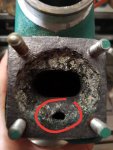
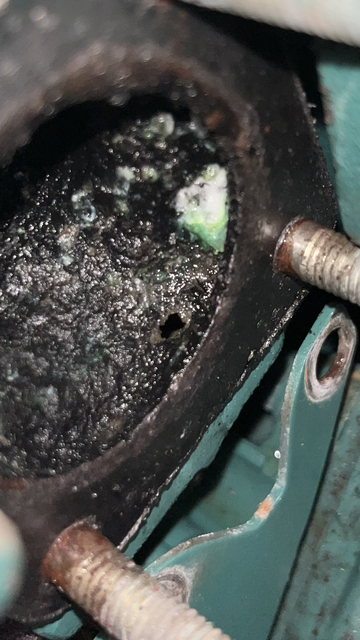
On closer inspection of the heat exchanger we discovered a small hole in the flange (the outlet connected to the elbow exhaust). Possibly caused by pressure build up from the coked elbow exhaust (good idea to check this every five years!).

Seawater must have been backing up over the years (our boat is 22 years old and the elbow exhaust had never been changed!) and weakened the cast aluminium flange which caused the coolant to exit from the heat exchanger into the elbow and out the exhaust hose.

We're now seeking an aluminium welder as the hole is no bigger than a little fingernail but significant enough to dump 4.5 litres of coolant out the back of the boat (which we are mortified about and seriously considering now an electric motor as a result!)

A very hard, potentially expensive and good lesson as to why every boat owner should check and maintain their engines regularly and over winter them correctly.

Just hoping the overheating issue hasn't caused any major damage anywhere else!

We hope this helps other boat users in the future ?
 

Attachments

  • 20200605_164012_resized.jpg
    20200605_164012_resized.jpg
    429.2 KB · Views: 64
Thank you to everyone for your replies...definitely worth checking all the options advised ?

We'll let you know how we get on!
 
Thanks Bilgediver for your speedy response...

On closer inspection of the heat exchanger we discovered a small hole in the flange (the outlet connected to the elbow exhaust). Possibly caused by pressure build up from the coked elbow exhaust (good idea to check this every five years!).

Seawater must have been backing up over the years (our boat is 22 years old and the elbow exhaust had never been changed!) and weakened the cast aluminium flange which caused the coolant to exit from the heat exchanger into the elbow and out the exhaust hose.

We're now seeking an aluminium welder as the hole is no bigger than a little fingernail but significant enough to dump 4.5 litres of coolant out the back of the boat (which we are mortified about and seriously considering now an electric motor as a result!)

A very hard, potentially expensive and good lesson as to why every boat owner should check and maintain their engines regularly and over winter them correctly.

Just hoping the overheating issue hasn't caused any major damage anywhere else!

We hope this helps other boat users in the future ?


If the welding does not work it might be worth Checking with Marine Enterprises in Dorset. They buy recondition and sell engines and may have one of these in acceptable condition .

There might be severe wasting of material in the area of that hole making welding difficult.
 
That looks like cast iron in the photo, you will not have much success with welding it. I think a mechanical solution would be better anyway, welding rusty metal is never easy. Can you drill the hole out and plug it, either threaded or a press fit? I cannot quite see what the hole connects with so be certain before doing anything.
 
If the welding does not work it might be worth Checking with Marine Enterprises in Dorset. They buy recondition and sell engines and may have one of these in acceptable condition .

There might be severe wasting of material in the area of that hole making welding difficult.
Thanks for the link, I've been looking for a good reconditioned engine as a spare for my charter boat.
 
I would clean the hole out throughly and fill with jb weld,the rest of the area looks choked up and needs cleaning,the top of the bore should be round and not straight.
 
Hi All,

Just an update on our coolant loss and heat exchanger issue. We managed to find an excellent welder who did an amazing job of cleaning up the heat exchanger flange, welding the hole, taking out the four holding bolts and re-polishing the gasket sighting area. New gasket and some Dirko HT gasket sealant and 3 litres of replacement coolant and she started up first time! Sounds sweet and running nicely so far. Welding cost £80! Which is by far cheaper than £850 for a complete new heat exchanger.

We opted for a stainless steel exhaust elbow which was slightly cheaper than a volvo original part.

So for any boat owners who are scratching their heads wondering where their coolant is going to when there is no sign of it in the engine or bilge, it has departed out of your exhaust system probably due to a hole in your heat exchanger, luckily ours was easy to get to and could be welded. Secondhand Heat exchangers are difficult to get hold of and you definitely won't want to chance your arm with one especially if you're making long passages as it's not the sort of thing you carry a spare onboard for. Either find yourself a very competent welder or take a deep intake of breath and replace the heat exchanger for a new part if it can't be welded.

To avoid getting to this stage we would recommend checking your exhaust elbow every 3-5 years dependent on your engine hour usage. Cleaning or changing it will save you from a more expensive job further down the line. If your elbow exhaust is coked up, seawater and gases back up into the heat exchanger causing corrosion and pressure.

We intend to clean out the old elbow exhaust (unfortunately with Brick acid) and retain this as a spare part.

Thank you again to everyone for your words of wisdom and hope our info also serves useful to boat owners alike.

Happy sailing :)
 
Very helpful thanks - read this thread before taking my D1-30 heat exchanger apart and guess what… ? Currently with an engineering firm being fixed ?

 
Top