Glueing handle back onto hatch

wicksta_105

New Member
Joined
20 Jun 2016
Messages
11
Location
Sevenoaks, UK
Visit site
Hi

I have a small hatch which, when opening today, the handle/latch just sheered off. On closer inspection it was just glued/bonded on to the 'perspex' or whatever it is (there are no holes through the hatch) - has anyone any suggestions/experience with the right sort of glue to fix it back on?

I've had a google/search on the forums and have ended up bewildered by the options.

Many thanks in advance,

James
 
Hi

I have a small hatch which, when opening today, the handle/latch just sheered off. On closer inspection it was just glued/bonded on to the 'perspex' or whatever it is (there are no holes through the hatch) - has anyone any suggestions/experience with the right sort of glue to fix it back on?

I've had a google/search on the forums and have ended up bewildered by the options.

Many thanks in advance,

James

Depends also what the handle is made of. If it is also perspex, it is easy - one-purpose perspex glue (perspex disolved in chloroform) will do magic. If anything else, it may be tricky because not many general-purpose glues bond perspex... The only one coming on mind is superglue. If it should work well, the matching surfaces should be as smooth as possible.
Another solution may be a high quality double-sided tape, I would try something by 3M. Their products are excellent.
 
Last edited:
VicS
09-12-12, 07:45
Its important that the sealant does not contain any solvent detrimental to the acrylic

If the sikasil-P is suitable for use with acrylic and UV resistant then fair enough.
It is a solvent free marine grade silicone with good UV resistance and said to be suitable for mineral and "organic" glazing!

The "marine" product from Sika for sealing and bonding acrylic and polycarbonate glazing is Sikaflex 295 UV but note that it is an adhesive sealant

Sikaflex Users guide (http://www.bluemoment.com/downloads/sikaflexusersguide.pdf)

.

vyv_cox
09-12-12, 17:47

Quite a few years ago I made the mistake of using Sikaflex 291 to bed polycarbonate windows. The following weekend every window was cracked. I replaced them all and bedded on Sikaflex 295 instead, which was still fine when I sold the boat. I heard later that many motorbike crash helmets, also polycarbonate, had cracked after people put adhesive stickers on them, due to stress corrosion caused by the solvent in the adhesive.

Well that's news to me! I would have thought 291 would be ideal.

Clive
 
Last edited:
VicS
09-12-12, 07:45
Its important that the sealant does not contain any solvent detrimental to the acrylic

If the sikasil-P is suitable for use with acrylic and UV resistant then fair enough.
It is a solvent free marine grade silicone with good UV resistance and said to be suitable for mineral and "organic" glazing!

The "marine" product from Sika for sealing and bonding acrylic and polycarbonate glazing is Sikaflex 295 UV but note that it is an adhesive sealant

Sikaflex Users guide (http://www.bluemoment.com/downloads/sikaflexusersguide.pdf)

.

vyv_cox
09-12-12, 17:47

Quite a few years ago I made the mistake of using Sikaflex 291 to bed polycarbonate windows. The following weekend every window was cracked. I replaced them all and bedded on Sikaflex 295 instead, which was still fine when I sold the boat. I heard later that many motorbike crash helmets, also polycarbonate, had cracked after people put adhesive stickers on them, due to stress corrosion caused by the solvent in the adhesive.

Well that's news to me! I would have thought 291 would be ideal.

More info in the Sikaflex Marine Handbook https://www.sealantsandtoolsdirect.co.uk/pub/pdfs/Sika_sikaflex_marine_handbook_.pdf

Clive

I think in fact Sikaflex 295UV is an adhesive and would be suitable provided it adheres to the material from which the handle is made

More info in the Sikaflex Marine Handbook https://www.sealantsandtoolsdirect.co.uk/pub/pdfs/Sika_sikaflex_marine_handbook_.pdf
 
Last edited:
If both parts are perspex(acrylic) then an acrylic cement will be the best. Search online for "Acrylic Weld Cement".

It's worth practicing before you do the job for real. I've had some very strong joints before, but also failures. The two pieces need to be a very close fit, the solvent "melts" the two surfaces but only by a small amount so there is no gap filling. You need to use enough cement to get a deep enough melt, but any run out will of course spoil the part of the hatch it runs into. Maybe use masking tape to protect it.

Acrylic can be sanded using fine grained sanding sheets, maybe 240 grit would be good for this. You could lay a sheet over the hatch and run the handle against it to get the shape correct.

As an aside, you can progressively use higher and higher grits and get an almost see through finish.
 
Thanks very much. I think the latch handle is some form of plastic rather than acrylic (see below) so I might try the Sikaflex rather than the acrylic weld. Reading around I've also seen stixall suggested especially because it is clear?

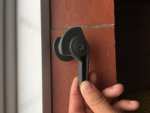
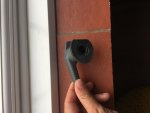
Pictures of the offending article - I assume this sort of thing is plastic rather than acrylic?
IMG_2917.jpgIMG_2918.jpg

Thanks again.

James
 
It looks to me like some high density polyethylene - another stuff hard to glue... I'd again suggest to look at the double-sided mounting tape by 3M. This stuff is incredible. I used it on a few occasions and find the bonds virtually impossible to break.
 
I've glued this kind of plastic (to another part made of the same, not polycarbonate windows - Gebo hatch handles) with gorilla glue, and that lasted until a recent gale with waves over the foredeck washed the exterior handles away. The spares are now glued on with (silica) thickened epoxy, after sanding and carving a "grid" pattern into the plastic to increase surface area. This seems to have formed a very strong bond.
 
The handle is glass-filled nylon. The original fixing method is a pressure/heat fixing method...these are notoriously difficult to re-attach in the field.

There is a "small handle kit" available which could be used. Rather than glueing to the acrylic, this kit involves drilling a fixing hole, and the handle is thru-screwed into an external moulding.
 
Thanks very much for all the advice - I'm instinctively nervous of trying to glue it because it seems to me that the joint will have to withstand quite a lot of torque when closing the hatch shut - it was doing this that caused it to shear off in the first place. Especially if it was originally done with some fancy pressure based system that I couldn't hope to replicate.

The lewmar handle kit looks like a good option for a better fix. Is there anything I should know before drilling perspex...?

Have found http://www.ybw.com/forums/showthread.php?166403-Drilling-perspex-hatch and, accordingly, I think I will try to get a couple of drill bits for ceramics.
 
Thanks very much for all the advice - I'm instinctively nervous of trying to glue it because it seems to me that the joint will have to withstand quite a lot of torque when closing the hatch shut - it was doing this that caused it to shear off in the first place. Especially if it was originally done with some fancy pressure based system that I couldn't hope to replicate.

The lewmar handle kit looks like a good option for a better fix. Is there anything I should know before drilling perspex...?

Have found http://www.ybw.com/forums/showthread.php?166403-Drilling-perspex-hatch and, accordingly, I think I will try to get a couple of drill bits for ceramics.

Small pilot hole, drill slow.
Then drill final hole from either side of the acrylic into the middle to avoid break-out of the top/bottom surfaces.
 
Top