Gelshield 200

LeonF

Well-Known Member
Joined
25 Jun 2001
Messages
1,217
Location
South London
Visit site
My 1996 fully encapsulated long keel hull is about to be sand blasted. Was originally Gelshielded. I've gouged it in places over the years stripping anti fouling etc. I'm hoping the blasting will go through the grey layer and leave me the green. International suggest applying two fresh layers then antifouling within 3/4 hours. I'm inclined to use a primer like SMS Shield over the gelshield 200 as I use their Cupro anti fouling. Does the Gelshield need laying off after brushing on/rolling on ? Or should I just skip Gelshield and use something like Jotun antipest two part epoxy primer ? The Gelshield has certainly worn well.
 
Gelshield is obviously a barrier coat. I'd be pretty careful what you do if I were you and I'd follow the Gelshield directions.

When put 3 coats of Alex Barrier coat I had to put the firs coat of Altex No 5 anti fouling on before the barrier coat had fully cured (when you could mark the barrier coat with your fingernail)
 
My 1996 fully encapsulated long keel hull is about to be sand blasted. Was originally Gelshielded. I've gouged it in places over the years stripping anti fouling etc. I'm hoping the blasting will go through the grey layer and leave me the green. International suggest applying two fresh layers then antifouling within 3/4 hours. I'm inclined to use a primer like SMS Shield over the gelshield 200 as I use their Cupro anti fouling. Does the Gelshield need laying off after brushing on/rolling on ? Or should I just skip Gelshield and use something like Jotun antipest two part epoxy primer ? The Gelshield has certainly worn well.
I applied Gelshield 200 to a clean grp hull followed up by a coat of hard antifouling on tacky epoxy 20+ years ago. It has never given any cause for concern. I would do exactly as International suggest.
 
We hand scraped our hull (never again) back to the original epoxy coating. Applied 6 coats of Gelshield followed by Seajet antifoul. Superb products gave excellent results, we sold the boat 16 years later with no signs of adhesion problems. Only one coat of Seajet annually kept the paint accumulation down so we didn’t have to blast/scrape again.
 
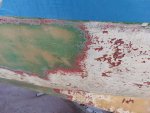
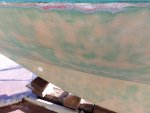
Thanks everyone. This what the hull looks like at the moment. I believe it's clear gelcoat, slightly discoloured by the green Gelshield ? No strands of matt visible. Slightly orange peel, I may give it a gentle wet sanding. I still haven't made up my mind what to use before I antifoul. Either Gelshield 200, tow coats recommended by International, or Jotuns Penguard HB epoxy ? 20230327_094502.jpg20230327_170020.jpg
 
I think your gelcoat is long gone !
That looks like bare polyester and mat layup.
The boat was originally navy blue so I can't imagine what colour the gelcoat would have been ? The white square at the front is the same on both sides so looks like it's where they had something to handle the lead keel that was filled once the keel was encapsulated and they were removed.
 
There is a lot of confusion here. Gelshield 200 is a solvented epoxy. It dries matt so no need to worry about waiting before you antifoul. It needs 5 coats.

Gelshield plus is UNsolvented and needs wet on tacky and only needs 2 coats.
 
Last edited:
Think that should be Gelshield plus is unsolvented.

Maybe boats had osmosis treatment, where the gelcoat was stripped off. I think the unsolvented epoxy is what you’d use in these cases, as there’s no gelcoat to prevent solvent absorption.
 
Think that should be Gelshield plus is unsolvented.

Maybe boats had osmosis treatment, where the gelcoat was stripped off. I think the unsolvented epoxy is what you’d use in these cases, as there’s no gelcoat to prevent solvent absorption.
Absolutely right my typo will fix. In trying to clarify I made it worse!!
 
Top