G70 chain

Neeves

Well-Known Member
Joined
20 Nov 2011
Messages
14,070
Location
Sydney, Australia.
Visit site
This may have been covered previously - I might have missed it.

For those with an interest in saving weight in their rode.

Jimmy Green historically sold Maggi chain from Italy, G40 and G70. Maggi developed a reputation, I'm not sure it was deserved, for poor galvanising and not long after the complaints of galvanising started to surface Maggi went into some form of 'administration' (this was maybe 2-4 years ago). I believe Maggi continued to trade under the administrators.

I note that Jimmy Green are now offering a G70 (and G40) galvanised anchor chain from a company called MF in Italy

High Strength MF DAMS Grade 70 Calibrated Anchor Chain - Jimmy Green Marine

It appears Corrado Maggi, who was MD at Maggi, departed from Maggi (maybe it closed down or assimilated into another company) and now is employed at MF and MF are now making a G40 and G70 anchor chain. It appears that Corrado persuaded MF to produce and market the G40 and G70 products (or that's my interpretation).

Like the original Maggi product the MF G70 is a 'true' G70 - unlike the Peerless G70 (which confusingly does not meet G70 specifications - the feedstock is G70 but on galvanising the strength is degraded to around a G55 quality, but they still call it galvanised G70). The MF G70 is thus stronger than Peerless G70 product (made at the Peerless ACCO plant in America). MF now have a minimum specification for galvanising thickness, the first specification I have seen for galvanising of a marine leisure anchor chain, of minimum 80 microns (though that minimum is subject to a caveat :) ). They are also claiming some form of original and unique improved galvanising process - the technical details of which are 'vague'.

I suspect it is too early for any feedback from users on what all this means.


The life of an anchor chain is effectively determined by the life of the galvanised coating. Lives of around 4 years of effectively continuous usage were achieved on Maggi's G70 and G40 product. that's anchoring every night (except on passage) and anchoring in one place might be for days - so effectively over 1,000 days at anchor. This life - very subjective, was repetitively posted as poor. It merits mention that a galvanised coating of, say 80 microns, that lasts being dragged over an abrasive seabed is actually surprisingly good over 4 years. The galvanised coating is actually quite hard, harder than the underlying steel. However when measured the galvanising also incorporates some raw zinc, which is quite soft - but it shiny. The coating that 'does' all the work is the underlying alloys, of Zn and Fe - and its the underlying coatings that offer abrasion resistance. If all anchor chain makers defined their specification - then the thickest coating should last the longest. Coating thickness is easy and quick to measure - it should be part of specification (as thickness determines life).

Jonathan
 
Johnathan, your slipping, it has taken you nearly a week to start Februarys anchoring thread on YBW :unsure:

Shame there is no G70 x 6mm, that would go nicely with your idea of little tiny anchors to save weight or have longer chains and no I am not commissioning my own chain. I want reliability backed by a known manufacturer and someone else to test the galvanising in the real world first. I don't want to be the first mouse to the mouse trap on this occasion. What we need is a journo who is interested in this stuff.

Take care.
 
Interesting reading thanks.

Sorry for the basic question but what does the G stand for? I’m guessing galvanised.
Another basic question, 70 is better than 40 due to the thickness Of the galvanising?
 
Interesting reading thanks.

Sorry for the basic question but what does the G stand for? I’m guessing galvanised.
Another basic question, 70 is better than 40 due to the thickness Of the galvanising?
You will find a considerably more detailed explanation on my website, but very briefly, G simply stands for Grade. The 30, 40 and 70 are the strengths of the wire used, 30 being mild steel, 40 with some alloy constituents and 70 a heat treated version of 40.
 
Interesting reading thanks.

Sorry for the basic question but what does the G stand for? I’m guessing galvanised.
Another basic question, 70 is better than 40 due to the thickness Of the galvanising?

Jonathan had his own 6mm G70 chain made by buying a length of plain lifting chain and then having it galvanised, which I guess works for him.
 
The thread was meant to be about drawing attention to the Jimmy Green G70 but as Pete7 raised the issue:

I suspect that the MF G70 is based on a G100 feed stock, otherwise I cannot see how they do it, my thoughts seem supported by how Gunnebo have gone about the same exercise, see below.

The galvanising process I used has been tested by the US Navy, which might be close enough to the real world for you Pete. The US Navy spec for coating is 80 micron, I prefer belt and braces and specify 100 microns. The US Navy's focus is on weight saving and as the gal coating is harder and thus more resistant to abrasion they are claiming longer life and thus significant cost savings.

In addition to my own 6mm chain I have also 'helped' with the coating of a 100m x 8mm chain to replace a conventional 10mm chain for a 43' Ovni, who in addition to owning the Ovni is owner of one of Australia's bigger boat builders, for Marine Police etc and a further 100m x 6mm chain, replacing 8mm chain, for a 50' tri.

Gunnebo (now owned by Crosby) make a galvanised 6mm G80 but it is based on a G120 feed stock - and G120 is achieved by using a G100 wire but of a size 10% larger in diameter than normal. Whether this would fit a conventional gypsy is unknown. In addition to Pete''s caution there does seem an absence of matching components for a galvanised G80 - but with Crosby in the background that might change.


The original 'G' numbers reflected the strength of the wire from which the chains are made - that simple idea is slowly being eroded as Peerless don't make a galvanised G70 to that definition (its a G70 chain, that is then galvanised and as its marked G70 - they sell it as G70. Gunnebo's galvanised G80 falls into the same sort of category. Fudging is developing. Check the UTS of some of these more exotic chains - the strength data is a better selection of quality.

So using 'plain' lifting chain seems accepted by Peerless, accepted by Gunnebo, possibly accepted by MF - so if its good enough for them - its good enough for me.

Interesting comment from Pete on wanting the backing of a known manufacturer - I wonder how many in the UK know a single Chinese chain maker, apart from CMP. I know not one of these chain makers offers a galvanised coating specification and I suspect few if any buyers request to see a test certificate of the chain they buy. Yet he will not buy a chain galvanised by a process endorsed by the US Navy, which would be tested, his actual length would be tested by an independent NATA approved facility for ultimate strength, and extension to break.

Odd world.

Jonathan
 
The MF website now shows that they offer 6mm and 7mm G70 HDG chain. Has anyone had any experience of this? Is this new?
 
Jonathan had his own 6mm G70 chain made by buying a length of plain lifting chain and then having it galvanised, which I guess works for him.

A bit of repetition for you Pete - to ensure you have read and understood - saves you being critical unnecessarily.

I think you will find that G80 or G100 lifting chain is not described as 'plain'.

There are 3 x 6mm rodes and 3 x 8mm made using the Armorgalv process here in Oz. One 6mm rode was 75m, one was 60m all the other rodes are 100m with most also opting for an extra 30m to incorporate in a mixed rode as a spare or second rode. Operators in Israel regularly coat HT chains for anchor rodes and the US Navy have made 1,000s of metres. You would hardly be the first were you to use the concept. All you need to do is keep upto date and not show ignorance.

The chains made here are tested for strength by a NATA test facility, (NATA is as independent as you will get for testing). all I do is submit the samples. The test certificate provides UTS and elongation - now tell me how many chandlers support their sales with individual certification. I wonder do you have a test certificate for your own rode? Tell me how many chandlers know what the gal thickness is - gal thickness determines life. The galvanising thickness is measured by the coating operator and I check as a back up. Samples of the chain are supplied to each purchaser and if they have doubts they can have the samples tested themselves. The samples for thickness need to be specially prepared - its difficult to measure gal thickness on a curved surface. The hardness of the coating, which determines gal life has been confirmed at Woolongong University. I run tests to compare the resistance of the abrasion, in comparison to HDG. This is unnecessary as the gal coating thickness is greater than HDG and the combination of hardness and increased coasting thickness is well known to result in better abrasion resistance. Tests on this have been run by Bisalloy, amongst others. The rodes are supplied complete with enlarged links, chain hooks or bridle plates and a Boomerang if requested. The shackles to join the enlarged links to anchor are best supplied by the customer as they have their own choice of anchor. However I can recommend where to buy shackles, Crosby obviously but I can source from Campbell and Peerless in America, a manufacturer in Taiwan and 2 manufacturers now in China. I can arrange to have shackles tested in a NATA facility. You will undoubtedly mock supply from China - where do you think CMP source their shackles? The rodes would be marked at 10m intervals if requested.

The costs for a complete rode, enlarged links etc are less than buying an HDG chain (not a complete rode) from a chandler. I make no money from all of this - I just collect the data for future articles - which results in people arranging to make their own rode - or asking me for assistance. A British yacht, owner a member here, on a circumnavigation asked me to do this and his rode, 100m x 8mm will be delivered to him in Cairns over the next 14 days. His rode comes complete with Boomerang, chain hook, enlarged links and spare enlarged links. He knew of me though YBW, as he is a member here. You, Pete, may be sceptical but many are not. One of the other 8mm rodes was supplied to the owner of one of Australia's largest boat builder - supplying Marine Police with their offshore motor boats - he bought the chain for his own Ovni. He was not sceptical.

The downside is you need to have matching gypsy - so the best time to do all this is if you need a new windlass or are buying a new yacht. You also need to use sensible snubbers as you have sacrificed some catenary but the upside is you save weight in the bow and have more space in the bow locker.

Now Pete - tell me a chandler who offers all of this at a lower price than a 'plain' G30 length of chain. Tell me Pete how if you buy G70 chain you know what strength you are getting, where do you source the enlarged links of the correct strength that will match the shackles, where are you going to buy the swivel (better a Boomerang) of the correct strength and size and then the chain hook and bridle plate. If you want G70 chain you need to scratch around to find matching components, none of them are independently tested and most chandlers will not understand a snubber (or bridle).

Take care, stay safe

Jonathan
 
Last edited:
The MF website now shows that they offer 6mm and 7mm G70 HDG chain. Has anyone had any experience of this? Is this new?
Johnathan, your slipping, it has taken you nearly a week to start Februarys anchoring thread on YBW :unsure:

Shame there is no G70 x 6mm, that would go nicely with your idea of little tiny anchors to save weight or have longer chains and no I am not commissioning my own chain. I want reliability backed by a known manufacturer and someone else to test the galvanising in the real world first. I don't want to be the first mouse to the mouse trap on this occasion. What we need is a journo who is interested in this stuff.

Take care.

Maggi received a lot of flak as it was said that the galvanising did not last. The main complainant suggested that a 4 year life, what he achieved, was not good enough and did not compare with other manufacturers. This was all based on someone living on their yacht.

This all occurred a number of years ago.

Since then I have monitored what liveaboards say about the life of their galvanising (both here on YBW and on CF) and added comment from people who know how much their chain has been used and 4 years seems about right - or 1,200/1,400 nights at anchor. That's a wear rate of 1.5 microns a month - at anchor each night and some days with the chain dragging on an abrasive seabed.

The criticism of Maggi was unfair and as far as I can ascertain completely wrong.

A typical galvanised coating is about 80 microns and to expect an 80 micron coating to last, even, 4 years is (to me) quite amazing.

Galvanising can be lost due to chemical attack and there have been reports, very difficult to believe, that people who have anchored in slow moving rivers in Asia have lost their gal due to acid attack. High nutrient waters are host to anaerobic life that exudes sulphur containing compounds that are acidic. This is common in old harbours, sheltered muddy bays and slow moving rivers (think smelly muds). All gal will be eroded by acid - I have seen no tests to allow differentiation.

The other comment made has been that a smaller chain will lose its gal more quickly than a larger chain. I ran some tests comparing 6mm, 8mm, 10mm and 12mm HDG and Armorgalv chain and basically chain size has little effect - you cannot differentiate between 6mm and 12mm. You can differentiate between an Armorgalv coated chain and a HDG chain - Armorgalv last longer. Abrasion is a function of surface area, weight and the time on the seabed and resistance a function of thickness and hardness.

I'm sure doubting Pete will not want to believe this - maybe he and the complainant over Maggi gal life can get together and conduct some tests of their own - instead of being critical without any foundation.


I note that Maggi's demise and the fairly frequent criticism of their galvanising occurred at a similar time - and wonder if the criticism may have been a factor in their failure. Needless to say I dislike people who are critical based on a very subjective comment. Now if I misjudge - I would like to see supporting data.


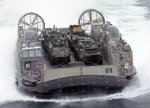
This is one use of the US Military of Armorgalv coated HT chains - the tie downs on military vehicles on landing craft, lots of abrasion and seawater. The other application is for anchor rodes for small craft. The move from HDG to Armorgalv was because HT chain can be smaller and is easier to handle but the major reasons were increased longevity resulting in financial savings. The US Navy are using G100 (and I believe G120) as feed stock for the coating.

US_Navy_030113-N-2972R-114_A_Landing_Craft_Air_Cushion_(LCAC)_Vehicle_from_Assault_Craft_Unit_...JPG


Our own usage of 6mm chain is basically - unremarkable. It does what its meant to do. You do notice if you have hand retrieved your old chain and need to hand retreive the new, smaller, chain - it is much, much easier. If you keep the 'same' size windlass - which is what we effectively did - the load on the windlass will also be less.

What we have noticed is that the Armorgalv coating polishes well, sort of looks like black stainless, and this should allow the chain to shed mud more easily. Companies offering an Armrogalv coating service are now offering polished product.

There are other processors than Armorgalv, Greencote is one and there is another called Impreglion. Between the 3 they service most of the world. They are all geared up to service small runs, like a 100m rode and its components.

One of the fears of using G70 chain is - what do you do when the gal wears off - which will be inevitable. The answer is simple - take it to a galvaniser and have it re-coated. If its an HDG chain then the re-coating will be at the same temperature and there will be no change to chain strength. Similarly if you take your chain to a processor using one of the alternative processes, but NOT HDG then re-coating will not impact chain strength as the process temperatures are the same. The only thing to watch is that you don't want you chain acid washed, if it is a HT chain. The chain needs to be grit blasted Or dragged behind a vehicle on a hard sandy beach :). Acid washing is said to be a cause of Hydrogen Embrittlement. Armorgalv use grit blasting as part of the process.

Pete said "What we need is a journo who is interested in this stuff." I have stripped HDG chain and Armorgalv coated chain and had them re-coated and strength is not impacted. To allay Pete's fears - my results are supported by Peerless - who have come to the same conclusion - at least for HDG

You can make you own rode - or have it made for you. Later you can have it re-coated when the coating wears.

There are a few tricks if you want to have your own rode made - send me a PM with your email address and I'll send you a pdf with some of the tricks that are not mentioned in the pdf.

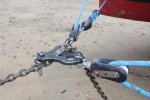
IMG_5022.jpeg

Jonathan
 
Last edited:
I'm sure doubting Pete will not want to believe this - maybe he and the complainant over Maggi gal life can get together and conduct some tests of their own - instead of being critical without any foundation.
Jonathan

Lets just correct this shall we. I never doubted or even mentioned Maggi chains. This is what I said:

I want reliability backed by a known manufacturer and someone else to test the galvanising in the real world first. I don't want to be the first mouse to the mouse trap on this occasion.

In other words since chain is expensive, I really don't want to have to do it very often.
 
Lets just correct this shall we. I never doubted or even mentioned Maggi chains. This is what I said:

I want reliability backed by a known manufacturer and someone else to test the galvanising in the real world first. I don't want to be the first mouse to the mouse trap on this occasion.

In other words since chain is expensive, I really don't want to have to do it very often.


My, we are sensitive - no-one said you mention Maggi chain but the only, named, chain for which galvanising has been an issue is Maggi - and so by inference the only chain that would need tested would be Maggi. Of course no chain, of which I am aware mentions a specification for chain though their is an allusion to a special process for the chain that Jimmy Green now stocks. But there is a complete absence of detail on what is so special about it and there is certainly no independent review of what they claim. I always wonder about manufacturers making claims without independent support.....?

My view is that if there was a special process for galvanising chain, or galvanising anything, it would not be a secret to Jimmy Green and their supplier. Others would know the advantage and would be offering the exact same process.

Chain is expensive if you buy from a chandler - if you have it made for you and check the credentials of the gal coating it is much cheaper. I'm sorry but I'd rather rely on an assessment by the US Navy than some liveaboard whining about something he knows nothing about.

You are not going to know of the reliability of the chain that Jimmy Green is offering for years - so I hope you are patient. But be careful of user comments - as I suggest, many have no objectivity. A user to pass comment needs to start his evaluation by measuring the gal thickness of his, new, chain.

Now -tell me any user who has any idea, at all, about the gal thickness on his chain. We now need to differentiate between the outer coating of raw zinc, which is soft and abrades quickly, and the alloy layers that are metalurgially bonded to the underlying steel. Not easy. The 100 micron coating I specify or the 80 micron coating the US Navy specify is all alloy - there is no raw zinc. If you are lucky then a 80 or I believe in Europe a 70 micron HDG gal coating is part zinc - and its the alloy layer that provides the abrasion resistance. So you actually don't need the coating thickness but the alloy thickness -I and the US Navy specify that 80 or 100 microns - now tell me what the alloy thickness is on your chain.

Now of course you are. not interested in any of this and you simply want to close you mind to new ideas - and ignore the moves made by the US Navy. Luddites rule.

I hope you are young - you will not get the answer you want till you are a good few years older - during which time you might have bought 2 new, short lived, rodes.

But thank you for the comments - you have given me further opportunity to air my ideas :)

Take care, stay safe

Jonathan
 
Our chain lasts about 4 years. Really it's probably 3 years but we put up with some rust for a season before replacing. We have no choice other than to replace since there is nowhere to get chain regalvanised in the Caribbean. That rules out G70 for us as it's costly chain only to end up scrapped.
 
My, we are sensitive -
Not at all, just don't like being miss quoted or something implied which isn't true. As a Journalist I sure you would agree the truth is important.

I'm sorry, but I'd rather rely on an assessment by the US Navy than some liveaboard whining about something he knows nothing about.

Apology accepted. You live on board don't you?

Now if you wrote an article that said company XYZ produces really good chain that has been shown to last, well I would take notice of your comments. A bit like someone testing anchors and producing lots of underwater footage on YT. All interesting data of what actually happens.

You are not going to know of the reliability of the chain that Jimmy Green is offering for years - so I hope you are patient.

Excellent, I will take your recommendation and buy my next chain from them if its going to last years.

But be careful of user comments - as I suggest, many have no objectivity. We now need to differentiate between the outer coating of raw zinc, which is soft and abrades quickly, and the alloy layers that are metalurgially bonded to the underlying steel.

I really don't care about the thickness of zinc on a chain, just it's well made and will last. There are more important things in life.

Now of course you are not interested in any of this and you simply want to close you mind to new ideas - and ignore the moves made by the US Navy. Luddites rule.

Why have you called me, a complete stranger, a Luddite? That's not nice on a Gentleman's forum, no wonder you keep getting banned from them. I look forward to yet another apology soonest.

I hope you are young - you will not get the answer you want till you are a good few years older - during which time you might have bought 2 new, short lived, rodes.

What on earth has my age got to do with anchor chain? Can I suggest buying a known brand from a reputable dealer is likely to achieve the best outcome. As I said earlier, there are more important things to worry about.

One of the shackles your photo isn't moused and the other two have cable ties complete with sharp tails. Disappointing and a total lack of attention to detail for a professional writer who spends so much time on forums concentrating on such a small subject area.
 
Last edited:
Interesting. The MF chain is also available at SVB (if you click the datasheet you'll see): High Strength Anchor Chain / galvanised from 29,95 € | SVB

Prices are about 2.5 times that of the Maggi G70 chain, which is by the way also still available from Nautilium: Ricerca prodotti

At that price it however must compete with high quality stainless chain such as Cromox DIN 766 8mm CXA8 AISI 318LN.
 
Last edited:
Interesting. The MF chain is also available at SVB (if you click the datasheet you'll see): High Strength Anchor Chain / galvanised from 29,95 € | SVB

Prices are about 2.5 times that of the Maggi G70 chain, which is by the way also still available from Nautilium: Ricerca prodotti

At that price it however must compete with high quality stainless chain such as Cromox DIN 766 8mm CXA8 AISI 318LN.

This may all be true - but the original Maggi website appears to have evaporated and Corrado Maggi who was the MD and 'invented' Maggi's Aqua 4 and 7 now works at MF.

Jonathan
 
Top