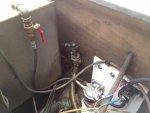
Fuel system upgrade.......your thoughts?

The Dogs Pollacks Brother

Well-Known Member
Joined
14 Nov 2011
Messages
294
Location
Portskewett
Visit site
Bora Da from sunny...but windy...Wales everyone.
Well the electrics have been completely re-wired now so on to the next job.
I am upgrading the fuel system on the Grumpy Uncle and contemplating fitting one of the new solid state electric fuel pumps in the line.
Currently it is like this......fuel tank----CAV type filter with primer pump------mechanical lift pump------engine mounted CAV type filter---------injection pump.

I am just wondering if I should leave the mechanical lift pump in the line, or do away with it completely? It does work, but its the origional on an old BMC 1.5 so is looking old and tatty. My thoughts behind taking it out of the line are simply it will be 2 less joints in the fuel line to worry about.

If I leave it in, I guess I could wire the pump so that it is switched manualy as and when I need it......e.g, bleeding, at start up (I read they can assist starting?) or purely as an emergency.

My early thoughts on the new system are to set it up as follows........fuel tank------electric pump-----new double CAV filter assembly (with glass water seps on each filter)------injection pump.
So in essence, I still have the two filters but they are in one unit and the whole thing will be fed by a 12v pump.

Any thoughts or pointers greatly recieved as usual guys n gals
Jeff.
 
I did a similar upgrade a couple of years ago - I left the mechanical pump inline, and have the electrical pump separately switched - that way, I can use it for quickly bleeding the system after a filter change, and as an aid to starting if the engine hasn't run for a few weeks, but otherwise leave it off, knowing it's there if the mechanical pump should fail.
 
I have a slight reservation about these pumps - they generally come with an inline filter. I assume this is necessary due to the tight tolerances of their working parts. If you install them before the main filter, the tiny mesh in the pump inlet will be taking the full load of crud from the tank. If it blocks it won't be obvious, you probably won't have a spare, and it may be fiddly to change.

Pete
 
My thoughts on this are: why would you want to remove the mechanical pump which has proved itself over the years to be utterly reliable and replace it with something that can fail? With the mechanical pump if you suffer a total electrical failure the engine will carry on running. In addition you would have the inevitability of the electric pump itself failing to worry about. What would be the benefit?
 
Thanks for all the input guys.....some very valid points there!
The pump I am looking at has NO inline filter it would seem, so perhaps I could mount it AFTER the new twin filters?......would this still allow me to bleed the filters after a change though as it will be sucking rather than pushing fuel?
I am being swayed more and more to leaving the mechanical pump in line and just putting the electric one in as an aid/back-up jobby........
 
Mechanical lift pumps are cheap, reliable and not difficult to change. Why not just carry a spare if you're concerned?
I agree, after a recent experience, that it's a good idea to have twin filters that can easily be changed over.
 
Last edited:
If I was spending proper money, I might want a system incorporating a small day tank after the coarse filter.
So that in the event of a filter blockage or lift pump failure, you can run the engine using clean diesel from a can poured into the day tank.

Just an alternative.
At the bottom level, there is no substitute for either knowing that your main tank is reasonably clean and being able to clean it sensibly.
If you have enough crud in the tank to block one filter when it gets stirred up on a lee shore, how likely is it to block the second filter when you switch over?
 
Mechanical lift pumps are cheap, reliable and not difficult to change. Why not just carry a spare if you're concerned?
a) Electric pump - £35, Mechanical pump - £100 plus...
b) With electric pump, system can be bled at the touch of a switch, so swapping out a blocked fuel filter takes minutes. With mechanical pump, either the engine has to be spun over for ages on the starter motor, or the small lever on the pump (if there is one) has to be wiggled up and down (after first turning engine to correct spot so that cam drive to mechanical pump doesn't stop aforementioned lever from working) and may be awkward to reach.
c) By fitting both, you have an instant spare already fitted and working - so keep the mechanical pump as the main device, but fit a parallel electric pump for backup and bleeding - that way, you get the best of both.
 
Would you put the electric pump in series with the mechanical lift pump - between the primary filter and the lift pump, or in parallel? If in series ( which would be simpler), would the electric pump add significant resistance to the fuel when only using the mechanical pump?

Neil
 
Mine is in series. The electric pump has a non-return valve incorporated, which is a bonus. It doesn't seem to affect the performance of the mechanical pump. Even with the engine stopped, if just the electric pump is on, fuel circulates around the system and back to the trank return.

Photo-0013.jpg

Both the filter and electric pump are mounted on a quickly-detachable back-board, so the filter and water drain can be at the level of the tank bottom, but it's easy to change the filter cartridge without having to be upside-down in the engine compartment. I painted the pump for better corrosion-resistance, and marked the flow direction clearly on it, to avoid any connection errors.
 
Last edited:
Last time my mechanical fuel pump packed up, it was on the way back up the Solent, coming back from the Med, after having been totally trouble-free for the previous 11 years. What would have been an hour's motoring, against the wind, to get back to my mooring, turned into a 4 hour sailing trip, beating up Southampton Water against wind and tide - not a disaster, but certainly unwelcome. It turned out that the rivets holding the pump actuating arm to the pump diaphragm had sheared. The repair has now lasted 16 years - but if it fails again, a flick of a switch and the problem is solved. Sometimes an engine failure can be the prelude to a disaster, and having a backup is cheap insurance. I certainly wouldn't suggest replacing the mechanical pump with an electric one though!
 
Top