Fuel supply - Tank/Engine

Yorkshire Exile

Well-Known Member
Joined
17 Apr 2017
Messages
247
Visit site
There are two hoses running between my plastic diesel tank and the engine. One has a stop valve fitted and i assume that is fuel out and the other has no valve apart from a connecter half way (a non-retrun valve?) and i assume that is the unused fuel return. If my reading is correct then last year these two hoses were fitted incorrectly i.e. the fuel return entered the tank at the outlet valve and the fuel feed left from the fuel return connection on the tank on its way to the primary filter. The engine worked fine all year even when there was only about 10 litres in the tank.

So, should it have worked and what are the implications?

Thanks in anticipation of authoratative, helpful replies!
 
Two things come to mind. (Not authorative but hopefully helpful!)
You are unable to isolate your fuel tank.
If the stop valve is closed inadvertenly, it might damage your fuel pump

The stop valve surely isolates it? As to closing the stop valve inadvertently, doesn't your comment apply to almost every boat?
 
pvb - Not sure what you mean. There are two hoses and four connections. Let's call the two conections at the tank A (fuel outlet) and B (fuel return), and the conection at the primary fuel filter C and engine fuel return D. So the correct configuration would be A to C and D to B. What I had was D to A and B to C. I never thought a simple post wuold turn out to be so much fun.
 
There are two hoses and four connections. Let's call the two conections at the tank A (fuel outlet) and B (fuel return), and the conection at the primary fuel filter C and engine fuel return D. So the correct configuration would be A to C and D to B. What I had was D to A and B to C.

Yes, all of that is what you said in post 1. And I answered in post 2 that if the connections both have dip tubes (as good practice dictates) then it wouldn't make a difference.

But then in post 5 you raised the possibility of the fuel valve closing off the return to the tank, which suggests that the fuel valve is in the return line. However, in post 1 you mentioned that you believe the return line has a non-return valve in it, in which case it could not have functioned as the supply line, as no fuel would reach the engine.

That's why I said it's not clear.
 
pvb - I can only profusely apologise for causing such confusion. I do hope that i haven't inadvertantly transgressed the dictates of good practice.
 
pvb - I can only profusely apologise for causing such confusion. I do hope that i haven't inadvertantly transgressed the dictates of good practice.

No need for that sort of reply. If you want clear answers it helps if you pose clear questions. I'll try not to help you again.
 
Yorkshire Exile,

From your original post, I read it that the line that had a stop valve in it should be the fuel supply line – so that you could isolate the engine from the tank when you wanted to change fuel filters, for example. If this line was then used as the return line from the fuel pump, closing the stop valve while the engine was running would put back-pressure on the fuel injector pump, possibly causing damage. I don’t know for sure. I am not a diesel fitter.

But as pvb said, if the other line has a non-return valve in it (as you suspected), it could not be used as the supply line. Further investigation might be required.
 
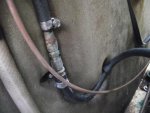
Thanks drawp. I agree that the stop valve could not be used to isolate the engine from the tank which could be a problem in an emergency e.g. fire. Like you I'm unsure what the effect would be if the valve was closed and prevented exceess fuel from returning to the tank. I suppose the design and length of the pick up pipes could cause complications. I tried to upload a photo of the valve? in the return line but for some reason the system wouln't allow it.
 
I am confused. Does the fuel line that is connected to the fuel filter have a stop valve or non return valve fitted?
Also, what makes you think they are fitted wrong at the tank? Are the connections at the tank clearly wrong (as in one connection at the top, one at the bottom of the tank) or are they marked? If both go to the top and dip tubes are fitted there is a possibility that one could be shorter than the other. In which case you will need to remove them to find out.
It depends on what type of injection pump you have as to what damage may result from blocking the return, either way engine will stop.
 
Looks like two hose tails joined together, used to join two lengths of pipe. Doesn't look like a non return valve, but simply remove it and look through it and you will know for sure.
 
Looks like two hose tails joined together, used to join two lengths of pipe.

That was my first thought even before seeing the picture - more likely any unidentified fitting in the middle of the hose was a lash-up used to join two lengths than that it was a non-return valve.

As for swapping the tank connections, the supply and return fittings on and in my tank are completely identical. I'm actually not sure whether I put the hoses back on their original fittings or not after rebuilding the fuel system - with my tank it makes zero difference. There are three dip tubes, two identical big ones with banjo fittings on top for flow and return, and a small one with a built-in hose barb for the eberspacher. Your tank may be similar.

Pete
 
Do you have a builder's diagram of the fuel hose routing?
Probably not, like most of us.....

Note that the fuel supply from the tank will commonly have a ball valve located at the tank outlet, whether from the tank base or a dip tube. The return line will enter the upper/top part of the tank with no impediment or any 'dip' tube.

Perhaps first you need to explore and find out, for certain, just how these two hoses are routed. Check for chafing potential while you are doing this... typically not work that you want to perform very often. :)

I previously replaced all of the original fuel system hoses in our boat, and last year installed a new Betamarine engine package. Sometimes the routing of these original fuel hoses will keep you guessing!
Good luck.
 
Last edited:
Top