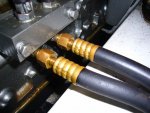
fuel line fittings

pcatterall

Well-Known Member
Joined
2 Aug 2004
Messages
5,507
Location
Home East Lancashire boat Spain
Visit site
With my new fuel pump came fittings for 1/4" copper pipe comprising a brass male fitting and a small rubber olive. I did fit them and they seemed to work without leaks. I guess that the rubber is just compressed and forms the seal. I am concerned that a good pull or slight pull and vibration could pull the pipe out. A brass olive seems to compress the pipe and cannot pull out. I have also seen the pipe end flared as in a brake pipe. I have also used plastic pipe with a brass insert and olive and this system seems ok.
Are these rubber seals OK and what is considered the best fitting these days?
 
I have also used plastic pipe with a brass insert and olive and this system seems ok.


"This Goodyear marine fuel hose exceeds SAE J1527 international standards and is CE & US Coast Guard & ISO 7840 Approved
 
Last edited:
I’m not familiar with those fittings, but can you not just secure the tube to the bulkhead (or whatever) close to the pump so that there cannot be any pull away from it? I would call that good practice regardless of the type of fitting.

Pete
 
I have also used plastic pipe with a brass insert and olive and this system seems ok.


"This Goodyear marine fuel hose exceeds SAE J1527 international standards and is CE & US Coast Guard & ISO 7840 Approved

I thought using plastic fuel pipes, or normal fuel hose inside the engine bay was verboten due to fire risk. I understood that it should be Copper fuel pipes, (Sometimes they are galvanised), when required due to heat issues, like to or from the high pressure fuel pump, or braided fuel hose for secondary fuel filter or lift pump, if you don't want to use all Copper.
Barrel olives are slightly better than stepped for metal pipes, and I always use PTFE tape once the oilive has been fitted just in case.
How compression fittings work (plumberparts.co.uk)
 
Have to push back on the use of PTFE tape in combination with compression fittings - if the fitting have been installed correctly PTFE tape is not necessary, if you deem PTFE tape is necessary then remake the fitting properly. Small pieces of PTFE tape can cause blockages in small orifices and disable a fuel pump, if you lack confidence in your compression fitting skills then use a small amount of liquid thread sealer.
 
I often come across olive fittings where the female part has ptfe wrapped around the thread ? That just screams " I don't know what I'm doing" as a leak will escape through the pipe hole in the compression nut and ptfe will do nothing.
 
...inside the engine bay ... it should be Copper fuel pipes, (Sometimes they are galvanised), when required due to heat issues, like to or from the high pressure fuel pump, or braided fuel hose for secondary fuel filter or lift pump ...

I don't think this is correct.

1. One has to use a flexible hose to connect fuel to the engine as the engine moves on its anti-vibration mounts. The hose has to be to ISO7840 A1 which is approved for use in engine compartments - and in fact can be used throughout: you don't have to use rigid pipe at all. This pic is typical (it doesn't look braided but conceivably is inside the plastic sheath):

P1010261_compressed.jpg

2. On the engine they are usually rigid pipes I agree, but not, I think Copper, let alone galvanised Copper, but steel. This is both because Copper risks fatigue fracture with such a high vibration environment and, more importantly, because Copper and diesel fuel are not supposed to be in contact according to many engine manufacturer's procedures and QA standards (it's an ULSD stability problem, so maybe this only applies to the more modern engines?). The short Copper stub to compression fitting in the pic above was fitted not by the engine manufacturer (Kubota) but by the boat builder, and is only an inch or so long anyway.
 
Last edited:
I don't think this is correct.

1. One has to use a flexible hose to connect fuel to the engine as the engine moves on its anti-vibration mounts. The hose has to be to ISO7840 A1 which is approved for use in engine compartments - and in fact can be used throughout: you don't have to use rigid pipe at all. This pic is typical (it doesn't look braided but conceivably is inside the plastic sheath):

View attachment 131017

2. On the engine they are usually rigid pipes I agree, but not, I think Copper, let alone galvanised Copper, but steel. This is both because Copper risks fatigue fracture with such a high vibration environment and, more importantly, because Copper and diesel fuel are not supposed to be in contact according to many engine manufacturer's procedures and QA standards (it's an ULSD stability problem, so maybe this only applies to the more modern engines?). The short Copper stub to compression fitting in the pic above was fitted not by the engine manufacturer (Kubota) but by the boat builder, and is only an inch or so long anyway.

You can use Copper fuel pipes from a secondary filter to and from the HP pump, as those parts are both on the block, it's the fuel feed and final return line from the primary filter that are subject to some movement issues. Within the engine bay area they should be stainless steel mesh over normal diesel fuel lines. Ouside that area standard car flexible pipes are OK if you can't use Copper due to an Alloy hull etc.
You might be right about some of the silver looking pipes, as they could be stainless. Not cut one up to find out what they are made of. Not sure about other fire resistant fuel lines, as the ones in the picture look expensive.
 
I often come across olive fittings where the female part has ptfe wrapped around the thread ? That just screams " I don't know what I'm doing" as a leak will escape through the pipe hole in the compression nut and ptfe will do nothing.
I agree, but if the fittings are old, a belt and braces approach is worth considering. Thread locker will not stop a leak from a badly fitted olive, although I do use it for oil feed lines. Lots of different types of thread locker, so it is essential to check if it's OK for oil and fuel, and not a seriously tough locker, otherwise you will have to use a blow lamp on the fitting to get it off!
 
With my new fuel pump came fittings for 1/4" copper pipe comprising a brass male fitting and a small rubber olive. I did fit them and they seemed to work without leaks. I guess that the rubber is just compressed and forms the seal. I am concerned that a good pull or slight pull and vibration could pull the pipe out. A brass olive seems to compress the pipe and cannot pull out. I have also seen the pipe end flared as in a brake pipe. I have also used plastic pipe with a brass insert and olive and this system seems ok.
Are these rubber seals OK and what is considered the best fitting these days?
Not sure of your system but just overhauled an old diesel car... high pressure end and low pressure... no olives on high pressure end (I followed Haynes Manual). Low pressure just used good tight fitting nitrol (hose?)
 
Top