Fuel Guard - Fuel polishing/filtering system - any advice?

I made my polishing kit with a Baldwin filter separator with a Holley pump. It is important to suck through the filter then the pump. If you pump first the motion can breakdown droplets into particles too small to separate effectively.


I also use instant dripless connectors - Male on both ends of the polishing set up, with females on each engine / tank system - tank low point; fuel pre-filter inlet from tank; spill return line.


I can draw from either tank and return to either tank. The connection on the pre-filter allows me to prime the pre and on engine filters, whilst also pushing fuel back into the tank through the normal pickup so if I ever pick up a slug of muck I can blow it back into the tank. Normal operation is from the low point connection and back via the spill line.

 
Last edited:
I simply added a circulating pump to pump the fuel from my tank through the existing engine fuel filter and back to the tank.

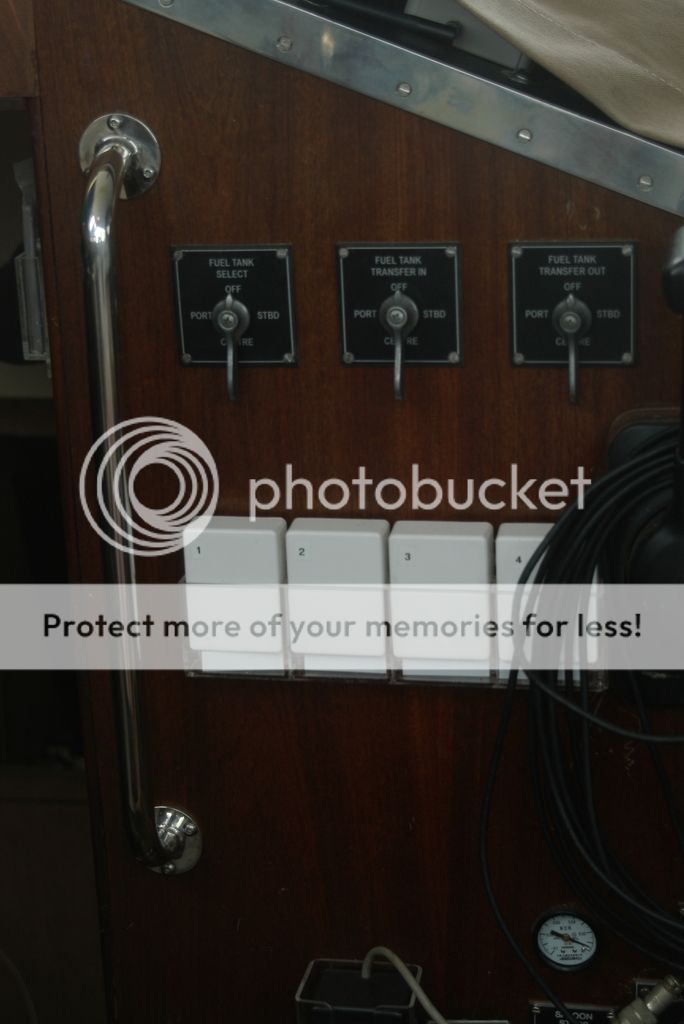
Mine was a little more involved as I have 3 tanks and used 2 three way valves to use the same setup for each tank. It also allows me to transfer from one tank to another.

IMGP2693_zpsziniddwn.jpg
 
Last edited by a moderator:
I'm considering fitting one of these fuel polishing/filtering systems to my boat.

http://www.fuel-guard.co.uk/

Basic filter kit £255 seems good value.

Has anyone advice or recommendations please?

There seems to be no detail on that website as to what the "free fuel polishing kit" comprises. The filter itself is a lot of money for a basic 30 micron filter. OK, the filter element can be cleaned and re-used, but that would be a messy process and you can buy a hell of a lot of cartridge filters for £255. I'd be tempted to spend a lot less on a decent 10 micron cartridge filter.
 
I thought about this, but in the end decided against doing so.

I decided that the disaster had already occurred by the time you had pumped a load of dirty fuel into your tanks. Even with a polisher the water and muck is going to settle on the bottom and then potentially get stirred up when at sea, or worse, stay there and gradually rot the bottom of the tank.

I therefore decided to avoid the problem before it occurred and have bought the largest fuel filter on the market - about £60, so its a lot less expensive as well. It takes the fuel through it at full chat and seems to do a very good job of removing everything but the fuel, albeit I havent yet come across some bad fuel. Doubless somewhere they are going to complain about using a filter funnel, but that hasnt happened yet. With 300 gallon tanks hopefully I will not be too bothered anyway and just go somewhere else.

Its early days but I am hoping it is a better solution combined with some additive as well which cant do any harm.
 
There seems to be no detail on that website as to what the "free fuel polishing kit" comprises. The filter itself is a lot of money for a basic 30 micron filter. OK, the filter element can be cleaned and re-used, but that would be a messy process and you can buy a hell of a lot of cartridge filters for £255. I'd be tempted to spend a lot less on a decent 10 micron cartridge filter.

Peter, you just can't stop saving me money, even old posts!
 
I thought about this, but in the end decided against doing so.

I decided that the disaster had already occurred by the time you had pumped a load of dirty fuel into your tanks. Even with a polisher the water and muck is going to settle on the bottom and then potentially get stirred up when at sea, or worse, stay there and gradually rot the bottom of the tank.

I therefore decided to avoid the problem before it occurred and have bought the largest fuel filter on the market - about £60, so its a lot less expensive as well. It takes the fuel through it at full chat and seems to do a very good job of removing everything but the fuel, albeit I havent yet come across some bad fuel. Doubless somewhere they are going to complain about using a filter funnel, but that hasnt happened yet. With 300 gallon tanks hopefully I will not be too bothered anyway and just go somewhere else.

Its early days but I am hoping it is a better solution combined with some additive as well which cant do any harm.

hello, i fitted this system 2 years ago.
IMHO Much depends upon your tank outlet to the fuel guard circuit and the outlet to the engine fuel filter.
I believe the outlet to the filter/polishing system is ideally taking diesel from the very bottom of the tank.
It is here that the foreign particles and bug will lay.
If you are always sailing in very calm conditions only, the chances of particles or bug getting stirred up are less.
If your diesel outlet pipe to the engine comes up high into your tank, as it should, in some cases many centimetres, then it maybe only rough conditions for a long period of time, on a fairly empty fuel tank, that you will see particles and bug getting sucked into the engine filter line and eventually bringing things to a standstill.
I am witness to having this very problem.
I was involved in serious conditions offshore for 3 days on a lowering fuel tank.
By half way down the tank, the engine began to fail due to bug as we were entering a port of refuge in NE Spain. It was one member of crew who continued to assist the fuel to the engine by continuously operati guess the lift pump for around 2hrs, otherwise the engine would die.
My tanks do not have the outlet to the engine as high up into the tank as i suggest it should be,
A regular polishing from the bottom of the tank will give you the better protection.
The Safe Guard pump is fairly rapid and noisy. However, every time you go for a shop, a beer, a stroll, a ride in the dinghyec, you could be giving yourself the best insurance policy against the bug.
?
 
My first experience of realising that a lot of yacht fuel tanks don't draw from anywhere near the bottom was the engine coughing due to sucking a mix of air and fuel when it got a bit lumpy. Finding you can't use the last two gallons ever, or the last four gallons in choppy water was more than a bit irritating.
The best insurance against the bug is to draw fuel from the bottom of the tank and get the water out. There are several ways to do that. Ranging from manually making an effort with what you have at no cost, to spending a few hundred quid on installing extra dip tubes, pumps, filters, day tanks whatever you choose.
 
Top