
Frozen seacock tips and which way to close

farmer.leo

Well-Known Member
Joined
8 Oct 2011
Messages
80
Visit site
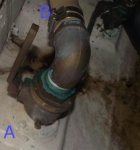
Which direction should the vertical handle rotate, towards A or B?
open.jpg

Also, any advice on how to free up a frozen seacock? Not sure if it froze from corrosion, or pushed too hard in the wrong direction, or a combination.
 
Which direction should the vertical handle rotate, towards A or B?
View attachment 48636

Also, any advice on how to free up a frozen seacock? Not sure if it froze from corrosion, or pushed too hard in the wrong direction, or a combination.

On all the ones I've taken off the ball will rotate in either direction, so it is the handle that limits rotation. Those little lugs on the spindle of the handle will determine which way it can go.

Calcium deposits internally seem to be the worst cause of siezing. Is it a heads outlet?
 

It's usually the heads outlet where the calcium builds up.

If you can reach the ball with a long screwdriver when the boat is on the hard you might be able to scrape or knock away enough calcium to be able to turn it. Also safer to use brute force when out of the water.

I replaced one last year (had to replace the skin fitting too). Frustrating as the old one was perfect apart from the calcium deposits, but it was impossible to reach, so no alternative.
 
It's usually the heads outlet where the calcium builds up.

If you can reach the ball with a long screwdriver when the boat is on the hard you might be able to scrape or knock away enough calcium to be able to turn it. Also safer to use brute force when out of the water.

I replaced one last year (had to replace the skin fitting too). Frustrating as the old one was perfect apart from the calcium deposits, but it was impossible to reach, so no alternative.

Yes, we will fiddle with it next time it's hauled.
Can you tell from the photo which direction we should "ease" the handle?
 
Yes, we will fiddle with it next time it's hauled.
Can you tell from the photo which direction we should "ease" the handle?

No but unless there are any stops that prevent it it will close clockwise. I dont think I have ever come across a valve that doesn't, from little cocks to big high pressure steam valves.

It may well, probably will as suggested) turn in either direction
 
As a general rule. righty tighty lefty loosy works.
In line open, across closed.
Most ball valves have a little tab on the 180 opposite side of the handle. which comes up against a stop on the main casing after rotating 90 deg clockwise.
In an awkward spot where you can't see, feel with your finger..

To free it I would suggest.
direct heat to casing with a heat gun.
The casing should heat up faster and expand more than the ball.
A couple of good sharp taps with a hammer on casing. right around it. and directly on the end of the spindle(not the handle).

The handles on the valves are sometimes not very robust so be careful if trying a pipe or hammering the handle.

If you do wreck the handle some can still be removed and a cresent wrench of the right sise
may still work.

once you get it to move. open and close every now and then
 
As a general rule. righty tighty lefty loosy works.
In line open, across closed.
Most ball valves have a little tab on the 180 opposite side of the handle. which comes up against a stop on the main casing after rotating 90 deg clockwise.
In an awkward spot where you can't see, feel with your finger..

To free it I would suggest.
direct heat to casing with a heat gun.
The casing should heat up faster and expand more than the ball.
A couple of good sharp taps with a hammer on casing. right around it. and directly on the end of the spindle(not the handle).

The handles on the valves are sometimes not very robust so be careful if trying a pipe or hammering the handle.

If you do wreck the handle some can still be removed and a cresent wrench of the right sise
may still work.

once you get it to move. open and close every now and then

I suggested a similar process to a friend in the summer and also suggested trying to let some diesel soak in first for a week or so before pouring boiling water over the valve (no heat gun available). He was worried about trying this in a marina as it has been shut since he bought the boat and holding tank is full. I didn't expect the diesel to do much but worth a try before heating. I think that he decided to wait until lift out before resolving the problem. I don't think there are any pump out facilities nearby and wouldn't want to be around when it I opened on the hard.

It will be interesting to see if heat does free it but intend to find out from a very great distance. :D
 
My vote is for c/wise to close too.

While not teaching multiple grannies eggwise, easing is done both ways incrementally to allow the seizing gunge to work loose. If easing is possible before a fracture, you'll feel which way moves most and go mainly in that direction.

N
 
Take it very easy with long levers and/or hammering the handle. The connection between the ball and stem is usually brass and a lot less meaty than the spindle, so hearty heaving may well cause it to rotate without moving the ball. Personally I would plug the skin fitting with a suitable piece of wood or plastic and fill the valve with dilute hydrochloric acid, bought as brick cleaner from a wide variety of suppliers, e.g. B&Q. Make sure it is HCL as some are not. It will only take five minutes for all the calcium deposits to be dissolved.
 
If you can mask off the GRP with foil or rockwool then apply some heat with a heatgun a bit of light tapping might free it avoid plastic pipe area or you might get a nasty surprise.
 
Personally I would plug the skin fitting with a suitable piece of wood or plastic and fill the valve with dilute hydrochloric acid, bought as brick cleaner from a wide variety of suppliers, e.g. B&Q. Make sure it is HCL as some are not. It will only take five minutes for all the calcium deposits to be dissolved.

I cola to get rid of calcium deposits on the outlets. I left the pipes attached and filled them from a one-litre bottle of the cheapest pop I could find. The initial reaction was surprisingly violent with lots of foam. Left overnight and the sea-cocks had freed completely.
And people drink the stuff!
 
"On all the ones I've taken off the ball will rotate in either direction, so it is the handle that limits rotation. Those little lugs on the spindle of the handle will determine which way it can go." quote from Ipdsn

detents are the little lugs on the body of the valves
 
Gotta say to the OP, you've more guts than me to leave a seacock in the open position long enough to sieze! Close ours whenever we leave the boat.
 
Which direction should the vertical handle rotate, towards A or B?
View attachment 48636

Also, any advice on how to free up a frozen seacock? Not sure if it froze from corrosion, or pushed too hard in the wrong direction, or a combination.
From the first day on the job as an apprentice. If there is a handle, it is open when in line with the pipe, closed at right angles to the pipe. ALWAYS turn clockwise, looking at the handle, to close. Anticlockwise to open. If opening a wheel handled valve, open fully, then close half a turn. This is so the wheel is loose, signifying that it is open. If someone opens it fully against the stop then it can feel fully shut and people could damage it trying to open it further.
S
 
Success. Flushed the cheapest 3 liter of cola over the course of two weeks. Then a heat gun for about a minute and a half. Light tapping with a hammer in the clockwise direction (facing the seacock) moved it straight away. After it was closed, tried flushing some water and it was indeed closed.

I'll be sure to operate all seacocks on a regular basis.

Is there anything else I should do with the problem seacock between now and next haul out? Don't know if it's worth the trouble to remove the waste hose, pour more soda in, or maybe mild acid. Apply lanolin. Or should I consider it resolved as long as its operated on a regular basis?
 
Top