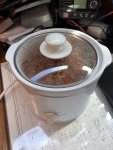
From Gas to Electrons...

... so, it can be done!

Yes, we spent two days over Easter just using electric cooking. No shore power and charging just with solar. We are about 30Ah a day short so an upgrade to the 300w solar needed next winter perhaps.

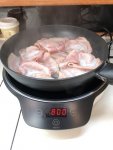
We actually started experimenting last summer with a mix of gas and electric and halved our gas usage, mainly by using a small 0.8L Argos kettle. We drink a lot of tea. As Kelpie says, you don't need a lot of power to cook with induction, certainly not the max power figures some are capable of. Also induction hobs cycle on and off like a fridge, so the over all power draw is way less than expected.

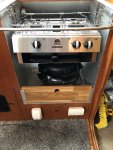
We ditched the old cooker and installed a gas hob and grill which gives us space underneath to store the air fryer.
 

Attachments
  • Bacon.JPG
    Bacon.JPG
    140.9 KB · Views: 14
  • IMG_0920.JPG
    IMG_0920.JPG
    164.1 KB · Views: 15
  • Spag Boll.JPG
    Spag Boll.JPG
    182.7 KB · Views: 17
  • Hob and grill.jpg
    Hob and grill.jpg
    237.1 KB · Views: 17
Last edited:
It can be done, but is hardly green.

Let's make calculations of the relative CO2 emissions from three means, assuming 1 kWhr is required to make your daily meals (approximately one burner for one hour). 1kWhr is 3.6 MegaJoules. Even if this number is way OTT for your cuisine, since it's relative efficiencies we are calculating the absolute number isn't important.

ELECTRIC COOKING WITH INDUCTION HOB POWERED FROM A GENERATOR
Assume efficiency of energy in to energy imparted to the food is 90% for your induction hob (probably it's a bit less).
Generator's use (pretty much all of them, from 3kW to 35MW) about 210g of diesel per kWhr (see for instance Brake-specific fuel consumption - Wikipedia) so to get 3.6MJ into the food one needs to use 210 / 0.9 = 233g of diesel.

In terms of CO2 emissions, that's 233 / 142 = 1.64 moles of Decane, C10H22, so 1.64 * 10 * (12 + 2*16) = 722g of CO2.

ELECTRIC COOKING WITH INDUCTION HOB POWERED BY SHORE-POWER
Same induction hob at 90% efficiency.
In 2020 the UK average - so including renewables and nuclear as well as gas - for electricity generation was 233g of CO2 per kWh (btw, this has to fall to below 50g by 2030 to meet our climate commitments - which gives an idea of the scale of changes we still need to make).

In terms of CO2 emissions, that's 233 / 0.9 = 259g of CO2.

BURNING LPG ( PROPANE)
Assume only 50% efficiency of enthalpy of combustion into the cooking pots (probably pessimistic).
Enthalpy of combustion is around 50MJ per Kg, so to get 3.6/0.5 = 7.2MJ you have to burn 144g.
Propane is C3H8, molecular weight 44g, which when burnt converts to 3 x (12 + 16) = 84g of CO2.

So 144 / 44 * 84 = 275g of CO2.

CONCLUSION
Cooking by propane is pretty much a wash with using shore-power in terms of CO2 emissions, and emits only 38% as much as cooking with an induction hob and a generator.

As shore-power gets greener (less emissions per kWh) the advantage of using induction hobs will increase, and for those with sufficient solar and batteries it's already better, but no way is it green if you have to use an engine or generator to power it. Finally, Propane can be made from renewables anyway; it's a by-product of bio-diesel manufacture.

CONTEXT
What is 275g of CO2 compared to motoring? Suppose your motoring uses about 3 litres of diesel an hour.
That's 3 * 0.85 = 2.55Kg, which makes 7.9Kg of CO2. Hence a day's cooking on gas is the equivalent of motoring for all of 275 / 7900 * 60 = 2 minutes. And I assume you do bicycle to the boat...


Interesting

Now compute the environmental impact of getting the propane (from wherever) to your yacht, electricity from your solar panel - we are going to need some new ideas or more Lithium if we want to cook 'all electric'.

Jonathan
 
Interesting

Now compute the environmental impact of getting the propane (from wherever) to your yacht, electricity from your solar panel - we are going to need some new ideas or more Lithium if we want to cook 'all electric'.

Jonathan

We're not electric just for environmental reasons. It's about becoming as self sufficient as possible, and also reducing the heating inside the cabin. Oh and an induction hob is a pleasure to clean compared to a gas one.
 
As we are. Whilst we will keep the gas hob for a while as it provides a gimbaled surface for cooking at sea, being able to cook properly from electricity generated free from solar appeals to me.

5 years ago we went down to the West country for two weeks. The camping gaz ran out early in the holiday but no problem there is a spare cylinder. However, I was shocked to find it empty at 8pm at night. Now I am quite religious about changing cylinders straight away so couldn't understand why. A fellow yachtie tied up along side lent us an electric kettle so we could make a cuppa. We bought an electric kettle the following morning. However, the search for gas was a disaster. Tried marinas, chandlers, garages and campsites. No one in the West country had gaz. We finally bought the last half sized gaz cylinder from Nos marina which we eked out to get us home. Determined not to be caught short again we switched to Calor gas :rolleyes: and we know how that's going post covid.

It just opens up a very useable alternative, even if you only use it on shore power. However, even a modest LifePO4 / solar set up enables a cooking in more remote locations on a small yacht.

Pete
 
Last edited:
Sod that at least on a 26'er Gas to the cooker, light it with a flint striker or a match. Hot food is very important on a passage. too important to give over to wriggly amps. Of curse if you have a 30m yacht with a diesel generator......
 
We've been cooking electrically since last year. Left the gas cooker in place and occasionally still use it e.g. after a few days of dull weather.
We have 1kw of solar (plus another 200w which can be deployed at anchor). A 270Ah DIY lithium battery (cost less than equivalent lead acid capacity). A 3kw inverter (total overkill, but should be long lived as it doesn't work hard).
The hob is a Vango Sizzle, 2*800w which sounds puny but it's actually fine most of the time. We don't need to cook in a tearing hurry like we did when we lived in a house. The only time we feel that it's underpowered is for steaks or large stir fries. We could always get a more powerful single burner. For an oven, we use a Remoska, drawing about 500w. Also have a toaster.

Very pleased with the project. We've used one bottle of gas since moving aboard last summer. There's noticeably less condensation from electric cooking, and less background heat. And yes I do feel a bit of smug going weeks on end living entirely off solar power. It's just one less thing to worry about, especially changing countries and having to deal with different gas bottles.

What sort of area does 1kw of solar occupy?
 
I do recall in the deeper recesses of my memory (which I am trying to forget) that in some parts of the UK you have clouds and rain - what is the fall back - or do you just go hungry. We use the air fryer at home for the 2 of us - but when we entertain the air fryer is simply too small.

I know - you could run the engine(s), have a gen set or a wattnsea - or all three. But now you need redundancy - which you never really needed with gas (as you scheduled the gas replacement and never ran out).

I am also constantly reminded that ones use of electricity seems to increase to slightly more than the ability to generate said power - all this essential components, iPads etc etc soon eat up the electrons and no matter how big your battery bank (or what it is made from) it always seems to be running low.

We have an electric kettle, toaster and bread maker - and we schedule the bread maker such that its high power usage (when actually baking as opposed to kneading and proving) occurs when we run engines - entering or leaving an anchorage - but you cannot do that so easily for making porridge.

Jonathan
 
I do recall in the deeper recesses of my memory (which I am trying to forget) that in some parts of the UK you have clouds and rain - what is the fall back - or do you just go hungry. Jonathan

We have a Victron DC/DC charger from the engine battery to the LFP. As you said sometimes we have clouds and rain so used the Victron twice during a 3 week cruise last year. Solar did the rest with a mix of gas and electric cooking.

You might assume gas is easy to source. In the UK cylinders are exchanged not owned. Problem is there's a shortage of the more popular caravan and yacht sized cylinders, though god only knows why.
 
Pete,

Here every petrol station has a stock of gas cylinders - its part of the culture built round bikinis, beaches and BBQs (with, in this case, the emphasis on the BBQ). Every petrol station sells bait (for fishing :) ). Same background but developed to a different culture. If you go off piste you need to plan and most caravans (and our cat) carry 2 cylinders. We would go part electric, air fryer and the like, but we needed to replace our house bank 400ah - at the time when lithium was a bit nerdy - and the new bank is currently fine. In hindsight - or now - lithium would be very sensible - but even here it rains (wettest quarter on record) and we would want a fall back (which seems to be your option also). Its interesting the speed with which lithium and electric cooking (on a yacht) has gained acceptance, like GPS.
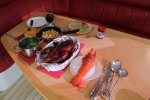
Cooking is a major thing for us - we are not camping in the 1960s - and we fish, catch crays and try to eat, and drink, well. Oddly we steam fish In a microwave (have done for decades) but like slow cooked casseroles (thermal cooker aka Shuttle Chef). There is no one answer and we like and would want the choice as we cannot get a duck into an air fryer but it fits neatly in our gas oven :)


IMG_4896.jpeg

The advantage of gas, currently, is that if you have the kit - and have no pressure to change - gas is easy and a cylinder from the service station is cheap.. Lithium means more solar, different charging system, new appliances (that don't neatly fit the space) - the money adds up.

Give it a few more years.

Jonathan
 
Has anyone considered converting their on board cooking facilities from gas to electric?
Induction hobs are now chap. Microwave ovens are quite efficient. Toasting can also be rather fast and homogeneous.

Just a thought.

Yes. We’ve been using an induction hob and microwave for the last five years - mainly on shore power.

It was amusing a couple of years ago in an anchorage on a dull day when I was worried about using the inverter. We couldn’t remember how we used to make a cup of coffee in ‘the old days’ then we remembered that we could turn the gas on!!!
 
We have a Victron DC/DC charger from the engine battery to the LFP. As you said sometimes we have clouds and rain so used the Victron twice during a 3 week cruise last year. Solar did the rest with a mix of gas and electric cooking.

You might assume gas is easy to source. In the UK cylinders are exchanged not owned. Problem is there's a shortage of the more popular caravan and yacht sized cylinders, though god only knows why.
I think the shortage of the small cylinders is that they are stuffed in garages and sheds all over the place, there now is a growing secondhand market delveloping and some I know are accumulating to speculate on future value, this just makes it worse when added to the calor business model.
 
Top