Fresh water and anodes

peteandthira

Well-Known Member
Joined
13 Jan 2005
Messages
786
Location
On boat
Visit site
Hi all

After sitting in Glasson Dock (fresh water) for a month, followed shortly afterwards by 3 weeks in Penarth (fresh water) I was warned that my anodes might not be working 'cos they're zinc and should be magnesium.

I lifted the old girl out and replaced the anodes, again with zinc. The old ones were shot after only 6 months. There was no sign of electrolysis anywhere else. I have 10 days left in fresh water now before moving on and returning to salt water.

Are the anode-aware amongst you able to tell me whether this is OK, ie the 10 days in fresh water with new salt water anodes?

Thanks as ever

Pops
 
I'm not sure that I understand the question 100% but:

1. If your anodes are shot it proves that they are in fact working, if there is no sign of electrolysis elsewhere the better but be aware that you can't check everyting inside the engine for instance or reverse gear etc...

2. The speed of the electrolysis depends of the conductivity of the medium, salt water is 10 times more conductive than river water. I don't believe you should use different kind of anodes in salt or fresh water. But some fresh waters are heavily polluted with acids and that could probably change a lot. Perhaps we need someone with a chemistry background to answer this in full.

3. Zinc or Magnesium? It depends of what metrial you want to protect. The further away materials are from each other in the galvanic series of metals the better the higher ranked material is protected by the lower. The lowest in the rank is magnesium. Zinc is 2 places higher. Meaning if you have an aluminum boat use magnesium as anode. If you have an iron boat you can use zinc (cheaper an will last longer) but you could also use magnesium.
 
I kept my boat in Glasson Marina 2004 & 2005. I think there must be a high level of stray electical currents in this fresh water marina. I'm particularly attentive to this matter as mine is an aluminium boat.

After a few weeks in fresh water your zinc anodes will become ineffective as they will become coated with a white deposit, if this is scraped off they are OK again. For protection in fresh water you need magnesium anodes. I suspended one of these over the side whilst in Glasson Marina and the rate of errosion was very rapid - suggesting something may be amiss with the wiring running down the pontoons or on one or more of the attached boats.
 
Zinc anodes will be fine for very short trips to freshwater, though you might want to give them a scrub afterwards to clean them off. Aluminium are better for brackish water use, though companies like mercruiser use them as standard on sea going vessels from new now

Magnesium are better for extended freshwater use
 
As we have lots of freshwater but also lots of seawater here in the Netherlands, we have a different solution, of which I do not know if it's available in the UK. We have aluminium anodes in stead of zinc or magnesium. They work in both fresh and seawater, but are eaten more quickly uin seawater. We use them all the time.This company has them. go to 'motor en techniek', then click ' motor diversen' , end then, of course, 'anoden' . It's all in Dutch but will give you a clue. They don't even do magnesium anodes anymore, only zinc and aluminium.

If you often change from sea to freshwater, this is the only proper solution.

Hope this helps

cheers
 
Good info. How often would you change the anodes if you were in the water all year, mostly freshwater, some saltwater?

Can an amateur like me change them or does it require an engineer? (I hear that one is behind the propellor).

cheers
 
My boat is moored in freshwater (Wareham River) but used in saltwater. I don't appear to have any problems with zinc anodes. After all there's still the same difference between the metals, but the electrolyte is so much weaker that corrosion is virtually nil.
 
Depends a lot on how often you are in sea water. We change typically every 2-3 years. Normally, it is no big deal changing an anode. Depends a little bit on its shape. A propshaft anode is easy to install, just NEVER change the (mostly galvanised) bolts for Stainless Steel. They need to corrode a little in order to stay put. Stainless steel bolts on propshaft anodes have a habit of working themselves loose this causing the anode to fall off.

Of course, you need to have the boat lifted in order to change the anodes if you aren't a diver.

cheers
 
Hang On!. You will probably have no problems with the anodes because the are not working well. The anodes get a layer of zinc oxide in fresh water which isolates them from the water. So the anodes will not suffer, but they won't work either.

cheers
 
How long roughly will Zinc(saltwater) anodes last before they become dysfunctional if kept in fresh water? I only ask because i have to put my boat back in the water from a yard in fresh water and then get it out to the Sea as soon as i can?
 
My understanding, partly from talking to a Naval Architect/surveyor friend of mind is; zinc for the sea, magnesium for fresh water with aluminium falling in the middle. The whole point being that you want the anode to erode, sacrifice itself before the boat metalwork does. Fresh water being less conductive means that you have a more reactive element in the anode. My boat had been in fresh water and had magnesium anodes on when she was put into the sea. I was able to change them after two weeks but they had eroded very quickly.
Conversely; with zinc in fresh water I would be worried that it is not reactive enough and therefore you run the risk of electrolysis on your prop and fittings as they will erode rather than the anode sacrificing itself.
My understanding for what it's worth.
Also, I think that I am right in saying that in marina situations when you can have current leaking from nearby boats that fitting a galvanic isolator to your boat is the way to go?
 
My understanding, partly from talking to a Naval Architect/surveyor friend of mind is; zinc for the sea, magnesium for fresh water with aluminium falling in the middle. The whole point being that you want the anode to erode, sacrifice itself before the boat metalwork does. Fresh water being less conductive means that you have a more reactive element in the anode. My boat had been in fresh water and had magnesium anodes on when she was put into the sea. I was able to change them after two weeks but they had eroded very quickly.
Conversely; with zinc in fresh water I would be worried that it is not reactive enough and therefore you run the risk of electrolysis on your prop and fittings as they will erode rather than the anode sacrificing itself.
My understanding for what it's worth.
Also, I think that I am right in saying that in marina situations when you can have current leaking from nearby boats that fitting a galvanic isolator to your boat is the way to go?
Aluminium anodes are far more versatile than you suggest. Their galvanic voltage is almost exactly the same as that of zinc thanks to careful alloying. An article of mine in YM occasionally comes up on Facebook detailing the considerable benefits of aluminium anodes. Its big bonus is that it can be used in fresh, brackish and sea water without developing any isolating coating. The time is coming when zinc will disappear from this market . The following is an extract from the text of my original article:

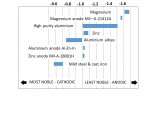
It can be seen that the voltages of magnesium, aluminium and zinc anode alloys differ quite considerably from those of the general alloys which, for example, allows an aluminium saildrive leg to be protected by an aluminium anode.

The tables show the composition of three commercial anode alloys. There are several important points to note here:
Firstly, the chemical composition is extremely closely controlled, particularly where iron is involved. The US MIL specification limits iron to very low levels as it inhibits the action of the anode. DIY re-melting of old anodes is very unlikely to comply with these specifications. Even cleaning anodes with a steel wire brush or file may inhibit its action.

Secondly, the open circuit potentials of zinc and aluminium anodes are very similar but the capacity of the aluminium version is very much greater. Thus aluminium anodes are superseding zinc ones in general use, as:
  • They may be used in both salt and brackish water
  • Their higher electrical capacity allows the use of smaller anodes
  • The alloy remains active if exposed to air and will reactivate when re-immersed
Zinc anodes still have some advantages but these are usually of lesser importance in yachts:
  • They have better impact strength
  • Their decay is more even across the anode
  • The formation of zinc oxide in fresh and brackish water will inhibit their action
Magnesium alloys react rapidly in seawater and are only suitable for use in fresh water where their loss rate is reduced by lower open circuit potential.

And the galvanic series:
Modified galvanic series.jpg
 
Thanks for that Vyv, I was certainly not putting myself forward as an expert but just sharing what little I had learned. I really enjoy understanding the whys and wherefores of such matters. Or at least trying to. :)
 
Top