Following Bigplumbs post

Shifty

Well-Known Member
Joined
19 Jan 2021
Messages
148
Visit site
I have 2x D6 and have done approximately 70 hours this season. Question is I’ve not had any problem with fuel and have been depending on the water in fuel sensors to do the checking. A. Are these sensitive enough to prevent damage, or should I invest in glass bowls underneath the filters?
 
I have 2x D6 and have done approximately 70 hours this season. Question is I’ve not had any problem with fuel and have been depending on the water in fuel sensors to do the checking. A. Are these sensitive enough to prevent damage, or should I invest in glass bowls underneath the filters?

When it comes to these things, personally I would go for glass bowls. Sensors are great but they aren't infallible and a good mechanical visual check is a good failsafe.
 
I don't have glass bowls nor any sensors.
I have had no fuel issues with this same arrangement on the boats I have owned since March 2008.
Perhaps the presence of glass bowls encourages fuel issues (or perhaps not).
 
Can I suggest a re-visit to the basics, i.e. from where does the offending water in the fuel tank come.

1 It leaks into the tank through the occasionally saturated deck filler - a good dollop of waterproof grease stops this, but many owners don't like getting grease on their fingers to do this and again when fuelling.

2 It is bought and paid for when filling up. Check and polish every time.

3 It forms from condensation. Bunkum (IMHO) !

There are not too many other sources.

Keep the fuel clean and dry and have a simple boating life.

i will always have clear bowls, plastic or glass, to allow me to check.
 
3 It forms from condensation. Bunkum (IMHO) !

I agree .
I wonder what the moisture content of air above the fuel is . I would expect that air to be relatively dry since the fuel is highly hygroscopic. So there is relatively little water in the air available to condense on the tank walls above the fuel level.
 
I generally agree with Superheat with the addition of:
4/ always use a diesel biocide Marine 16 or Grotamar
5/ change the O rings on diesel deck fillers annually (as well as on water tank)
6/ check rain cant enter the fuel tank breather

I am an advocate of clear bowls and an occasional drain of the bowls if required also lift and check Racor/Separ elements and check for debris part way through season.

I have sumps and stripping lines I do take a litre or so out of each tank each year and I carry a small vacuum oil remover Pella type pump on board in case of problems.
 
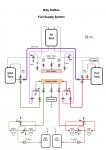
The fuel system on my Grand Banks has 27 valves. Slightly OTT, but my goodness what a system, but I don't like that both tanks feed a common pair of supply and return manifolds, so contamination in one tank can easily move to the others. Further complexity due to having a third reserve tank.

I have decided to fit a separate polishing filter and pump. A Racor 500 (copy) that can draw from the manifold, which the valves allow me to select any of the tanks to draw from or return to. This will be separate to the two pairs of Racor 900s (original) on the main fuel supplies to each engine, after the manifolds, but each has a pair of 3 way valves to allow either / or of each pair to be selected.

I am now deciding how much I need to pay for the circulation pump - £12 or £300 seems to be the options.

A bit of pipework modifications to get the filter installed, plus a further two isolation valves.

I drew the system out on Saturday and have now converted this to a proper system schematic. Just need to decide where is simplest to hook into for the polishing pump and filter. The balance line would partially work but does not allow me to draw from the reserve tank. Getting on to the manifold would be quit difficult, as this would require a major dismantling of the heart of the system.

Billy Ruffian - Fuel Distribution.drawio.jpg
 
The fuel system on my Grand Banks has 27 valves. Slightly OTT, but my goodness what a system, but I don't like that both tanks feed a common pair of supply and return manifolds, so contamination in one tank can easily move to the others. Further complexity due to having a third reserve tank.

I have decided to fit a separate polishing filter and pump. A Racor 500 (copy) that can draw from the manifold, which the valves allow me to select any of the tanks to draw from or return to. This will be separate to the two pairs of Racor 900s (original) on the main fuel supplies to each engine, after the manifolds, but each has a pair of 3 way valves to allow either / or of each pair to be selected.

I am now deciding how much I need to pay for the circulation pump - £12 or £300 seems to be the options.

A bit of pipework modifications to get the filter installed, plus a further two isolation valves.

I drew the system out on Saturday and have now converted this to a proper system schematic. Just need to decide where is simplest to hook into for the polishing pump and filter. The balance line would partially work but does not allow me to draw from the reserve tank. Getting on to the manifold would be quit difficult, as this would require a major dismantling of the heart of the system.

View attachment 144998


Blimming Heck Trev!

I though my fuel tank, combined water separator & fuel filter and primer bulb was complex!
 
The fuel system on my Grand Banks has 27 valves. Slightly OTT, but my goodness what a system, but I don't like that both tanks feed a common pair of supply and return manifolds, so contamination in one tank can easily move to the others. Further complexity due to having a third reserve tank.

I have decided to fit a separate polishing filter and pump. A Racor 500 (copy) that can draw from the manifold, which the valves allow me to select any of the tanks to draw from or return to. This will be separate to the two pairs of Racor 900s (original) on the main fuel supplies to each engine, after the manifolds, but each has a pair of 3 way valves to allow either / or of each pair to be selected.

I am now deciding how much I need to pay for the circulation pump - £12 or £300 seems to be the options.

A bit of pipework modifications to get the filter installed, plus a further two isolation valves.

I drew the system out on Saturday and have now converted this to a proper system schematic. Just need to decide where is simplest to hook into for the polishing pump and filter. The balance line would partially work but does not allow me to draw from the reserve tank. Getting on to the manifold would be quit difficult, as this would require a major dismantling of the heart of the system.

View attachment 144998
Now that is complicated
 
But fuel circulates through the racors anyhow when the engines are running .80 % is returned .So every min never mind hrs the engines run they are polishing it as you go , over and over again .The less volume you run with the greater % concentration it’s processed , sorry polished as you go .

Fit WIFs with a gauge on the dash and periodically depending on hrs run change the paper cartridges of the two main racors .

Use tank sight glasses ( fitted from the lowest point of the tanks ) to visually see what’s happening at the bottom .Have a sump drain cock on the two main tanks . This is for the inevitable water ingress through as you say , filler , breather, fresh fuel or where ever .


None CR ( which you are ) you can be a more relaxed anyhow .

That schematic does not look , squaddy proof , it’s looks very open to an inadvertent operator error resulting in a dry pump = show stopper , or a muddle figuring out which of the “27 “ valves handles should point where and when !
What ever happened to the KIS approach? The least number of connections is the way to go , working on the basis any connection is potentially a source of air ingress .

Your spill header mixes it all together and sends it back ( assuming both cocks open ) to both main tanks .So microorganisms are potentially mixing , spreading , cross contaminating both tanks .Moving from one to the other . You can’t keep each side independent of the other …..easily with out a rubrics cube esq tank cock puzzle phaff .Ideally imho each side should be totally independent as the default setting with the possibility of linking up tanks and engines

Your “supply tank “ also could receive contaminated fuel from either side and kill the geny .Geny has no protection from water from what I can see .It ought to come from after a racor .The gent needs to be the last thing running if the mains die .
Last thing you need after toiling away changing filters / flushing pipes , chasing down air leaks is the sound of “ dead man’s click “ when you attempt to crank the motors .The motors that really NOW need multiple cranking to clear the air introduced from trying to sort the fuel fowling out .

You geny will top up the batts .It needs protection too .Esp if it gets dark .
 
But fuel circulates through the racors anyhow when the engines are running .80 % is returned .So every min never mind hrs the engines run they are polishing it as you go , over and over again .The less volume you run with the greater % concentration it’s processed , sorry polished as you go .

Fit WIFs with a gauge on the dash and periodically depending on hrs run change the paper cartridges of the two main racors .

Use tank sight glasses ( fitted from the lowest point of the tanks ) to visually see what’s happening at the bottom .Have a sump drain cock on the two main tanks . This is for the inevitable water ingress through as you say , filler , breather, fresh fuel or where ever .


None CR ( which you are ) you can be a more relaxed anyhow .

That schematic does not look , squaddy proof , it’s looks very open to an inadvertent operator error resulting in a dry pump = show stopper , or a muddle figuring out which of the “27 “ valves handles should point where and when !
What ever happened to the KIS approach? The least number of connections is the way to go , working on the basis any connection is potentially a source of air ingress .

Your spill header mixes it all together and sends it back ( assuming both cocks open ) to both main tanks .So microorganisms are potentially mixing , spreading , cross contaminating both tanks .Moving from one to the other . You can’t keep each side independent of the other …..easily with out a rubrics cube esq tank cock puzzle phaff .Ideally imho each side should be totally independent as the default setting with the possibility of linking up tanks and engines

Your “supply tank “ also could receive contaminated fuel from either side and kill the geny .Geny has no protection from water from what I can see .It ought to come from after a racor .The gent needs to be the last thing running if the mains die .
Last thing you need after toiling away changing filters / flushing pipes , chasing down air leaks is the sound of “ dead man’s click “ when you attempt to crank the motors .The motors that really NOW need multiple cranking to clear the air introduced from trying to sort the fuel fowling out .

You geny will top up the batts .It needs protection too .Esp if it gets dark .
I agree that having the systems permanently cross connected is less than ideal, although even thinking about a major re-plumb to separate the two primary Port & Stbd systems is a massive task. So that said contaminant is normally water entry related, and that is most commonly either a twat selling you contaminated fuel, or a leaky fuel filler deck cap. I have resolved the latter already with a judicious dollop of grease on each filler cap thread, and with the polishing system and religious use after each refuel I should resolve the former.

I am noticing a distinct build up of a fine black slurry in the duty Racor 900s, so there is something there presently that needs removing, and the pickups are about 40mm above the tank bases, so the offending layer will be hard to draw. But there are also inspection hatches to each tank, which are GRP. So perhaps I pump over to one tank and have a gander inside and clean them out one at a time in conjunction with the polishing system.

As an aside I have added 4 too many valves so just 23 rather than 27 !!!

Not helpful that GB have only provided the diagram for a twin tank set up, so I am pleased to have worked out what each valve does and how they connect.

Looks like I will have a busy Winter. I am somewhat annoyed with myself that I gave my old polishing system away with the Corvette.
 
Top