Fill/repair shower tray on modern AWB

wonkywinch

Well-Known Member
Joined
30 Jul 2018
Messages
3,930
Location
Hamble, UK
Visit site
I noticed today that the moulded shower tray that forms the entire floor of the heads has had a dink kicked into it.

Not very familiar with plastics so wondered what I could use to fill & repair this.

It's below the door threshold so must have been kicked at some point but doesn't feel loose.

Something glossy white I can fill, sand and polish?
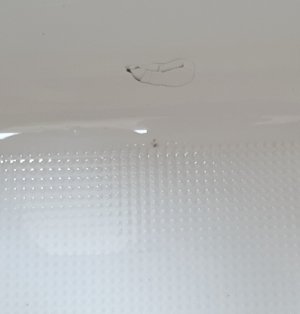
Screenshot_20250811_221658_Gallery.jpg
 
It’s presumably fibreglass with gel coat? So for an easy but not necessarily invisible repair some gel coat filler / repair kit from chandlery.
 
It might help if you define the yacht and its 'year'. This might indicate what sort of resin was used, which then defines the repair resin.

The interior components of modern yachts are now commonly made as separate pieces, dropped into the hull from above and the deck installed over the various components.This probably means you cannot access the 'outside' of the shower unit. Sometimes furniture units are part of the structure and glassed in sometimes not and simply attached with a sealnat/adhesive. If you can access the outside then repair from the outside, sand the inside when the repair has set off and then coat with matching gelcote.

It is likely a fibreglass unit and you should see the glass, or strands of glass, at the location of the damage. The photo is not very clear.

If you cannot access the outside then you need to fill from the inside, a well filled resin (or it will run) then sand and coat with gelcote.

It is likely the gel cote is the same as the deck and hull - ask the dealer/importer for the Pantone colour code (or ask here)

Jonathan
 
It might help if you define the yacht and its 'year'. This might indicate what sort of resin was used, which then defines the repair resin.

The interior components of modern yachts are now commonly made as separate pieces, dropped into the hull from above and the deck installed over the various components.This probably means you cannot access the 'outside' of the shower unit. Sometimes furniture units are part of the structure and glassed in sometimes not and simply attached with a sealnat/adhesive. If you can access the outside then repair from the outside, sand the inside when the repair has set off and then coat with matching gelcote.

It is likely a fibreglass unit and you should see the glass, or strands of glass, at the location of the damage. The photo is not very clear.

If you cannot access the outside then you need to fill from the inside, a well filled resin (or it will run) then sand and coat with gelcote.

It is likely the gel cote is the same as the deck and hull - ask the dealer/importer for the Pantone colour code (or ask here)

Jonathan
Thank you, a 2016 (built 2015?) Beneteau Oceanis 38 (not 38.1).

The whole piece is a module that forms the floor of the heads and I may be able to get to the other side by lifting a sole board and reaching up behind the door sill, will check later today. If I push on the damage, it doesn't give at all so I assume it's just the top (gel) coat that has been chipped.

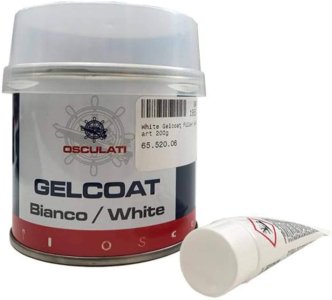
As I have a little dink on the bow where the anchor caught it and another parking rash on the rear quarter, I ordered a gel coat repair kit. Do I need to add anything to the mix?

gelcoat.jpg
 
I'm no expert and hopefully you will enjoy more informed comment than mine (on fibreglass repairs. :) ). You need to clean any damaged areas with acetone. The topic of the thread is in a shower and the shower may have been used despite the damage - you need to brush the acetone into the 'damage' to remove any grease.

When I repaired damage on our cat I used an epoxy resin which I filled with glass beads, talc or 'filler'. International, here at least, used to sell small, 500gm, bags of filler. I'd make up some gelcote and add filler, you really will not need much and thicken it so that its thicker than toothpaste and sits on a spatula - thinner and it will sag. Leave it to set off, sand back and then paint, so not filled, with the appropriately white gel cote - paint with a paint brush. Again you will not need much. You may need 2 cotes of gel cote - so let the first cote set off, then overpaint. It will bond better if you paint with gel cote on a 'just sticky' base cote.

You only need to fill if the resin/fgelcote runs or sags. Your damage looks 'big' enough to need filler - but the picture might be deceptive.

If you can access the outside then repair from the outside but put a layer of packing tape (sellotape) on the inside and then you can fill all the c racks with a spatula. Your external repairs can also benefit from your applying the filled gel cote and then the first layer being covered with packing tape (it will keep any moisture at bay when you want for it to set off, dew, unexpected rain.

You might need to fill and sand, fill and sand, paint and sand, paint - until you are comfortable the repair is 'invisible'.


If access to the back of the shower is difficult you may find this is a 2 person task. One person you, playing the role of the contortionist and another person (wives are very competent) passing you the 'filled' spatula or paint brush. If its really difficult you may need to hire a 12 year old to wriggle their arm up in the narrow space. This then needs careful coordination between you and your 'mate' so they pass you things in order and have rags and acetone (cleaner) at the ready. Its really good for grandfather/grandchildren bonding. :). (and, be warned, ground for divorce if it all goes belly up. :(. )

Been there, done that. - well, not the divorce part.

None of this is difficult - and if it all goes wrong - when it is set off - simple sand back flat and another cote of unthickned white gelcote will cover a host of sins.

I don't know what resins Benny used nor what white they used - someone here, YBW, should know

Jonathan

edit

You will need little mixing containers and stirrers - cheap chop sticks, paper cups, small jam jars or small tins are ideal - but you will not need much and a brush for the final top coat. Sand paper, rags, acetone, packing tape (the sort that is 2" wide) and for exterior work - a decent dry forecast - rain is the killer.
 
Last edited:
It's a void between the gel coat and laminate, break it out until you come to a firm edge then use the. gel coat repair material you have, sand back then make good any holes sand again then polish. use some clingfilm to cover the gel coat as it sets.
 
Thank you, a 2016 (built 2015?) Beneteau Oceanis 38 (not 38.1).

The whole piece is a module that forms the floor of the heads and I may be able to get to the other side by lifting a sole board and reaching up behind the door sill, will check later today. If I push on the damage, it doesn't give at all so I assume it's just the top (gel) coat that has been chipped.

As I have a little dink on the bow where the anchor caught it and another parking rash on the rear quarter, I ordered a gel coat repair kit. Do I need to add anything to the mix?

View attachment 197652
Grind it back a little to get rid of the damaged gelcoat then fill with gelcoat / gelcoat filler.

If it isn't a good enough match you can sand it back a little and tint some gelcoat with a pigment. East Coast Fibreglass stock anything you might need (others available too of course).
 
I used the Osculati gelgoat repair paste to repair some chips along the styling line below the blue strip parallel with the deck on Musketeer (Moody 29). I'd never used such stuff before, but I recon it did quite a good job. I know it's a different shape to the OP's dent, but grind out the cracked bits, avoiding going all the way through if possible, then build up in fairly thin layers until level(ish) with the surrounding surface. Rub down with wet&dry, used wet, refill as required and repeat until a good finish is achieved. I suspect the standard white finish will be close enough for your location.
 
Top