
Excessive frosting on fridge evaporator plate?

Tim Good

Well-Known Member
Joined
26 Feb 2010
Messages
2,888
Location
Bristol
Visit site
Summary:
My Frigoboat fridge has been fine for a couple of years now but has recently developed a of frost on the evaporator plate that I think it is affecting its performance. What could this be down to? It is a double door side opening fridge, not a top loader.

Detail:
It was fine in all of Norway last year. This year since heading south and now in Spain where temps have recently got to around 26c in the cabin, I'm struggling to keep it down below 5c even as max setting. The plate accumulates thick frost within a few days and then I have to defrost it.

It this the warm humid air getting in there when we open the fridge? Can anything be done?
 
Welcome to the warmer world. We've found there are two options in the Med with the fridge: set to where we'd have it in UK and the higher relative humidity will produce a nice coating of frost, set to a slightly higher temp and the bottom of the fridge is swimming in condensation which eventually finds its way out of the drain hole....
Ours is top opening, so if it's set to a frosty temp, it takes a week or ten days to build up enough to need defrosting.
You might find that rigging a computer fan to blow a stream of air over the plate might help but that's about all I can think of other than letting the temperature rise a little (use less electricity as well that way but the chicken won't stay fresh for as long).
 
Welcome to the warmer world. We've found there are two options in the Med with the fridge: set to where we'd have it in UK and the higher relative humidity will produce a nice coating of frost, set to a slightly higher temp and the bottom of the fridge is swimming in condensation which eventually finds its way out of the drain hole....
Ours is top opening, so if it's set to a frosty temp, it takes a week or ten days to build up enough to need defrosting.
You might find that rigging a computer fan to blow a stream of air over the plate might help but that's about all I can think of other than letting the temperature rise a little (use less electricity as well that way but the chicken won't stay fresh for as long).

Well you might have a point. We could set a timer perhaps that will turn the fridge off around 3am and turn it back on again when the solar starts working around 9am. This would give it 6 hours to defrost and drain away as you say.

I have put a computer fan in a while ago but I'm unsure if this makes it worse or not.
 
Summary: It this the warm humid air getting in there when we open the fridge? Can anything be done?
Of course it is; when you open the door(s) the cold air falls out, to be replaced by the ambient stuff which, even in moderate humidity carries a lot more moisture than the cold stuff in there. The fuller you keep the fridge (by putting in. say, bottled water, empty plastic storage boxes or even polystyrene blocks), the less pronounced the effect.

Incidentally, contrary to popular belief, reducing free air volume in the fridge has only a tiny effect on the power required to cool the 'new' air down to fridge temperature. Air has a specific heat value roughly 1/3000 that of water.

I can't see that a computer fan in the fridge would do much good, although it's useful blowing over the coils next to the pump.
 
Last edited:
Fitted a new fridge this year and the instructions said that if the bottom drain was not fitted and opento drain, then frosting would be an issue. Obviously the drain takes away excess liquid but not sure how relevant it is to hotter, humid air, maybe check the bottom drain.
 
Of course it is; when you open the door(s) the cold air falls out, to be replaced by the ambient stuff which, even in moderate humidity carries a lot more moisture than the cold stuff in there. The fuller you keep the fridge (by putting in. say, bottled water or even polystyrene blocks), the less pronounced the effect.

Incidentally, contrary to popular belief, reducing free air volume in the fridge has only a tiny effect on the power required to cool the 'new' air down to fridge temperature. Air has a specific heat value roughly 1/3000 that of water.

I can't see that a computer fan in the fridge would do much good, although it's useful blowing over the coils next to the pump.

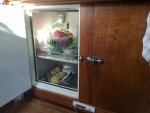
Thanks for this. My fridge albeit side opening does have an upper and lower section. The lower section sits down below the doors. See picture. I was told I could move my plate down to the lower section and keep the lower part super cold and then the upper part would be maybe 5-10c for sauces and other non essential things. Maybe then, when opening the doors only the warmer upper part (5-10c) would fall out rather than the colder lower part?

IMG_9938.JPEG
 
Fitted a new fridge this year and the instructions said that if the bottom drain was not fitted and opento drain, then frosting would be an issue. Obviously the drain takes away excess liquid but not sure how relevant it is to hotter, humid air, maybe check the bottom drain.

Interesting. Not sure why a drain would affect it. I'd have thought it would allow cold air to escape into my bilge.
 
I was told I could move my plate down to the lower section and keep the lower part super cold and then the upper part would be maybe 5-10c for sauces and other non essential things. Maybe then, when opening the doors only the warmer upper part (5-10c) would fall out rather than the colder lower part?

It might work, although the temperature differential might be greater than you suppose.
The main thing your photo illustrates is that there's a lot of free air in that fridge...rather more than 75% of total volume, at a very rough guess. Filling it, as I suggested, would help.

Apologies for the omission from my earlier post, but beer is also an excellent packing agent ;)

P.S. Defrosting (the wife's quick and highly effective method): empty fridge, wrap contents in a duvet. Place a large bowl of hot water at the bottom of the fridge. Wait. Mop up, re-load, switch back on.

P.P.S. Any damage to the door seal would, of course, exacerbate the frosting you describe, but I presume you've checked this.
 
Last edited:
If there's frost on the plate, then clearly the plate is below 0degC.
If the body of the fridge is above 5 degC, then the plate is not big enough for the amount of heat that's getting in.
So either you open the door too often or the insulation is inadequate.
A fan should help, anything that makes the temperature of the food iin the fridge closerto the temperature of the plate with be good.
You could try increasing the surface area of the plate, maybe some fins like a big heatsink?

What are you putting in the fridge? Anything that can give off water? Make sure everything is in sealed containers or warm food will evaporate water which obviously turns to frost on the plate.
 
Interesting. Not sure why a drain would affect it. I'd have thought it would allow cold air to escape into my bilge.

The drain is fitted with a loop so there is a small water trap under the fridge which stops all the cold air draining out. The warm,humid air, cools in the fridge and vapour condenses into water and runs down the side into the base. I assume if it drains off it leaves less water vapour in the cabinet to freeze on your plate. However, I don’t know, but the instructions were specific that to avoid frequent frost build up the drain had to be installed.
 
Of course it is; when you open the door(s) the cold air falls out, to be replaced by the ambient stuff which, even in moderate humidity carries a lot more moisture than the cold stuff in there. The fuller you keep the fridge (by putting in. say, bottled water, empty plastic storage boxes or even polystyrene blocks), the less pronounced the effect.

Incidentally, contrary to popular belief, reducing free air volume in the fridge has only a tiny effect on the power required to cool the 'new' air down to fridge temperature. Air has a specific heat value roughly 1/3000 that of water.

I can't see that a computer fan in the fridge would do much good, although it's useful blowing over the coils next to the pump.

+1

It is not clear, to me, what is meant in some of the posts about adding a fan - I agree with Mac, I cannot see how having a fan in the fridge is of any benefit - it will help if the fan blows over the coils (and any warm air round the coils are extracted). You want to try an ensure that the air you blow over the coils is as cool as possible (and the coolest air is possibly some from your anchor/chain locker). If your compressor and coils are in an enclosed space - you are simply recyling hot air.

Jonathan
 
Welcome to the warmer world. .

+1

My fridge thermometer is an arduiono which displays the inside temp, coldplate temp and duty cycle. When the outside temperature gets up higher I've noticed that the duty cycle goes from below 20% to sometimes up above 50% but also the coldplate temperature will go down well below zero when it's cooling, I'm guessing my frost buildup is down to that.

Yet to try a fan inside but it might help by keeping the coldplate temperature up bit.
 
Last edited:
I have a fan inside operating when the compressor is cooling. I fitted the fan mainly to even out the temperature within the fridge as parts were quite warm.
 
We had problems with our fridge since the day we brought the boat oct 2016 , three lots of engineers , three lots of vacuum a new dryer and two thermostat, it would had been three but I refused to let the last engineer change the one that was put on just some weeks early , A couple of thread here and throw in £350 in so call engineer fees and the only thing that keeps my fridge going at a good temp is a cheap Chinese timer and a cheap Chinese thermostat working on combination with each other And a defrost once a month . While it's working it's going to stay that way .
I not enjoyed ice cream on the way as the last few months .
 
Last edited:
A thread about a year ago talked about having a fan inside the fridge. I looked it up at the time and found it to be quite a common practice. Maybe on bigger fridges than we use.

We have a modest sized fridge with a relatively large coldplate.
A small fan improves the efficiency greatly.
We tested it out with a thermocouple taped to a can of beer.
The beer cools nearly twice as fast with the fan running.

If you've got great insulation, once everthing is cold, the fan won't make much difference though. It might mean you use more power as it tries to keep the bits lthat leak heat cold.
 
I've added a small radial 12V fan (originally intended for cooling the nozzle on a 3D printer) to the fridge some time ago. This solves the issue where you have a very cold spot in the fridge (the evaporator) and some relatively warm ones (the items you wish to refrigerate) and the heat transfer between them being fairly low as they're not in direct contact and there's a lack of air movement. The fan makes a big difference in efficiency, as it circulates air past the evaporator and to the items.

When something shifts in the fridge during a rough sail and blocks that air circulation past the evaporator, the ice buildup is very notable.
 
Besides of the other points made here already, I'd suggest to check the door seals properly. The excessive frosting may be due to increase of air flow in and out of the fridge through poor seals.
 
The drain is fitted with a loop so there is a small water trap under the fridge which stops all the cold air draining out. The warm,humid air, cools in the fridge and vapour condenses into water and runs down the side into the base. I assume if it drains off it leaves less water vapour in the cabinet to freeze on your plate. However, I don’t know, but the instructions were specific that to avoid frequent frost build up the drain had to be installed.

The loop generates a trap to stop air being pulled into the fridge, cold air creates a slightly lower air pressure and it sucks in warm damp air from outside.
 
As already said: check the door seal(s). I had a problem with my fridge when the boat was new whereby the nice wooden door which was attached to the actual fridge door was not spaced far enough away from the fridge door and was preventing the fridge door from closing fully! This was causing excessive frosting of the cold plate. A few extra washers as spacers solved this problem. So, I agree with above post(s) that suggest to check the door seal is in good condition and that the door of the fridge is closing fully.
Nothing worse than warm beer down here in the med!!!

Alan.
 
Top