Esper Refit 35 - PSS Dripless Seal; dimmable LED lights

I have recently been discussing PSS seals with a surveyor in Falmouth, he's had to do reports on 3 which have failed in the last couple of weeks, petrolium products damage the 'rubber causing fails, incorrect fitting of the S/S ring, shaft should be either have 2 shallow holes for the grub screws or the shaft should have 2 flats ground off, these seals should be checked very often, they are not 'fit and forget!! pm me if any further info reqd

My PSS has been on for 18 years - I'd agree that it's not a fit and forget item - especially if one enjoys prop-wraps.
In all fairness to the surveyor, putting a small dimple in the shaft is not an earth-shattering idea - but his "checking very often" is imprecise as to be meaningless.
It certainly needs to be checked every time on lift-in. Whilst I changed my bellows at the 10 year mark, I need not have bothered, the old one was unmarked.
As Vyv points out, humankind can always find a way to fit something badly and as for the "petroleum products damage the bellows" I would respectfully disagree with his opinion.
Many surveyors have strange bees in their bonnets and I've no doubt your contact is no exception to the rule.
 
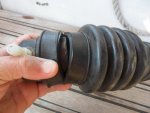
In fairness to Squeaky it's quite obvious the seal has failed and, probably, catastrophically. It's also clear that the bellows has been fitted back-to-front by a particularly botch-handed fitter.
I'm not surprised PSS refused to have anything to do with the matter - their seals come correctly handed and only a psychotic self-believer would have disassembled it and put it together in the manner shown.
Squeaky's dispute should be with the yard who fitted the seal..
I've found PSS particularly supportive - and am surprised to find the two nay-sayers on this thread (though one is a third-party opinion based on an apocryphal authority).

In answer to the original poster - yes the SS rotor can slide down the shaft - if you have a soft drive and sufficient of a prop-wrap to pull the shaft out of the clamp. It's happened to me twice. Putting dimples (or flats) in the shaft are not sufficient to prevent this happening - but it's probably better than having a shaft or gearbox breakage. When you take the wrap away the shaft moves forward and one has a leak from the carbon block - insufficient to sink the boat (unless you're particularly unobservant) but sufficient to fill bilges in about 4-5 hours.
Compared to a packed seal, a Bukh or Halyard seal (the two latter are lipped seals like the Volvo) it's much simpler, more reliable and has less considerably less frictional resistance.
 
In fairness to Squeaky it's quite obvious the seal has failed and, probably, catastrophically. It's also clear that the bellows has been fitted back-to-front by a particularly botch-handed fitter.
I'm not surprised PSS refused to have anything to do with the matter - their seals come correctly handed and only a psychotic self-believer would have disassembled it and put it together in the manner shown.
Squeaky's dispute should be with the yard who fitted the seal..
I've found PSS particularly supportive - and am surprised to find the two nay-sayers on this thread (though one is a third-party opinion based on an apocryphal authority).
In answer to the original poster - yes the SS rotor can slide down the shaft - if you have a soft drive and sufficient of a prop-wrap to pull the shaft out of the clamp. It's happened to me twice. Putting dimples (or flats) in the shaft are not sufficient to prevent this happening - but it's probably better than having a shaft or gearbox breakage. When you take the wrap away the shaft moves forward and one has a leak from the carbon block - insufficient to sink the boat (unless you're particularly unobservant) but sufficient to fill bilges in about 4-5 hours.
Compared to a packed seal, a Bukh or Halyard seal (the two latter are lipped seals like the Volvo) it's much simpler, more reliable and has less considerably less frictional resistance.

Good evening Mr Reed:

Where in heck did you get the idea that the bellows were fitted end for end? You were not present and have only a photo on which to base your view.

I certainly don’t welcome or appreciate your comments and use of the terms “particularly botch-handed fitter" or
"psychotic self-believer"

I have already admitted that possibly myself and others on this forum are not as clever or highly evolved as yourself but I do wonder why you are so determined to show anyone who has or had a negative experience with PSS seal in such a negative light. Do you per chance have a financial interest in this seal or company?

If these seals are so frigging great why have you had sufficient dealing with them to form the impression that they are supportive – this was not my impression and I have the correspondence to support this impression.

If you have any PSS seals in your possession, I respectfully suggest you stick them where the sun doesn’t shine – that is all they are good for in my humble opinion.

Cheers
Squeaky
 
I spent a lot of time looking at the pics of your failed PSS seal and compared your pics with one I had in my hand.

It was quite clear that the bellows was fitted the wrong way round and the worm clips fitted such that they cut the bellows in such a way that it caused the failure you had.

Who fitted then I don't know but I agree with charles_reed that who ever fitted the seal I would not let any where near my boat.

So again Mr Squeaky you should aim you discontent in the correct direction that that IMHO is not the manufacturer or members of this fora but to the person who "fitted" the said device.

This fora has some very experienced and knowledgeable people who in most part give advice freely and in my case will stop doing that in this matter as it is obverse that you have made up your mind and it seems no amount of engineering analysis by qualified and experienced professionally engineers will change your mind.
 
As some on here know, I am not a lover of face seals in general for this application - a view formed from experience with early incarnations of the type. The weaknesses are the need to pre set the bellows to maintain contact, the tendency of the faces to stick when left unused (which can in extremis lead to bellows tearing if the engine is run in gear under load), pit or wear and in some installations where either the mounts are very soft or excessively worn and engaging gear is enough to move the shaft forward and open the faces. In one extreme case with a cruiser racer where the stern tube was open at the rear, surfing was enough for water pressure to move the engine and shaft forward and open the faces.

However the PSS version of the design is much improved over the early ones (whose makers have now gone) and if properly installed and checked periodically as recommended are satisfactory. My preference however is still for seals around the shaft - either lip seals or a traditional stuffing box. None of these are totally fool proof, but failure of lip seals or packing are usually progressive rather than catastrophic.
 
I spent a lot of time looking at the pics of your failed PSS seal and compared your pics with one I had in my hand.

It was quite clear that the bellows was fitted the wrong way round and the worm clips fitted such that they cut the bellows in such a way that it caused the failure you had.

Who fitted then I don't know but I agree with charles_reed that who ever fitted the seal I would not let any where near my boat.

So again Mr Squeaky you should aim you discontent in the correct direction that that IMHO is not the manufacturer or members of this fora but to the person who "fitted" the said device.

This fora has some very experienced and knowledgeable people who in most part give advice freely and in my case will stop doing that in this matter as it is obverse that you have made up your mind and it seems no amount of engineering analysis by qualified and experienced professionally engineers will change your mind.

Good morning Mr Shaw:

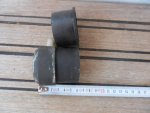
I don't know how you determined that the bellows was fitted wrong way around because both ends of the bellows were the same size (50 mm) and a spacer was provided to make up for the difference between diameter of the stern tube and carbon piece.
http://1drv.ms/1wFGcCV

The jubilee clips were fitted where indicated on the bellows however as this photo indicates the carbon piece was not long enough to fit into the bellows sufficient so that the aft clip clamped to it resulting in a "scissoring" action.

http://1drv.ms/1qwvxoo

The various bits were sent to the European dealers and I suggest that they would have been the first to jump on the fact that the bellows had been installed incorrectly if this were true.

You and Mr Reed can attempt to defend PYI and the PSS seal as much as you wish however I remain of the opinion that this seal is a dangerous bit of kit however if it works for you, fine but it certainly didn't work for me.

Cheers

Squeaky

PS - the image of the carbon piece and spacer seems to be shown twice however I think you can see the image showing the bellows and how the jubilee clips were to be fitted by clicking on the second link.
 

Attachments

  • Failed PSS seal 04.jpg
    Failed PSS seal 04.jpg
    52 KB · Views: 0
  • Carbon piece and spacer rt. 2JPG.jpg
    Carbon piece and spacer rt. 2JPG.jpg
    85.2 KB · Views: 0
Last edited:
There is no arguing with the believers - shall we let Squeaky be the one person in the world who has had a failure of his PSS seal and leave it at that.
PSS are quite easily the largest suppliers of shaft seals in the world - their marine use is a small and insignificant part of their total turnover, so have one delusional disbeliever is not going to cause any board-level insomnia.
 
Good morning Mr Reed:

Yes, a very clever way of avoiding responding to the question as to how you determined that the bellows were incorrectly fitted or respond to the question as to your financial interest in proving that the PSS seal is the best thing since sliced bread.

The seals I was sold could not have been fitted incorrectly as both ends were 50 mm and there was a spacer provided to make up for the difference in diameter of the stern tube and carbon piece. Also as shown by the images the carbon piece was not long enough to allow the aft jubilee clip to firm clamp the bellows to the carbon piece.

I gather from your evasive response that you would be happy to just declare me as a "kook" and continue with your superior belief that you are right therefore I must be wrong.

Cheers

Squeaky
 
Mr Spueaky

You comment " or respond to the question as to your financial interest in proving that the PSS seal is the best thing since sliced bread. " is totally out of order unless you have proof the Charles Reed and/or myself have any financial interest in PYI or any of it agents. My geographic location would put that one in question anyway.

Now My comment as to the bellows being fitted the wrong way round is nothing to do with your statement that the size of the bellows at both ends is 50mm so could not be fitted the wrong way round. The 50mm looks like the inside diameter of the bellows. It is the length of the clamping section of the bellows that has a different length at both ends. The carbon stator has a spigot 50mm dia by 35 mm long as determined from the pic http://1drv.ms/1wFGcCV.

Now pic http://1drv.ms/1qwvxoo clearly shows that the clamping section of the bellows is much longer than the carbon spigot and as such allows the clamping to be fitted such than the inner worm clamp can be positioned on an unsupported section og the bellow clamping section thus cutting into the bellows as shown.

You do not show a pic of the end of the bellows that in your case was fitted to the stern tube but a new PSS seal I have waiting to be fitted to one of my sail boats has the length carbon rotor spigot and the the length of the clamping section of the bellows to be the same length thus providing the bellows was fitted to the carbon rotor fully would not allow the clamping worm clips to cut the bellows as happened in your case. Also the on the spare PSS I have the bellows clamping section that goes onto the stern tube is in fact longer than the clamping section intended to be fitted to the carbon rotor. This is why I concluded that your seal was fitted with the bellows the wrong way round.

Now with regard to the potential for catastrophic failure by tarring the bellows due to the rotating face seizing up also applies to conventional gland stern seal where a rubber tube connects the gland fitting to the stern tube. On higher power installations there are sometimes anti torque dogs fitted to prevent this. I the cane of the current design of PSS seals there is a vent tube that can help provide an element of anti torque/twist thus reducing the possibility of the bellows being twisted to destruction. I do prefer the face type seal at it has a separate replaceable sealing element that is not intergrial with the prop shaft thus if damaged only that small part needs replacing not the whole prop shaft. The pitting that Yvy_cox reported also applied to the gland type system and in fact a large amount of pitting was shown on Esper's prop shaft and that caused this discussion.

With regard to lip type seals again these in post cases seal directly against the prop shaft thus causing ware on the shaft and in the worse cases needing replacement of the prop shaft. Again there has been discussions with regard to this about the replacement of engine raw water pump shafts. Yes it is possible in some cases to blend out the ware or to move the shaft so the seal is located on a different part of the shaft. This also being easer on prop shafts than pump shaft.

The main reason for defending PSS seals is a give a different view than your absolute condemnation of this type of seal so that other perhaps less technical boat owners on this fora don't get a "misguided" view as you seem to be waging a one man war against PSS type seals.

Don't know your technical background perhaps you could indicate. as for myself being a boat owner and DIY fixer-up-a for 40 years and being a degreed mechanical design engineer in the UK before moving into design of control systems before retiring 4 years ago to enjoy sailing and pottering around boats.
 
Good afternoon:

I am becoming bored with this subject as it seems the old adage of "a person convinced their will is of the same opinion still" applies in this case.

Had you put your feet down on the cabin sole after a nice day out sailing and found 3 or 4 inches of water covering it and then spend heaven knows how much time, money and effort trying to get to the bottom of the problem without success I think you and most people would feel as I do concerning the PSS seal.

You and Mr Reed can spend as much time as you like theorizing that it was my fault based on some images while Seaview and PYI had the original items and did not come to the concussion you did suggests that they were is a better position to analyze the problem than you are. Don't you think that they would have noticed if the tear was in the short end of the bellows sleeve if there was a difference in the lengths. There was absolutely no suggestion by them that "user error" was involved.

I do not have a photo showing both ends of the bellows but this photo gives a hint that both ends were of the same length.

Failed PSS seal 10rt.JPG

I have said many time that if your seal works okay, enjoy it but be warned that they can and do fail big time sometimes.

Cheers

Squeaky
 
I don't think the manufacturers have covered themselves in glory in this case. Perhaps due to the seemingly standard mystical American business practices, perhaps the fear of litigation. Who knows?

There are only three likely possibilities:

It was not a PSS seal at all.
It was fitted wrong.
The design and/or construction of the seal is seriously problematic.

Squeaky has hotly disputed the first two.

If the third explanation is correct then a high number of similar failures would be extant. There seems to be no record of this.
What is the statistical probability of two units failing, on the same boat, in the same manner, after as short as 20 hours? Well I don't know, but as PSS claims to be the biggest player in the market, lets just say: astronomical.

So there we have it.
 
Good afternoon Doug:

There is another explanation which you have not mentioned and that is that the items i received were mismatched and were a mixture of items designed for different sized prop shafts.

I am not going to bother digging through all the e-mails I have on this subject but I formed the impression near the end of my correspondence with Seaview and PYI that items are shipped in bulk leaving it to the final distributor to select and forward the items required depending on the order. I have no difficulty in believing that "Mehmet" could have been told to go to the stockroom and assemble the required items from containers containing various sized items and making a mistake although making the same mistake twice would be unusual.

Of course, this doesn't explain where the "spacer" came from or why it was necessary unless there are bellows with different sized ends and only one size of carbon pieces. I also could believe that there are different sized carbon pieces which would fit further into the bellows providing a surface for the aft clip to clamp to.

I suspect that Seaview and PYI know what went wrong but being afraid of litigation refused to admit what happened whereas I was mainly interested in discovering what caused the problem. If they knew what went wrong and have not taken action to correct it, they deserve to be sued.

Nothing in my correspondence indicated that I had litigation in mind and only an American could fear that anyone would mount a court case in Turkey for such a minor amount.

Cheers

Squeaky
 
Here is a section of the packaging from my PSS seal:

View attachment 46835

In the top corner ( not quite visible in this poor photo) is a simple specification code pre printed, or stamped, in red. In this case: 02-100-134.
Underneath you can see that the code has been confirmed by hand in red pen: Shaft 1" and Stern Tube: 1 3/4" and Seal Type - EP 2004 (Printed). Each of these has been further endorsed or checked with a tick in blue ink.

This suggests to me that the company are pretty much on top of what goes into their boxes and that these seals are assembled in America and checked twice at dispatch.

So unless the items are supplied to the French(?) distributors on a very different basis this would seem to put any tampering in the court of the installation technicians.
 
Had you put your feet down on the cabin sole after a nice day out sailing and found 3 or 4 inches of water covering it and then spend heaven knows how much time, money and effort trying to get to the bottom of the problem without success I think you and most people would feel as I do concerning the PSS seal.

Yes I have sailing from Richards Bay to Durban after the skipper " Fixed " the exhaust injection elbow. On entering Durban harbour and starting the engine caused water to enter the cabin at a high rate until it was 200mm above the cabin floor. We had to stop the engine and sail onto a finger mooring at a result.

I do not have a photo showing both ends of the bellows but this photo gives a hint that both ends were of the same length.

View attachment 46832

Type-1-Shaft-Seal_medium.jpg


This clearly shows that the cuff of the bellows that fits over the stern tube is much longer than the cuff that fits on the carbon rotor by at least the width of one of the worm clips.

I seem to remember that you had no reply from PYI or their agent, I also seem to remember you purchased the seal from some where in Turkey. If that is the case they are your first port of complaint as if as you suggest your set up was make up from incorrect bits and pieces.

Again 2 failure in a short time shows incompetent installation by whom I dont know.

I cannot comment on what or if PYI think but unless I can review the correspondence if any.
 
Rogershaw;5017883]

Yes I have sailing from Richards Bay to Durban after the skipper " Fixed " the exhaust injection elbow. On entering Durban harbour and starting the engine caused water to enter the cabin at a high rate until it was 200mm above the cabin floor. We had to stop the engine and sail onto a finger mooring at a result.

Your engine must have used an unusual amount of cooling water or the area of your cabin floor must have covered a very small area to flood the floor with that much water in a short period. Maybe it just seemed that much because of your surprise on discovering it or sense of panic.

Type-1-Shaft-Seal_medium.jpg


This clearly shows that the cuff of the bellows that fits over the stern tube is much longer than the cuff that fits on the carbon rotor by at least the width of one of the worm clips.

This image does not clearly show anything of the sort in my view and even if it does it is not the same as the bellows I had as both ends were of the same length.

I seem to remember that you had no reply from PYI or their agent, I also seem to remember you purchased the seal from some where in Turkey. If that is the case they are your first port of complaint as if as you suggest your set up was make up from incorrect bits and pieces.

I not only had responses from both Seaview and PYI but I exchanged over sixty e-mails with them and forwarded, at their request, the second failed seal.

Again 2 failure in a short time shows incompetent installation by whom I dont know.


Is your insistence on blaming the failure on someone else part of your personality or does this occur only when trying to throw responsibility for the failure of the seal on someone other than PYI?

I cannot comment on what or if PYI think but unless I can review the correspondence if any.

I also would not want to comment if PYI think or not - all I got out of them was a lot of obfuscation.

Cheers

Squeaky
 
Here is a section of the packaging from my PSS seal:

View attachment 46835

In the top corner ( not quite visible in this poor photo) is a simple specification code pre printed, or stamped, in red. In this case: 02-100-134.
Underneath you can see that the code has been confirmed by hand in red pen: Shaft 1" and Stern Tube: 1 3/4" and Seal Type - EP 2004 (Printed). Each of these has been further endorsed or checked with a tick in blue ink.

This suggests to me that the company are pretty much on top of what goes into their boxes and that these seals are assembled in America and checked twice at dispatch.

So unless the items are supplied to the French(?) distributors on a very different basis this would seem to put any tampering in the court of the installation technicians.

Good afternoon:

The seals I received were not in such a package but were in small cardboard boxes and I do not recall if there was a writing on them or not. At the time I assumed they had served their function and disposed of them in the garbage can which I suppose could suggest that I was also at fault for having done so not realizing that they would be needed for evidence two or three years later.

All I have ever wanted to know was what the heck went wrong with the seals I was sold however I still do not know although I am fairly sure that Seaview and PYI know but will not come clean and explain relying on obfuscation and delay to muddy the waters hoping the matter will simply go away.

Cheers

Squeaky
 
I empathise with Squeaky's feeling of paranoia, everyone is telling him he's got it wrong, why it went wrong and the arch-villians of the piece won't even give him an answer.
It's enough to drive one round the twist..
And Esper was just looking for re-assurance and now he's got this...
No doubt he's there LED trained on the seal trying to see what devilish shenanigans have been committed..
 
Top