
Engineering opinion please

Lightwave395

Well-Known Member
Joined
14 Aug 2016
Messages
2,940
Location
Me in Cowes, new boat back in Southern Brittany
Visit site
I've just replaced the engine mounts on my Yanmar 3YM30, apart from skinned knuckles it went pretty well and the engine runs very smoothly.

I do have a problem however (or a challenge...), I can't see why but the net result is that at the lowest level rear mount adjustment setting, the gearbox flange is about 10mm above the prop shaft flange. The new mounts have 'settled' a couple of mm but nothing like enough to successfully align the shaft.

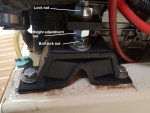
My initial thought is the basis of my question to any engineers out there - reference the picture is it safe / feasible to replace the full nuts that fix the bolt lock nut and the adjustment nut under the mounting bracket with 'half nuts' which would likely give me the 10 mm lowering movement I need ?

The adjustment bolts on the old rear mounts were both tightly down to their lowest positions.

This engine replaced a 3GM30 three years ago which as far as I can see is exactly the same dimension. The shaft alignment had previously been done with the boat out of the water and I recall the engine guy saying it had been a real pain to do and as it's a 30 year old boat I guess there has probably been some hull movement compared to it being done as it is now whilst in the water.

This is one of three solutions I can think of at this point, the other two being removing the adjustment nut altogether and using packing washers instead (this would be a PITA as it would potentially mean removing the mount and bracket perhaps several more times - a masochistic solution...) the other solution would be to have new mounting brackets fabricated with the mounting holes 10mm higher (they are simple brackets but this would be expensive)

Picture below - this is of the front mount, for clarity, where adjustment amount seems adequate, can't get a clear pic of the rears but the two nuts in question are tight together

Any thoughts or lateral thinking much appreciated, the boat is in France so 'popping down' and trying something is a little inconvenient !
Front mount2.jpg

Shaft 1.jpg
 
Last edited:
You can remove the lock nut completely, make the adjustment with single nut, back it off and squirt in thread locking compound. Far better securing than double nutting, especially under high vibration conditions. Double nutting is a very poor nut locking solution.
 
Nothing wrong in using half nuts if necessary - is the shaft in the centre of the stern tube ?- has it dropped under its own weight.Have you compared the top to bottom height of the old & new mount.

Jim
 
No engineer but:
Yes, your two slim locknut fix would be fine, for me. I would cut down the existing but it is probably easier in your situation to take the new nuts with you next time.

Bit of a pain to lift the engine. I find it just possible to remove feet one by one by jacking up from the sump and just getting enough wiggle room - of course this may not work for you.
 
You can remove the lock nut completely, make the adjustment with single nut, back it off and squirt in thread locking compound. Far better securing than double nutting, especially under high vibration conditions. Double nutting is a very poor nut locking solution.

I wondered about that, I've asked the supplier but had no response as yet - I assumed the threaded part might be a 'coachbolt' type bolt with a square head in the mount top plate, locked in with the the bottom nut ?
 
Bit of a pain to lift the engine. I find it just possible to remove feet one by one by jacking up from the sump and just getting enough wiggle room - of course this may not work for you.

Absolutely, that's just what I did, a corner at a time using blocks of wood and a pry bar ! Had the take off the impeller housing and belt to get the the front left
 
You can remove the lock nut completely, make the adjustment with single nut, back it off and squirt in thread locking compound. Far better securing than double nutting, especially under high vibration conditions.

Doesn't the lower lock nut hold the stud in the mount? If you remove it the stud would surely drop.
 
Nothing wrong in using half nuts if necessary - is the shaft in the centre of the stern tube ?- has it dropped under its own weight.Have you compared the top to bottom height of the old & new mount.

Jim

Thank Jim, that's what I thought, shaft is definitely in, or even fractionally above the centre in the picture. It has a new Orbitrade seal and actually doesn't move much
 
I assume you're completely sure the propshaft is at the correct angle?
are the bolts threaded in the lower part of the mount, or only held by the nut?
If you believe a full nut is required to take the weight, you could replace nut and lock washer with a thin flanged nut, altough many of those probably have no more turns of thread than a half nut.

I don't think it would be that hard to dispense with the nut and shim it with washers.
If you can get the gearbox and shaft flanges parallel, feeler gauge top and bottom, then it should be possible to measure how much height you need to lose accurately enough?
There will be 'some' tolerance at the cutless bearing?
 
Doesn't the lower lock nut hold the stud in the mount? If you remove it the stud would surely drop.

I think that may be the case, but the stud is probably screwed into a tapped hole. The washer under the bolt lock nut is not needed, and a thinner nut could be used. The OP needs to investigate how the stud is fitted into the top plate of the mounting. If it is just screwed in then a locking nut is definitely needed. If it is welded in place you might be able to do away with the nut altogether, though the steel plate looks a bit thin to take the load of the engine/gearbox weight on a welded or loctite fitted stud without any locknut. How do the new mounts compare for height with the old ones, and did the latter have locknuts or just welded in studs?

EDIT: I am cautious about doing away with the lock nut in case the engine weight and operating stresses strip the thread in the steel plate.
 
Last edited:
I've just replaced the engine mounts on my Yanmar 3YM30, apart from skinned knuckles it went pretty well and the engine runs very smoothly.

I do have a problem however (or a challenge...), I can't see why but the net result is that at the lowest level rear mount adjustment setting, the gearbox flange is about 10mm above the prop shaft flange. The new mounts have 'settled' a couple of mm but nothing like enough to successfully align the shaft.

My initial thought is the basis of my question to any engineers out there - reference the picture is it safe / feasible to replace the full nuts that fix the bolt lock nut and the adjustment nut under the mounting bracket with 'half nuts' which would likely give me the 10 mm lowering movement I need ?

The adjustment bolts on the old rear mounts were both tightly down to their lowest positions.

This engine replaced a 3GM30 three years ago which as far as I can see is exactly the same dimension. The shaft alignment had previously been done with the boat out of the water and I recall the engine guy saying it had been a real pain to do and as it's a 30 year old boat I guess there has probably been some hull movement compared to it being done as it is now whilst in the water.

This is one of three solutions I can think of at this point, the other two being removing the adjustment nut altogether and using packing washers instead (this would be a PITA as it would potentially mean removing the mount and bracket perhaps several more times - a masochistic solution...) the other solution would be to have new mounting brackets fabricated with the mounting holes 10mm higher (they are simple brackets but this would be expensive)

Picture below - this is of the front mount, for clarity, where adjustment amount seems adequate, can't get a clear pic of the rears but the two nuts in question are tight together

Any thoughts or lateral thinking much appreciated, the boat is in France so 'popping down' and trying something is a little inconvenient !

View attachment 82291

View attachment 82292

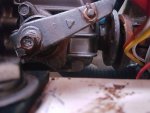
Looking at the second picture it is clear that the two flanges are closer at the top than the bottom. That means that to get proper algnment either the shaft needs to be raised or the front engine mounts lowered. As you say that the shaft is on or above centre I am wondering whether correct alignment can be obtained with these mounts. How do they compare with the old ones?

If yopu need to do so, can you cut dwn the engine bearers? I suspect that there is either a steel or hardwood bearer encapsulated in the fibreglass.
 
Last edited:
Looking at the arrangement, If the mounting does not have a thread the lock nut on top of the mounting will not lock the bolt in place. unless there is a nut under the mounting that cannot be seen.

My engine mountings do have a thread and I fitted a set screw from under the mounting which then does not need a lock nut on the top of the mounting. This gives space for a adjuster nut under the engine support.

It looks like the adjuster screws are something M16 which will be well over strong enough to support your engine. My engine is a very heavy 63hp Leyland 4 cylinder.
 
Just an idea, use 2 half nuts, loctite the bottom one, get the alignment correct then tap in/ force in a combination of "C" washers between the 2 half nuts. as belt and braces wrap the "C" washers with a jubilee clip to stop the washers moving.
 
Looking at the second picture it is clear that the two flanges are closer at the top than the bottom. That means that to get proper algnment either the shaft needs to be raised or the front engine mounts lowered. As you say that the shaft is on or above centre I am wondering whether correct alignment can be obtained with these mounts. How do they compare with the old ones?
I did try lowering the front but that effectively raised the gearbox flange higher, the mounts are the same size as the old ones overall but a bit higher as the rubber needs to settle a bit
According to Yanmar the mounts will settle 4.5mm with the weight of the engine


If you need to do so, can you cut down the engine bearers? I suspect that there is either a steel or hardwood bearer encapsulated in the fibreglass. I think at least at this point that idea would make me very nervous without knowing exactly whats underneath the encapsulation, which is part of the internal moulding...
 
Top