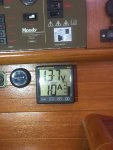
Engine Hours Counter

andythefiddler

Well-Known Member
Joined
4 Sep 2017
Messages
87
Visit site
I've just bought an engine hours counter for my yacht.

I now have to decide where to connect it to.

It's not a digital piece of equipment, so that makes matters easier.

It will be placed in the engine compartment and checked with the PFCs daily.

Just thought I'd tackle the broader community mind as I always get good answers here.

Andy
 
Assuming that the meter needs 12 volts and the engine is started with a key you need to take power from the key switch terminal that becomes live when the key is in the "run" position. If it is not marked its fairly easy to find which terminal if you set a multimeter to its 0-20 volt range and earth the negative probe and use the positive probe to check.
 
Last edited:
Assuming that the meter needs 12 volts and the engine is started with a key you need to take power from the key switch terminal that becomes live when the key is in the "run" position. If it is not marked or its fairly easy to find which terminal if you set a multimeter to its 0-20 volt range and earth the negative probe and use the positive probe to check.

+1 ... I fitted a simple inexpensive 50mm hour counter in this way. Unlike the back of a car ignition switch, boat switches are thankfully really simple.
 
I also fitted a engine hours counter positive to run position of start switch but the negative I connected to the oil pressure switch via a relay so that the relay connections the negative to the counter once the oil pressure light turns off so the engine is actually running.
 
My Volvo hours meter died , as they all seem to so I fitted a cheapo hours counter from flea bay.

To simplify wiring I took the feed from the fuel tank gauge that only powers up when the ignition circuit is live and coincidentally let’s me mount the gauge by the chart table.

93-C6530-F-882-A-4010-B9-F4-0-CDB53-D71384.jpg
 
Think there are numerous different options for this.
Depending on engine, you can have the hood meter on or around the dash....or you can have a feed down at the engine off the alternator, if you want the gauge down there.

For those who asked about the smaller outboard. A great wee thing is a device called a tiny tach. It’s a small digital and easily installed digital and deadly accurate rpm read out. Also records hours.
So easy to fit. Simply a signal wire wrapped round a plug lead or a coil and occasionally a grounding wire. The gauge can be installed anywhere you like.
 
Top