Engine fuse blown

chubby

Well-Known Member
Joined
28 Mar 2005
Messages
1,108
Location
hampshire, uk
www.flickr.com
My Vetus m4.17 has a 10 amp spade fuse on the engine near the relays which presumably protects the ignition circuitry and ? pre heat, which annoyingly blew and engine stopped and couldn't restart: turn the ignition and none of the panel lights responded, managed to drift onto our mooring buoy and investigation showed blown fuse and all seems well after replacement of said fuse but any reason why this should blow? anything to check to prevent it happening again or just replace, keep a few spares and carry on!?

The actual ignition key and also the relays were replaced this year because key sticky and corroded but have done 200 odd miles since with no problems, is it just a one off fuse blow??

thanks for any insight
 
Current for everything controlled by the key switch passes through that fuse including the fuel lift pump, but not the actual glow plug current nor the starter and starter solenoid current.

It should be a slow blow fuse Worth checking that's what you have.

It might be interesting to measure the current passing through the fuse when running

No extra kit added that would increase the current ?
 
My Vetus m4.17 has a 10 amp spade fuse on the engine near the relays which presumably protects the ignition circuitry and ? pre heat, which annoyingly blew and engine stopped and couldn't restart: turn the ignition and none of the panel lights responded, managed to drift onto our mooring buoy and investigation showed blown fuse and all seems well after replacement of said fuse but any reason why this should blow? anything to check to prevent it happening again or just replace, keep a few spares and carry on!?

The actual ignition key and also the relays were replaced this year because key sticky and corroded but have done 200 odd miles since with no problems, is it just a one off fuse blow??

thanks for any insight

At this stage, make sure you have some spares and suck it and see. It might blow next trip out, it might not blow for 1,000 years. Why waste a load of time and hassle at this stage, when it might be the latter.
 
Last edited:
Current for everything controlled by the key switch passes through that fuse including the fuel lift pump, but not the actual glow plug current nor the starter and starter solenoid current.

It's blindingly obvious they don't run the glow plugs or the starter motor through a 10a fuse !!

It should be a slow blow fuse Worth checking that's what you have.

How will he check ?

What types of fuse are available to him ?
 
Thanks for the advice, yes I realized the starter wouldn`t run through a 10 amp fuse but wasn`t sure in my ignorance how much current glow plugs took but happy to be informed.

The slow blow fuse is worth knowing about: so how would I know and are they labelled differently? The standard blade fuses commonly sold in chandleries and car shops like Halfords are just labelled as 10 amps but are some slow blow and some standard? If i was buying replacements what should I look for?
 
Thanks for the advice, yes I realized the starter wouldn`t run through a 10 amp fuse but wasn`t sure in my ignorance how much current glow plugs took but happy to be informed.

The slow blow fuse is worth knowing about: so how would I know and are they labelled differently? The standard blade fuses commonly sold in chandleries and car shops like Halfords are just labelled as 10 amps but are some slow blow and some standard? If i was buying replacements what should I look for?


Just stick with the standard automotive type that you have.
 
Last edited:
Thanks for the advice, yes I realized the starter wouldn`t run through a 10 amp fuse but wasn`t sure in my ignorance how much current glow plugs took but happy to be informed.

The slow blow fuse is worth knowing about: so how would I know and are they labelled differently? The standard blade fuses commonly sold in chandleries and car shops like Halfords are just labelled as 10 amps but are some slow blow and some standard? If i was buying replacements what should I look for?
Its interesting that you have a blade type fuse. As far as i can determine the automotive blade fuses are quick blow fuses.
The Vetus manual I am reading specifies a slow blow glass cartridge fuse.

You could just fit a new fuse, cross your fingers, keep some clean trousers available and hope . There might be nothing wrong and the new fuse will last "for ever" OTOH there could be something amiss which might result in the new fuse blowing at some awkward or dangerous moment. Even if there is nothing wrong you wont be confident or feel comfortable about it for some time.
For that reason I would check the current. If its well below 10 amps, no more than say 7.5 amps you can relax a bit. If OTOH you find it's a little more than 10 amps you know you have a problem to solve.
It could be an early warning of trouble with the fuel lift pump.
 
Thanks for all the advice, I have a supply of the automotive fuses but have also found one on line which has the standard blade but is resetable so could be quickly reset if needed. The advice of measuring current is good, presume stick probes from multimeter in the blade sockets and turn on? The blade fuse is what the engine has and seems original so not built with a facility for a glass one: could this have changed over the years?
 
Its interesting that you have a blade type fuse. As far as i can determine the automotive blade fuses are quick blow fuses.
The Vetus manual I am reading specifies a slow blow glass cartridge fuse.

You could just fit a new fuse, cross your fingers, keep some clean trousers available and hope . There might be nothing wrong and the new fuse will last "for ever" OTOH there could be something amiss which might result in the new fuse blowing at some awkward or dangerous moment. Even if there is nothing wrong you wont be confident or feel comfortable about it for some time.
For that reason I would check the current. If its well below 10 amps, no more than say 7.5 amps you can relax a bit. If OTOH you find it's a little more than 10 amps you know you have a problem to solve.
It could be an early warning of trouble with the fuel lift pump.
looked at fuel pumps and about £350 from vetus, now is it worth a fuse which is cheap and see how it goes or when do we look at a fuel pump: not planning to venture far from south coast but as VicS says these can go at a bad moment and what price peace of mind or as he says clean trousers and spare fuses!
 
Thanks for all the advice, I have a supply of the automotive fuses but have also found one on line which has the standard blade but is resetable so could be quickly reset if needed. The advice of measuring current is good, presume stick probes from multimeter in the blade sockets and turn on? The blade fuse is what the engine has and seems original so not built with a facility for a glass one: could this have changed over the years?

Beware of advice that has just been Googled and quoted from random manuals, that may or may not be for the correct engine or be up to date. As you can see, that isn't always helpful, no matter how well intentioned.

Your engine has a blade fuse, glass fuses are old hat. Forget any waffle about checking whether it's slow blow, fast blow or blowing smoke. It is there to do the exact same job as it would do in your car, all modern cars have blade fuses and they perform perfectly well. They are in fact the most reliable fuse a car has ever been fitted with, IMO.

If you want to fit the re-settable one that you mentioned, that's just fine.
 
Thanks for all the advice, I have a supply of the automotive fuses but have also found one on line which has the standard blade but is resetable so could be quickly reset if needed. The advice of measuring current is good, presume stick probes from multimeter in the blade sockets and turn on? The blade fuse is what the engine has and seems original so not built with a facility for a glass one: could this have changed over the years?
That does seem likely. Blade fuses are generally considered to be better. The original spec calling for a slow blow fuse may have been considered unnecessary or maybe just gone out of the window.
 
Not everyone asking for help gives the outcome!

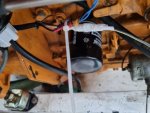
So some feedback and maybe a cautionary tale: armed with a plentiful supply of spare fuses and replacement fuel pump filters and a replacement pump ( not at vetus prices though)I tried changing the fuse and it repeatedly blew after a few minutes running on the berth.
20210604_122950.jpg
Eventually noticed the 12v+ lead to the fuel pump had a crimped spade connection with exposed metal that had rested on the adjacent painted filter and rubbed the paint exposing metal which allowed a short to ground as the filter was electrically in contact with the engine. Not easy to notice as hidden from casual view around the side of the engine but explained why the fuse blew after 200 miles: how long it takes to rub through the paint!

Fixed by wrapping the connection in insulating tape and cable tie so it can`t rub with plan to replace with better connection and heat shrink sleeve.

Before the inquest on why the connection was like that it was not my doing but probably when the engine was lifted out to gain access to the fuel tanks and a need to remake the 12V connection: lesson of the day: check all connections and insulate, tape for a quick job, heat sink sleeve for a more permanent one and plenty of choices on the market for extending wires as well as the crimp connections every chandlery sells.

Not a bad idea to have on board plenty of spare fuses, a couple of filters and a spare pump.
 
Not everyone asking for help gives the outcome!

So some feedback and maybe a cautionary tale: armed with a plentiful supply of spare fuses and replacement fuel pump filters and a replacement pump ( not at vetus prices though)I tried changing the fuse and it repeatedly blew after a few minutes running on the berth.
View attachment 116829
Eventually noticed the 12v+ lead to the fuel pump had a crimped spade connection with exposed metal that had rested on the adjacent painted filter and rubbed the paint exposing metal which allowed a short to ground as the filter was electrically in contact with the engine. Not easy to notice as hidden from casual view around the side of the engine but explained why the fuse blew after 200 miles: how long it takes to rub through the paint!

Fixed by wrapping the connection in insulating tape and cable tie so it can`t rub with plan to replace with better connection and heat shrink sleeve.

Before the inquest on why the connection was like that it was not my doing but probably when the engine was lifted out to gain access to the fuel tanks and a need to remake the 12V connection: lesson of the day: check all connections and insulate, tape for a quick job, heat sink sleeve for a more permanent one and plenty of choices on the market for extending wires as well as the crimp connections every chandlery sells.

Not a bad idea to have on board plenty of spare fuses, a couple of filters and a spare pump.

Always good to hear the outcome (y)

Glad to hear you got it sorted.
 
Not everyone asking for help gives the outcome!

So some feedback ..........
Thanks for the feed back.
Good to learn that you found the cause and fixed it rather than going down the brown trousers route.

I didn't mean to scare you into buying a replacement pump .
 
Thanks for the feed back.
Good to learn that you found the cause and fixed it rather than going down the brown trousers route.

I didn't mean to scare you into buying a replacement pump .
I looked at replacement pumps and the vetus one was £350 and available to order whereas an identical one from a company in the Midlands dealing with dumper trucks was £35 and available overnight if ordered before 4pm! For that price worth keeping aboard as a spare: I have been in the position of being stuck waiting for parts on a cruise!

Given that most marine engines are marinised auto motive engines it is interesting to speculate what spares are available from the automotive sector, say starter motors, solenoids, alternators?
 
Top