Dyneema Rope Terminals

coopec

N/A
Joined
23 Nov 2013
Messages
5,211
Visit site
I am going to use 10 mm Dyneema Rope as the cable in my chain/cable steering.
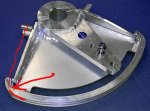
If I splice the ends of the rope at the quadrant, the rope diameter will be too large for the grooves in the quadrant (which are 10 mm).

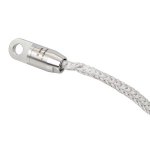
Why can't I use Dyneema Rope Terminals which surely would solve the problem? (I think attaching the Dyneema to the pedestal chain would be a better solution as well)

https://www.oceanchandlery.com/blue-wave-dyneema-rope-eye-terminal.html

https://jimmygreen.com/1200-bluewave-rope-terminals

I notice they say:

Safe working loads (SWL)
Blue Wave recommends that safe workloads should not to exceed one fifth (1/5) of the break loads listed.

But apparently that is engineering practice.
The SWL is determined by dividing the minimum breaking strength (MBS) of a component by a safety factor assigned to that type and use of equipment. ... For example, if a line has an MBS of 1,000 pounds and a safety factor of 5, then the SWL would be 200 pounds. 1000 / 5 = 200. Also called working load limit (WLL).
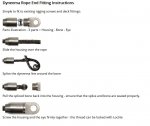
Temp Dyneema fitting.JPG
 
Last edited:
Might be worth an email first, quick google suggests you still need a splice for those terminals "as per rope manufacturers instructions" so maybe no further forward.

I've done many terminals in the past for aerialists on winches with dyneema, but can't remember where the company got the terminals. They had issues with slow slipping and ended up terminating the dyneema in the terminal by fluffing up the dyneema and making an epoxy plug. Nothing obvious came up from google for epoxy dyneema terminals so they might have be fabricated special. Sorry, not much help :)
 
I think you might regret using Dyneema, due to its tendency to 'creep'.
For this reason we tend to use Vectran in tackles where stability of length is important.
 
I think you might regret using Dyneema, due to its tendency to 'creep'.
For this reason we tend to use Vectran in tackles where stability of length is important.

Yes I have read Dyneema will stretch a little initially.
I think you are right: maybe Vextran is the way to go

Vectran is an alternative to Dyneema. It has less stretch and creep than Dyneema. Many think Vectran is the ultimate fiber, though it does not have quite the fatigue life or UV resistance of Dyneema. Also it is a little heavier and will not float.(rigworks. com)

Thanks for that.
 
Just tried a piece of dyneema in a norseman swageless terminal - looks like it might work if packed with epoxy. Though you'd be without the safety net of any data sheets so to sleep well would be worth making one up and hanging a tonne or so off it for a day or 2 to check for any slippage.

What kind of loads would a steering system generate anyway? Must be a huge factor of safety using 10mm dyneema. My personal favourite dyneema is marlow d12 max, sk99 so massively strong and a good anti chafe coating.
 
GHA

Yes you are right. The breaking strain of 10 mm Dyneema78 is around 4000/5000 kg.
If I was using Dyneema for rigging I'd go for SK99 as it is stronger but apparently it stretches more than SK78. (Of course with steering you don't want stretching)
 
Yes I have read Dyneema will stretch a little initially.
I think you are right: maybe Vextran is the way to go

Vectran is an alternative to Dyneema. It has less stretch and creep than Dyneema. Many think Vectran is the ultimate fiber, though it does not have quite the fatigue life or UV resistance of Dyneema. Also it is a little heavier and will not float.(rigworks. com)

Thanks for that.

With such a tiny length and loads must be a fraction of MBL, think you'd need a very good tape to measure the creep in this application. You could always stick a big load on it for a day or 2 first to get rid of the worst of any constructional creep though maybe very little gain for d12 sk99, D12 is pre stretched.

7fOSkbw.png
 
Last edited:
GHA

I'm sure you are right.: the short distance there's not going to be a significant amount of stretch over time (maybe initially) Each rope cable would only be about 4 M.

Thanks
 
There's quite a lot of R&D - and discussion, learned and otherwise - being done on the use of 'hi-tech ropes' for rigging ( standing and running ) and much attention focused on the negative, weakening effects of small Bend Radius..... such as around the dogbone shown in the OP's illustration at #1...... and inadequate splices.

That illustration seems to suggest a 'D:d Ratio' of about 1:1, which is not optimum. Similarly, the nature of the expected splice is not clear, with a simple single tuck shown. AFAIK rope makers such as Marlow and others seem to recommend a 'tapered bury' of over 40 x rope diameter, plus whipping.

According to Evans Starzinger and others who do repeatable testing, such as 'Thinwater', the point of failure of most such splices is at the end of the taper, especially when the tapered portion is short. CruisersForum has a lot on this topic.....

It might emerge that use of quality 'Low Friction Rings' plus quality splices might prove more satisfactory, but that also depends on the steering geometry and whether the thicker spliced sections can pass around existing sheaves.
 
There's quite a lot of R&D - and discussion, learned and otherwise - being done on the use of 'hi-tech ropes' for rigging ( standing and running ) and much attention focused on the negative, weakening effects of small Bend Radius..... such as around the dogbone shown in the OP's illustration at #1...... and inadequate splices.

That illustration seems to suggest a 'D:d Ratio' of about 1:1, which is not optimum. Similarly, the nature of the expected splice is not clear, with a simple single tuck shown. AFAIK rope makers such as Marlow and others seem to recommend a 'tapered bury' of over 40 x rope diameter, plus whipping.

According to Evans Starzinger and others who do repeatable testing, such as 'Thinwater', the point of failure of most such splices is at the end of the taper, especially when the tapered portion is short. CruisersForum has a lot on this topic.....

It might emerge that use of quality 'Low Friction Rings' plus quality splices might prove more satisfactory, but that also depends on the steering geometry and whether the thicker spliced sections can pass around existing sheaves.

Bend ratio does become an issue under higher loads, but in this case the rope has an average breaking load of nearly 15 tonnes - not really something to worry about, you'll rip the boat apart first :)
 
Thanks for your comment.

much attention focused on the negative, weakening effects of small Bend Radius.....

That worries me because on all quadrants the rope (or cable) will of necessity follow a very tight bend as it is tensioned up. Would this be considered a "small bend radius"?

Temp quadrant.JPG
 
Thanks for your comment.

much attention focused on the negative, weakening effects of small Bend Radius.....

That worries me because on all quadrants the rope (or cable) will of necessity follow a very tight bend as it is tensioned up. Would this be considered a "small bend radius"?

View attachment 78059

Having worked with D12 SK99, if you go for 10mm D12 max then almost certainly not a problem. You'll rip that to shreds long long before the dyneema goes. Imagine hanging a double decker bus off that quadrant...
 
Chafe is the real concern.

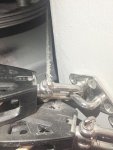
This is a boat show boat, and already, the cable is in trouble. Unlike rigging, it is rubbing against the quadrant side-to-side with every turn. NO SYNTHETIC does well in this situation.

The quadrant would need to be polished. IF you used cable before, I'l bet lunch there are some sharp burrs.

p1cs96pie8euc18j9s3rvuqm9p6.jpg
 
Last edited:
One of our steering cables failed a couple of months ago, different system on a cat, lots of sheaves, no quadrant. I carry a spare cable so replacement was not going to be an issue. We also have a fair amount of dyneema, left over from other tasks and my immediate thought was use the dyneema. The sheaves were so chewed up by the original cables I soon gave that idea up - and stuck with simply replacing the old cable.

However your arrangement is new and possibly not yet installed and you could easily spend some time polishing it. I might be concerned that under autopilot the quadrant will be constantly moving and Thinwater's comment about abrasion could become a real issue. An answer might be to sleeve the dyneema with a loose cover of dyneema arranged such that the cover will protect the cable. It only needs to be loose enough for a little play. (I'm thinking bunch it up and sew the ends - the cover can then move but the cable can be as taut as you want - as you might do for any abrasion sleeve). The sleeve needs to be considered sacrificial and looked at occasionally.

Maybe Thinwater and Zoidberg can comment.

I have sourced dyneema covers, or hollow tape, from Nautilus Braids in NZ (who might also be able to offer advise).

Jonathan
 
Last edited:
One of our steering cables failed a couple of months ago, different system on a cat, lots of sheaves, no quadrant. I carry a spare cable so replacement was not going to be an issue. We also have a fair amount of dyneema, left over from other tasks and my immediate thought was use the dyneema. The sheaves were so chewed up by the original cables I soon gave that idea up - and stuck with simply replacing the old cable.

However your arrangement is new and possibly not yet installed and you could easily spend some time polishing it. I might be concerned that under autopilot the quadrant will be constantly moving and Thinwater's comment about abrasion could become a real issue. An answer might be to sleeve the dyneema with a loose cover of dyneema arranged such that the cover will protect the cable. It only needs to be loose enough for a little play. (I'm thinking bunch it up and sew the ends - the cover can then move but the cable can be as taut as you want - as you might do for any abrasion sleeve). The sleeve needs to be considered sacrificial and looked at occasionally.

Maybe Thinwater and Zoidberg can comment.

I have sourced dyneema covers, or hollow tape, from Nautilus Braids in NZ (who might also be able to offer advise).

Jonathan

Not enough experience to comment. I'm not sure how the cover would move. I've worked with chafe guards plenty, but this is a unique case. If it was strong enough, I would suggest NER WR2. It has a VERY tight cover, optimized for side-to-side abrasion (most are not), and is very tough.
 
The cover would not move with small repetitive movement by the autopilot/rudder as the yacht moves over seas - the cover would be held by the friction imposed on the cover (and by the burrs - of which you mention). The core would move freely within the cover, dyneema rubbing on dyneema, and there would be no abrasion between core and sleeve. With major movement, tacking (for example) the core and cover would both move as the cover would need to be designed to allow small but not large movement.

It really is simply an extension of reducing abrasion on, say, a snubber where the snubber is free to move inside the cover which (the cover) might be fixed at the area of abrasion.

It might be considered a bit contrived :) but if you want to use dyneema - maybe its the price you pay. We have had 2 steering cable failures and when they fail panic sets in. Fortunately, for us, our autopilot is independent of the wheel and cable steering (the autopilot ram drives the tie beam between the 2 tiller arms) and we can steer 'electrically'. An accidental fail safe option - which would not be available if your autopilot drives the wheel.

Jonathan
 
a. 1:1 is fine so long as there is no moment (like a pulley). DSMs published data support this. So does independent testing I have reviewed.

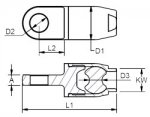
b. The Blue Wave terminators include a full bury splice, to my understanding. Look closely and you can see bot the brummel and the expanded cover due to the long bury. What they offer is a compact and chafe-free way to transfer the force from the pin to metal hardware. The pin bears on the barrel, and the splice is actually rather conventional. This is NOT related to a Norseman fitting, and I hope no one tries that.

phrp822105-closed.jpg
DyneemaRopeEyeDraw.jpg

Not sayin' I love the idea, just explaining what I understand.
 
Last edited:
My auto pilot (when I fit it) will drive the quadrant so that will overcome a problem in case of a cable break.

There is also a "square" milled into the top of the rudder stock which was used for emergency steering on the boat that it came off. I will have to have a shaft/tube which I can fit to that "square" and extend it through the aft cabin roof and then steer the yacht by ropes to the sheet winches.(I think that is what they did on the boat the quadrant came off)

Looking at the quadrant I can see I'll have to tidy up the grooves . Not sure what I would use to do that. Maybe a 10mm milling tool (or drill) on the side, a 10 mm stone (if there is such a thing) in the router or careful use of my die grinder.
 
Last edited:
Top