Dumb alternator question (Yanmar 2gm stopped charging today)

SvenH

Well-Known Member
Joined
28 Mar 2011
Messages
388
Location
The Netherlands
Visit site
I Had to take the boat out of the water today.

Immediately after starting the voltage was at 14 volt, indicating charging in progress. Immediately after starting the voltage normally is just over 12 volts, and jumps to 13.9 or 14 when the revs get high enough.

But when I got to the crane the voltage was back at around 12 volt and would not go back up when I increased the revs. It should not have dropped as the engine had not been switched off.

Can this be about the alternator itself?
Or can this behavior be cause by something else?

I have had the alternator serviced a few years back and the guy said that "It was fixed, but the problem could return"
So, maybe it has?
 
Poor connections & broken wires are the cheapest things to check so do them first. Then check the alternator. There are Chinese copies of the OEM Alternator available much cheaper than the Official Yanmar spare but beware, the one I got for my 1GM10 drew too much from the cold engine, it stalled. A good Auto Electrician should be able to sort most problems not requiring a rewind.
 
I Had to take the boat out of the water today.

Immediately after starting the voltage was at 14 volt, indicating charging in progress. Immediately after starting the voltage normally is just over 12 volts, and jumps to 13.9 or 14 when the revs get high enough.

Are you saying that normally the voltage starts at 12 and increses, more with engine revs but this time it hit 14 right away?
If so then you had a bad connection to the battery (mebby alternator output).
But when I got to the crane the voltage was back at around 12 volt and would not go back up when I increased the revs. It should not have dropped as the engine had not been switched off.

Can this be about the alternator itself?
Or can this behavior be cause by something else?

I have had the alternator serviced a few years back and the guy said that "It was fixed, but the problem could return"
So, maybe it has?
If there was a bad connection and it disconnected while the engine was running bad things can happen to the alternator, namely knackered diodes. If some, but not all diodes are knackered you might see a max less than normal ie 12 instead of 14.

All guess work, but as suggested a decent auto sparks will spot that right off and perhaps a cheap spare diode pack...
 
Thanks for the ideas guys.
The boat is on the hard now so I cannot easily run the Engine.

I contacted the people who checked the alternator the last time, and they'll check it for free.
So I'll take it off and see what the think of it.
 
My 15 year old alternator off my Volvo Penta MD 2020 was totally refurbed a couple of months ago complete with new bearings (I particularly asked for those to be changed as the first lot failed in 7 years) for £ 140-00 inc VAT.
Now working perfectly.
 
Last edited:
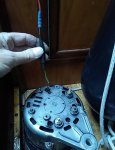
In taking of the alternator I found not one but two disconnected wires. One was broken, the other just not connected.
I vaguely recall connecting these when I could not fit an original connector but I cannot be sure.

The broken wire in the picture is red, the two other wires that were disconnected were black.

Do any of you guys know if these wires are involved in charging?

2018-12-09 10.57.12.jpg
 
In taking of the alternator I found not one but two disconnected wires. One was broken, the other just not connected.
I vaguely recall connecting these when I could not fit an original connector but I cannot be sure.

The broken wire in the picture is red, the two other wires that were disconnected were black.

Do any of you guys know if these wires are involved in charging?

Red is should be connected to the "Batt" terminal in your picture. The "E" terminal is -12v. Looking at the two terminals together, where you are holding the green wire, the terminal closest to the center of the alternator is the warning light. If any of these is missing it won't usually charge, although sometimes it will cope with the warning lamp wire being disconnected (depending on the alternator).
 
Thanks for the reply.

I forgot to mention, there were two other wires, black and red, those were connected to the alternator with nuts.

The two of which one is as you say connected to the warning light have a slide terminal (is that the correct term?), the red one was broken and is shown in the picture, the black one was loose all together.
 
I Had to take the boat out of the water today.

Immediately after starting the voltage was at 14 volt, indicating charging in progress. Immediately after starting the voltage normally is just over 12 volts, and jumps to 13.9 or 14 when the revs get high enough.

But when I got to the crane the voltage was back at around 12 volt and would not go back up when I increased the revs. It should not have dropped as the engine had not been switched off.

Can this be about the alternator itself?
Or can this behavior be cause by something else?

I have had the alternator serviced a few years back and the guy said that "It was fixed, but the problem could return"
So, maybe it has?

How are you measuring voltage? "Just over 12" is not sufficiently precise. Use a digital voltmeter not a built in moving coil one.

Using a digi voltmeter, when the engine is running the voltage should rise above when the engine isnt running. If the battery is well charged and there isnt a really heavy drain on the system then the voltage should be between 13.7 and 15. If the voltage when running drops down to the voltage when not running the alternator isnt charging.
 
I have fixed digital voltmeters.
"Just over 12 volts" is as shown there, probably 12.1, 12.2.

If I recall correctly the voltage at the batteries is 0.1 volt higher using a hand held digital multimeter on the connectors at the batteries.
I have not yet measured the voltage at the alternator.
 
Thanks for the reply.

I forgot to mention, there were two other wires, black and red, those were connected to the alternator with nuts.

The two of which one is as you say connected to the warning light have a slide terminal (is that the correct term?), the red one was broken and is shown in the picture, the black one was loose all together.

Spade terminal, not slide terminal :)

OK, you should have a red and a black wire, thicker then the others, with ring terminals. The red goes to "Batt", the black goes to "E".

The two terminals close together are often connected with a small plug (both wires int the plug) or two spade terminals. One the closest to the center is the warning light and should be blue with a black stripe, if you have a red wire with a black stripe it goes next to the warning lamp wire.

If you have a second black wire, it goes to the "E" terminal too.

If you have a wire coming from inside the alternator it is not connected, this is for the tacho on some engines and won't be needed on yours.

Be careful with some of the wire colours, as they will likely be painted.
 
I took the alternator to the specialist today and he put it on his test bench.

After some fiddling he told me he was surprised: He did not get the expected results, nor did he expect the result he got.

I can not repeat what he saw or expected but he had never seen this result in his decades of primarily working with alternators and starter motors.

He could get it to charge normally after an increase of revs, but he had to make a bit of extra contact somewhere, it would not start on its own.
He could also get it to charge at 15 volts or over, which it should not.


So, all in all I'm glad I took it in for examination and am curious if he can find something.
 
I took the alternator to the specialist today and he put it on his test bench.

After some fiddling he told me he was surprised: He did not get the expected results, nor did he expect the result he got.

I can not repeat what he saw or expected but he had never seen this result in his decades of primarily working with alternators and starter motors.

He could get it to charge normally after an increase of revs, but he had to make a bit of extra contact somewhere, it would not start on its own.
He could also get it to charge at 15 volts or over, which it should not.


So, all in all I'm glad I took it in for examination and am curious if he can find something.
See post 9 :)
 
Top